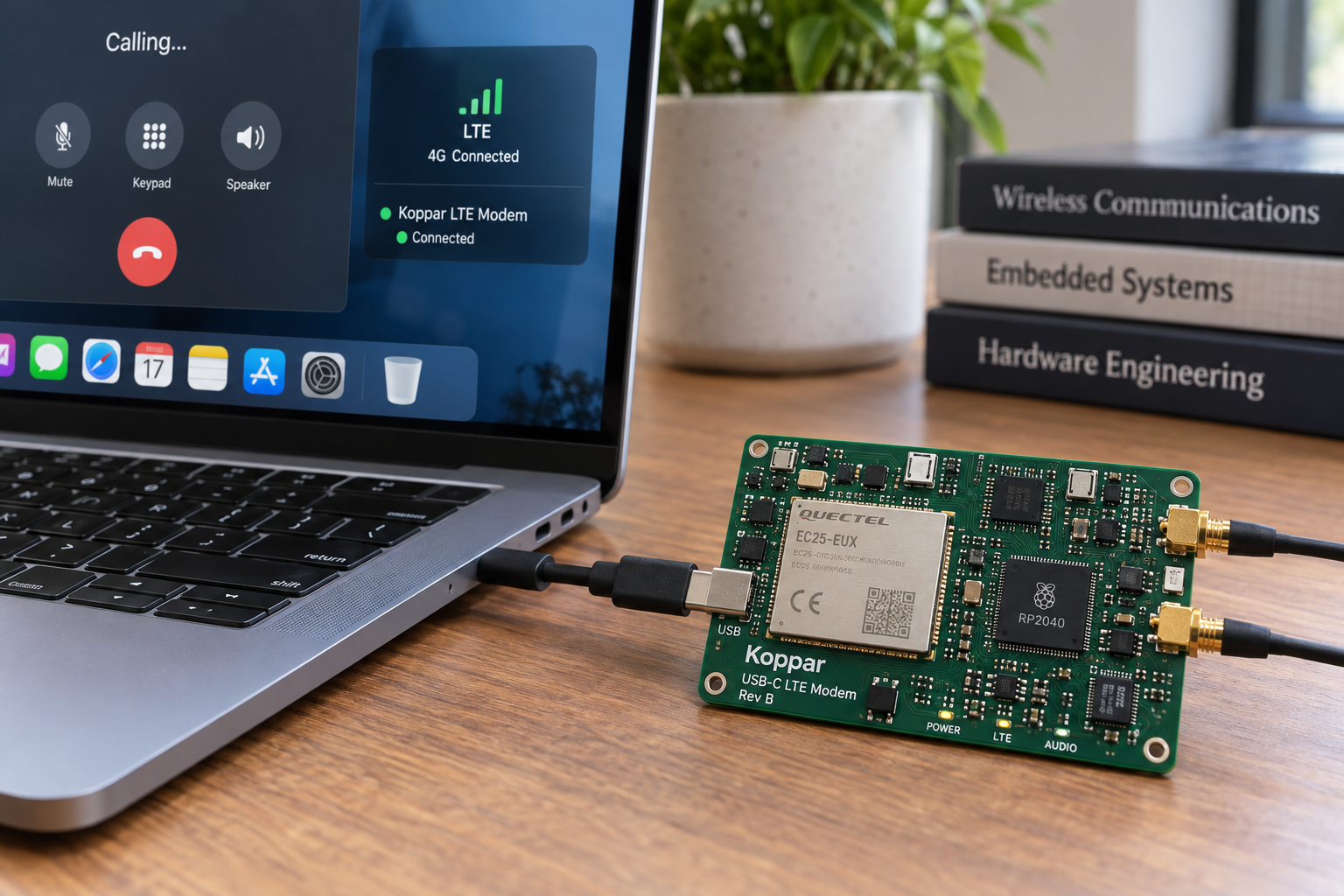
A 4G modem that Koppar designed from a one-page spec has been built, and it works. Plugged into a Mac, the board registers on the network, sends and receives texts, and places and answers calls with the audio running through the computer's microphone and speakers. The project also now serves as the reference layout in an AI benchmark, where five of six frontier models failed to match it.
The board is a four-layer USB-C LTE modem built around a Quectel EC25-EUX module, an RP2040 that acts as a USB sound card for call audio, a USB hub and a 3.8 V buck regulator. It measures 85 by 65 millimeters. Koppar first published the design in October, and it reached the front page of Hacker News. Readers asked whether it would ever be built and whether it would work if it were.
The team ordered the boards from JLCPCB, which returned them assembled. The engineers soldered the modules on by hand. The first board passed bring-up tests on the board itself in November, including USB enumeration at 480 Mb/s and a 3.90-volt output from the buck regulator with no load. The second board went further. It starts the module on PWRKEY in about three seconds, and the module appears on USB about 12 seconds later. Under load, the module reads its own supply at 3.81 volts.
Does the USB-C LTE modem actually work?
Registration came next. The modem connects on 4G using bands 3 and 20, with both antennas attached. Texts arrive in several parts when they are long, and sender names show up. Calls work with two-way audio through the computer. With VoLTE turned off, calls fall back to 3G.
What broke along the way
What went wrong when the modem was built?
The team reported several problems. The first was the hand soldering. Both boards needed a second pass on the EC25 module. On board 1, the module now starts but does not appear on USB, and its USB pins, 69 through 71, need reflowing. The team plans to have the assembler place the module next time or ship a stencil for a hot plate.
The boards also lacked recovery pads. The design review added pads for the RP2040 bootloader, SWD and the module's USB_BOOT, but this order was made from an export taken before those changes. To force the bootloader, the team bridged two pins of the flash chip with tweezers while plugging in the board.
A warm reset sometimes stopped the RP2040 from coming back on USB, a known erratum of the chip. The firmware now updates itself over USB and works around the problem. The team said the board came back on its own after 22 consecutive updates, each taking five to 20 seconds. A bug in the USB stack bundled with the Pico SDK also froze the board the second time the computer opened an audio stream. A newer version fixed it. Pulling the cable mid-operation could also cut the module's power during a flash write. The software now switches the module off cleanly before unplugging or shutdown.
Koppar says its own checks passed before release. A review against the datasheets then turned up 12 problems the checks did not cover, including 35-ohm antenna feeds and a SIM socket facing into the board. The team fixed all of them before ordering and redrew the copper by hand. Koppar says the next revision, Rev C, will add real BOOT and RESET buttons, test pads at the module's control pins, a module-on LED and signed firmware updates.
How the AI agents fared
Esuna Labs picked the board for RealPCB, its benchmark of AI agents laying out production circuit boards. It is one of 20 open-hardware example boards in the benchmark's repository and one of four that every model ran on.
Each agent receives the board with its 115 free parts unplaced and nothing routed. It has two hours alone in KiCad. A layout passes only if it is rule-clean and, on each quality measure the grader uses, is no worse than the layout the engineer released by more than a margin. For this board, that reference layout is Koppar's Rev B. The grader's reference figures are 271 vias and 4.1 millimeters from the buck to its inductor.
How did AI agents do on the RealPCB layout test?
Six models ran the test, each at its highest reasoning setting in its lab's own agent. Only Fable 5.2, running in Claude Code, landed within the margin of Koppar's layout, finishing in 96 minutes. GPT-6.2 Astra, GPT-6.2 Sol, Sonnet 5.5, Haiku 5.5 and Grok 4.7 did not. Grok 4.7 ran out of its 120-minute limit. The benchmark's two top-ranked models were among the five that fell short.
The design is open hardware under CERN-OHL-P-2.0. The KiCad project, Gerbers, JLCPCB assembly files, firmware, host software and build notes are in the Koppar-AI/koppar-lte-modem repository. The EC25 is not on JLCPCB's assembly line, so builders must deselect it when ordering and solder it themselves or send it for placement. The board needs a USB-C port that supplies 3 amps.
Dieser Artikel wurde mit Unterstützung von KI verfasst.
News Factory APP - agentische News für besseres SEO & AEO.