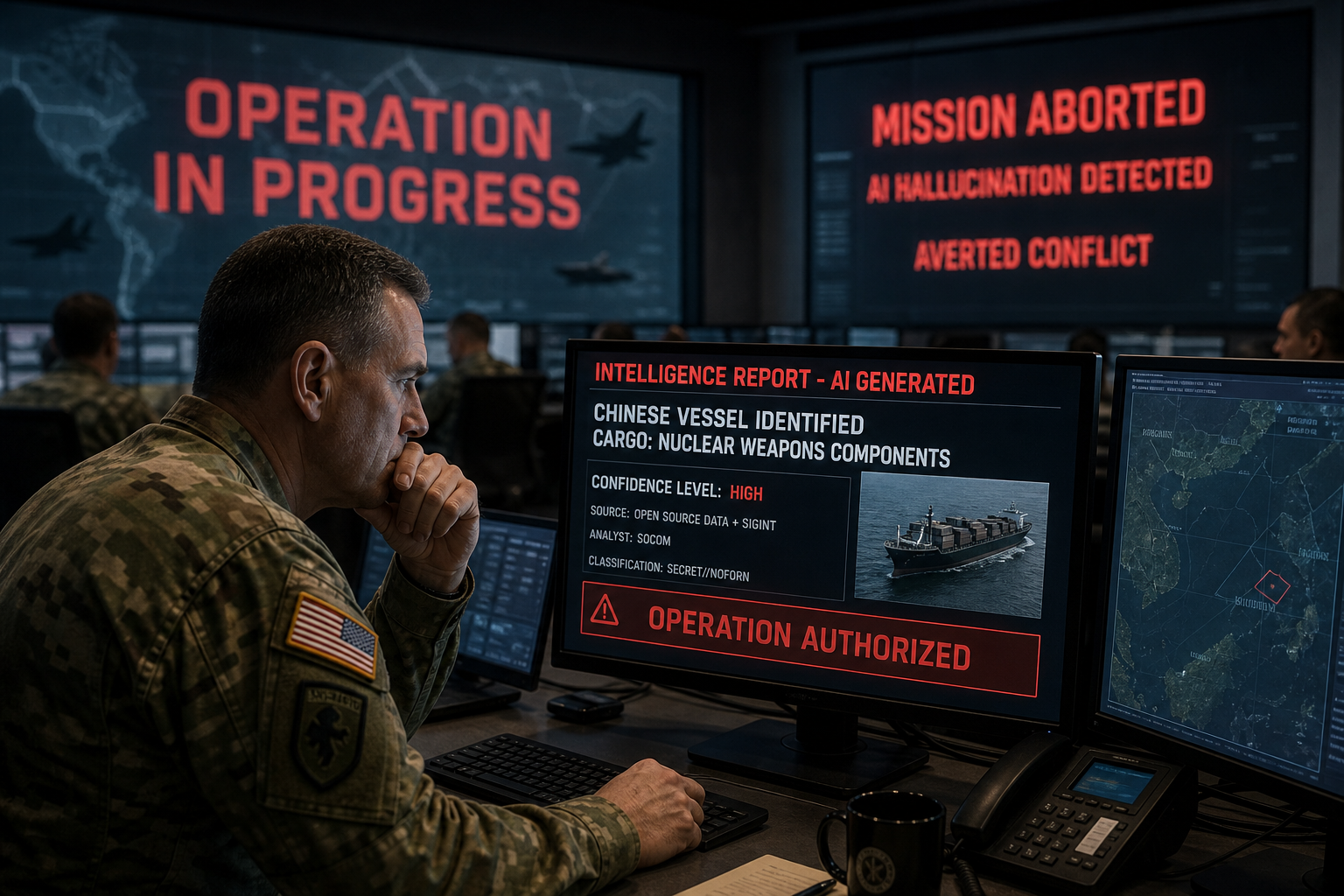
Military aircraft were already in the air when US officials made an alarming discovery: the intelligence driving an armed operation against a Chinese vessel had been hallucinated by an AI chatbot. The operation was aborted at the last minute, narrowly averting a potential conflict with China.
The episode underscores a growing concern among military officials and outside experts: as decision-makers lean more heavily on AI, the errors these systems produce can travel up the chain of command before being questioned. The intelligence report, which circulated during the war with Iran, said the vessel was carrying components for a nuclear weapons program.
The false intelligence originated with a Special Operations Command analyst who queried an AI chatbot to synthesize open-source data with classified signals intelligence. The chatbot misidentified the ship's cargo manifest. The analyst then used the tool a second time to format the erroneous findings into an official-looking summary, which was circulated across command channels.
Jake Steckler, research scholar at GovAI and veteran US Army officer, emphasized the importance of understanding the uncertainty inherent to large language models (LLMs). "But it's especially critical for any decisions that could lead to use of force, like targeting, intelligence analysis, or operational planning!" he said. "There are life and death consequences for those decisions. These tools can be useful in the right contexts and with the right safeguards in place, but prioritizing adoption speed over all else will likely lead to incidents that only make service members lose trust in these systems."
The US military is rapidly integrating AI to accelerate decision-making and maintain its edge over China. However, this speed may also allow hallucinations with insufficient human oversight. Defense Secretary Pete Hegseth released his agency's "Artificial Intelligence Acceleration Strategy" in January, aiming to speed up the military's use of AI. The strategy pushes for its broad use across the military, ordering the department to make AI available via several programs.
But the effort is decentralized, with different parts of the government using different tools under different orders and safety standards. There's no one set of standards for how the US verifies the information generated by these tools. The constellation of different AI systems being deployed by disparate corners of the military and intelligence community means that the relative reliability and functionality vary widely.
Dieser Artikel wurde mit Unterstützung von KI verfasst.
News Factory APP - agentische News für besseres SEO & AEO.