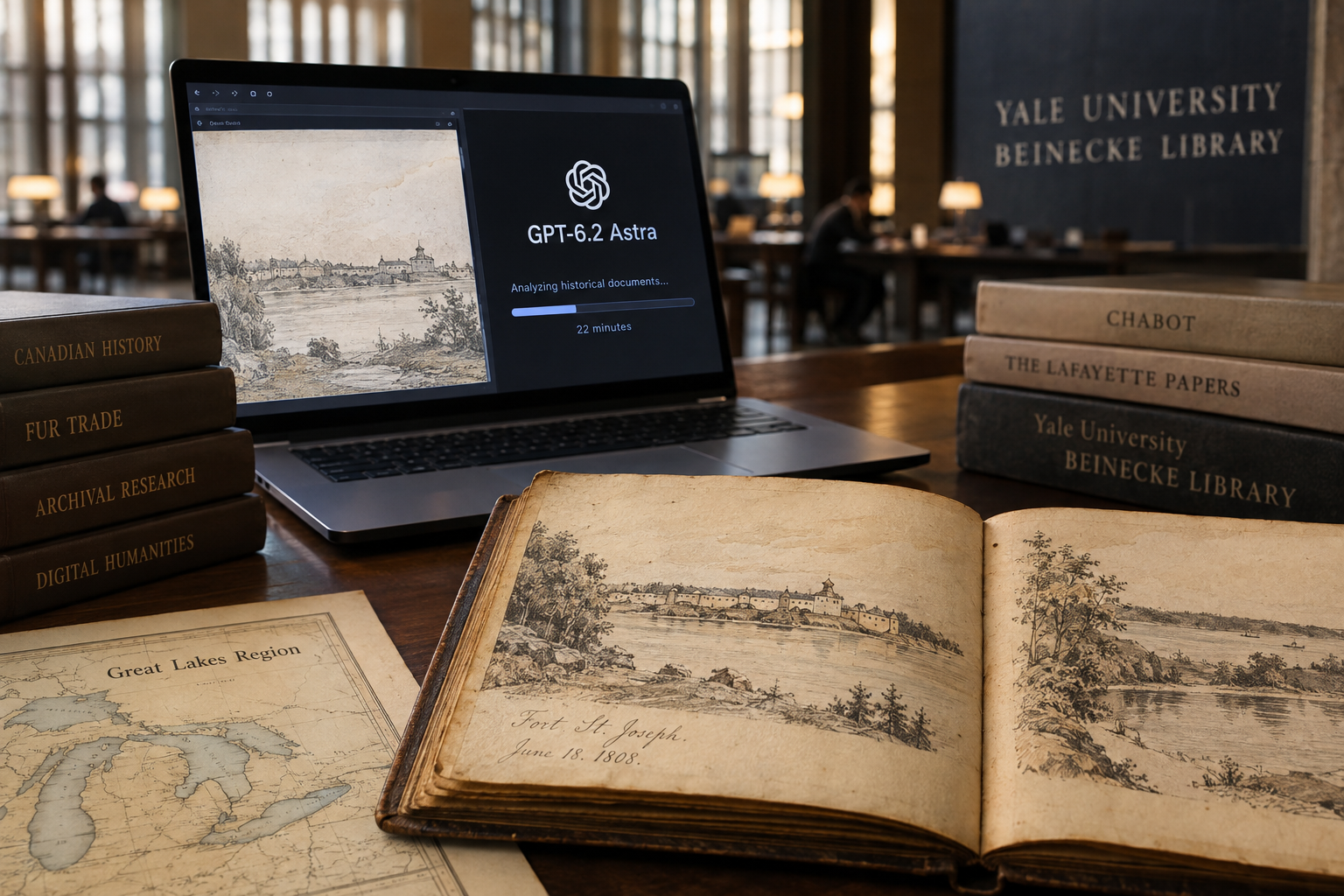
An AI model has identified the likely creator of an anonymous sketchbook that has puzzled historians for more than two centuries, and it did so in about 22 minutes. The model, GPT-6.2 Astra from OpenAI, was tested by a historian before its public release. The findings were described in a first-person account published by the researcher.
The sketchbook, held at Yale University’s Beinecke Library, dates to 1808. It records a journey from Montreal to Fort William and back, with drawings of places in the Great Lakes region that were destroyed only a few years later. It has 84 pages, 34 of which contain pencil and ink drawings or watercolors. Only three are dated. Its handwriting is distinctive, but the captions are short, and the artist never signed the book.
The researcher had spent years looking for the author without success. The sketchbook was bought by Yale from an antiquarian bookseller in 2020, after decades in private hands. The route it documents was traveled by hundreds of canoes and bateaux every year, which made the task of narrowing down the artist extremely difficult.
The historian gave the model access to the sketchbook images and a short prompt asking it to determine who likely painted them. The prompt also included two names the researcher had long wondered about, Kendall and Berczy, along with an article the historian had written. The model quickly ruled out both men, placing them elsewhere on the dates of specific drawings.
How did the AI model find the sketchbook's likely creator?
The model then searched primary sources. Its key lead came from the diary of Joseph Frobisher, a retired fur trader who recorded his social life in Montreal. The historian had cited that diary in an earlier article but had not connected it to the sketchbook. According to the model’s reasoning summaries, the diary showed that on June 6, 1808, the vicomte de Chabot left Lachine for Kaministiquia with William McGillivray and William McKay. The sketchbook places its artist on the Ottawa River five days later.
From there, the model traced Chabot to Fort St. Joseph later that month, using a letter by John Askin Jr. published in a document collection nearly a century ago. It concluded that Chabot “probably made the travel drawings.”
Who was Chabot, the likely creator of the 1808 sketchbook?
Chabot was a minor French aristocrat and Irish landowner whose family was displaced by the French Revolution. He later became a British Army officer and spent most of 1808 in Canada as Deputy Adjutant General. His papers were lost for a time and were found by a descendant in 1984. The historian said he had never heard of Chabot before the model’s answer, and that the only scholarly reference to his Canadian trip appears in George Nelson’s journals. Harry Duckworth published those journals in 2019, and he noted a “Count de Chabot” who had visited Fort William.
The historian ordered copies of two parts of Chabot’s journal. One part covers his travels in Lower Canada and is held by a private family archive in France. The other, the “Journal to the Upper Country,” was microfilmed by the Library of Congress as part of its Lafayette papers and is held by Cleveland State University. The model had traced that second journal to a footnote in a 2014 doctoral thesis by historian Juliette Reboul.
The historian said the handwriting in the journal matched the sketchbook, and the itinerary lined up with the dated drawings. The clincher came on June 18, 1808, when Chabot wrote that he reached Fort St. Joseph and “took a sketch” of the fort. The journal describes the same view as the matching drawing.
The journal is also significant for historians beyond the sketchbook. It runs to about 162 notebook pages and includes new detail about fur trade life. Chabot spent time at Niagara Falls, though no images of the falls appear in the sketchbook. The journal came with excerpts from long-destroyed North West Company papers, which shed light on the fur trade’s business structure, Indigenous ethnography and the origins of the Masson Collection.
The historian said the model’s search would have been very hard for a person to replicate. Most researchers starting from the sketchbook would not think to check Frobisher’s dinner diary, and even a researcher who did might not recognize Chabot’s name as significant. The historian also said a model tested with the same prompt, Fable 5.2, reached the same conclusion in about 35 minutes but did not find the journal.
Can AI be trusted to make historical attributions?
The model was not entirely confident in its own findings. Even after the diary arrived, it raised doubts about whether an unsigned diary could be Chabot’s and whether it should be credited for every sketch. The historian called those doubts unreasonable and said the model preferred to describe the diary as “an anonymous diary attributed to Chabot.” The historian suggested that the model’s tuning for mathematical proofs might explain the hedging, and expected that limitation to be fixed.
The historian argued that the episode points to a shift in historical research. Mathematicians have watched AI systems solve hard problems over the past year, and the historian expects historians to face a similar moment of reassessment in the coming year. Historical writing, the historian noted, is less about a single answer than mathematics is, which may leave the field somewhat better placed. Still, the historian said, researchers will need to decide how to work alongside systems that can do things human historians cannot.
Dieser Artikel wurde mit Unterstützung von KI verfasst.
News Factory APP - agentische News für besseres SEO & AEO.