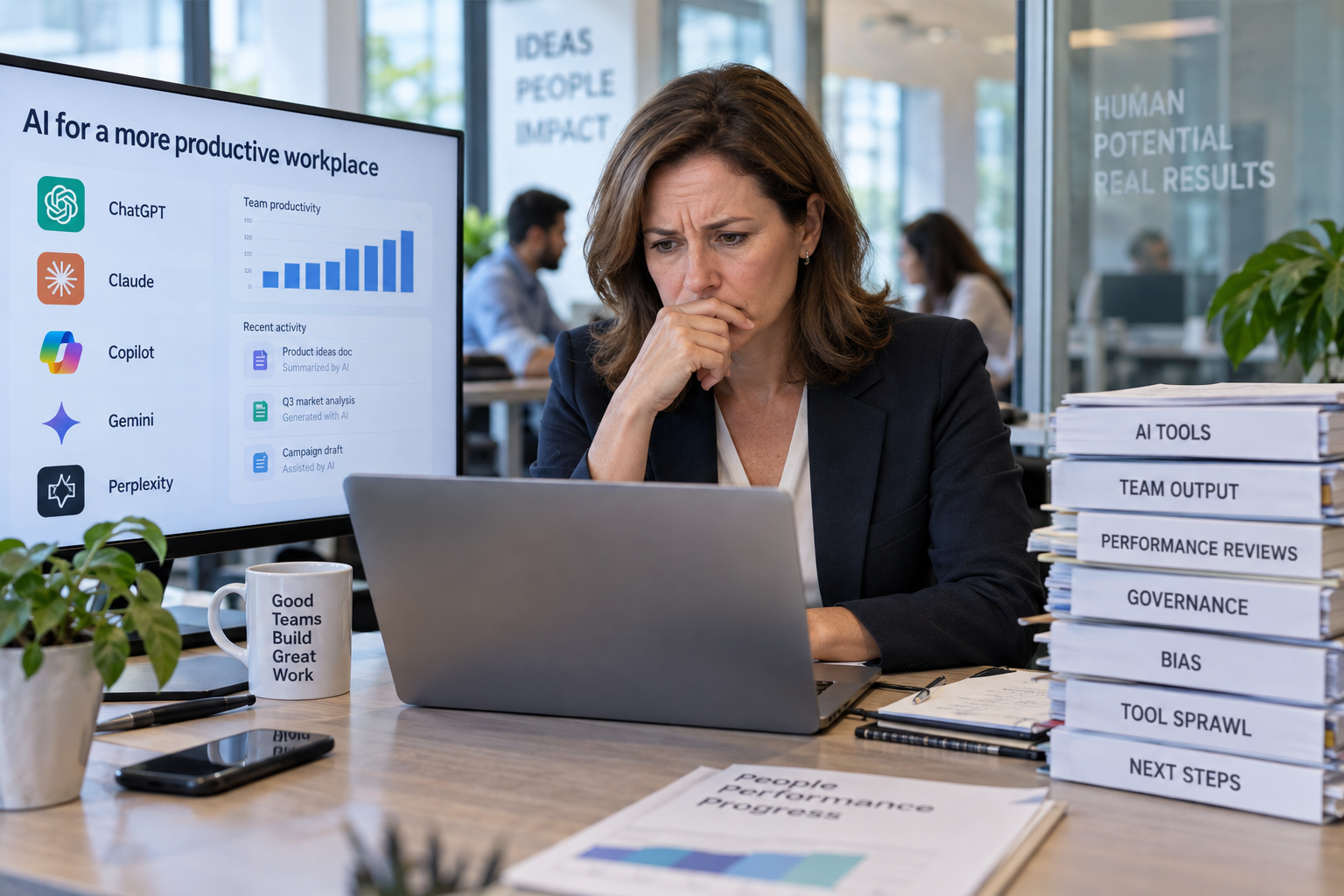
A Nielsen survey of 1,700 directors and senior managers across seven countries, commissioned by Monday.com, found that more than half of senior leaders find it harder to evaluate employee work since adopting AI. Managers remain enthusiastic about AI, but they struggle with oversight, tool sprawl and governance as the technology outpaces company processes.
Companies are handing employees AI tools to make them more productive. For many managers, those tools have created a new set of headaches.
More than half of senior leaders say they have a harder time evaluating their employees’ work since adopting AI, according to a Nielsen survey of 1,700 directors and senior managers across seven countries. The survey was commissioned by Monday.com, a work-management company. The main problem is that employee output now often arrives polished, making it difficult to tell how much came from the worker and how much came from AI. As a result, nearly half of managers say they spend more time reviewing and guiding their teams’ output than they used to.
The managers aren’t souring on the technology. Far from it. Some 94% of those polled said they were excited to improve work using AI, and many feel confident they know where it delivers the most value. Michal Miller Levi, head of market research and customer insights at Monday.com, compared the enthusiasm to the early days of the internet in the 2000s, when people saw a similar kind of “magic.”
The trouble, Levi told TechCrunch, is that AI is developing faster than companies can adjust. “AI works very well for [managers] individually, but they also have a different role as managers. They need to drive the organization as well … Their struggle is [due to] the fact that AI is just moving faster than the organizational processes,” she said.
How are managers judging employee work since adopting AI?
Managers are also changing how they judge their teams. Seventy-eight percent of respondents said they have altered their evaluations since adopting AI, putting more weight on how well staff write prompts, decide which tasks to delegate to AI and experiment with new ways of working.
That raises a harder question: how fairly can employees be judged when managers can’t easily tell how much of their work was produced by AI? The survey also found that 46% of managers use AI to help inform their decisions, and 39% of leaders use it to draft performance reviews.
Can AI safely help with performance reviews?
That practice could introduce more bias than usual into the review process. Large language models are, at their core, prediction machines, and they tend to repeat patterns found in their training data. Research from the Luxembourg Institute of Socio-Economic Research earlier this year found that, “in the absence of clear objective standards and when individuals are rated independently,” LLMs tend to rate performance much like humans do. A research paper from early 2025 found that AI models can be biased against Black male candidates and “demonstrate significant biases, varying in terms of the directions and magnitudes across different social groups.” When asked whether using AI to weigh in on people’s performance could bring outside bias into the process, Levi said companies have yet to work out how to handle such issues.
AI is also changing the daily routine of managers. Someone has to decide which tasks to hand to AI agents, check what those agents produce and step in when something goes wrong. The report suggests that this oversight could amount to a new layer of “invisible labor.”
Why is managing AI tools getting harder?
The software itself is getting harder to manage. Fifty-seven percent of managers say their organizations now have more tools in circulation than before, and about 51% say their tools have become more interdependent and clustered since adopting AI. Only 29% describe their AI infrastructure as fully optimized and centralized.
Levi said businesses expected AI to help shrink their software stacks. Instead, they are dealing with more apps, more integrations and more shadow AI use, as employees adopt tools outside their companies’ approved systems. “Managers completed 2025 with the feeling that they will consolidate tools, actually, that they’ll reduce the number of software. But what happened is that the number of tools that they’re using increased,” Levi said. “More than 50% are saying that they’re using more tools now than they did last year, and it’s not stopping.”
The need for control looks increasingly urgent as companies deploy AI agents that can act on their own. The survey found that 58% of managers expect to oversee more AI agents than human employees within the next year, and 46% worry about losing control over what those agents do. Another 35% said they fear being held responsible for decisions made by AI, given that LLMs remain largely unpredictable. “They don’t want their agents to be fully autonomous,” Levi said, explaining that managers want people involved and consulted by AI on crucial tasks and decisions.
At heart, the report suggests that AI adoption is becoming as much a governance problem as it is a chance to raise productivity. Without proper processes and infrastructure, managers are scrambling to keep things running.
Dieser Artikel wurde mit Unterstützung von KI verfasst.
News Factory APP - agentische News für besseres SEO & AEO.