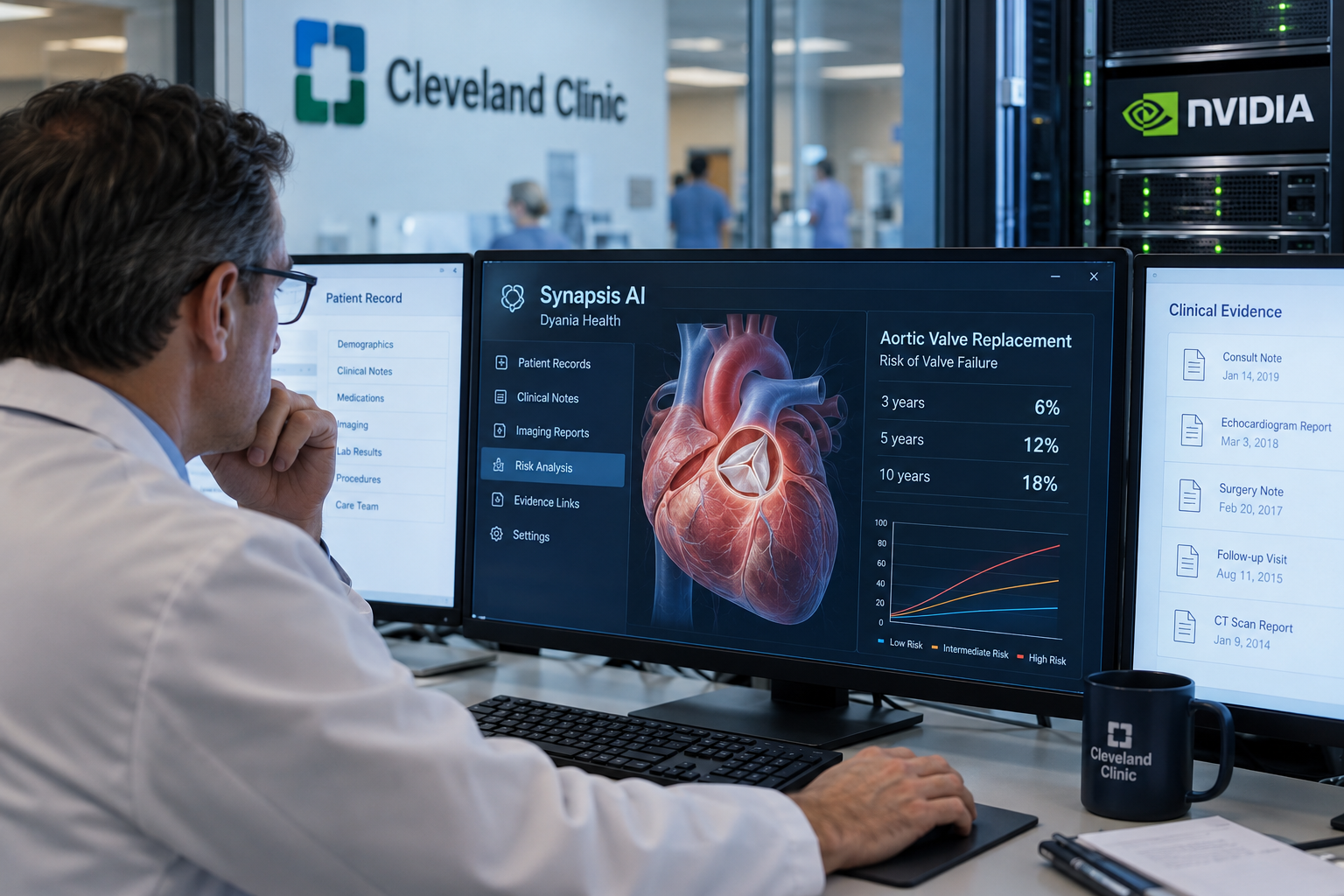
An AI system called Synapsis AI read up to 16 years of medical records for more than 7,800 Cleveland Clinic heart patients entirely on the hospital's own servers, Nvidia said. The study shows the tool can build a dataset and predict risk of replacement valve failure, but it does not show better patient care, and doctors review every decision.
An artificial intelligence system has read up to 16 years of medical records for more than 7,800 Cleveland Clinic heart patients, and it did the work entirely on the hospital's own servers, Nvidia said Friday.
How does Synapsis AI read patient records?
The software, Synapsis AI, is made by Dyania Health, a New Jersey startup. Much of a patient's history sits in doctors' notes and scan reports rather than neat data fields. Synapsis reads those notes, answers clinical questions and links each answer back to the record it came from.
Does the AI keep patient records inside the hospital?
Because the system runs on Nvidia hardware inside the hospital's network, patient records never leave the building. Nvidia pointed to a similar approach in the United Kingdom, where a triage AI built with Nvidia is used by the National Health Service.
For the study, the tool answered 88 questions about each patient who had an aortic valve replaced between 2005 and 2021. The answers fed a model that predicts the risk of a replacement valve failing three, five and 10 years after surgery. Nvidia says that chart review would have taken clinicians years to complete by hand.
Lars Svensson, head of the Cleveland Clinic's heart institute, called the work "a promising step towards enhanced outcomes and more personalized care for patients."
Does AI improve patient care at Cleveland Clinic?
The caveats are significant. Doctors still review the AI's evidence and make every decision. The study shows the tool can build a dataset and predict risk, but it does not show that the tool improves patient care. Dyania says Synapsis still needs outside validation.
The Cleveland Clinic is also an investor in Dyania. The hospital disclosed that relationship last year, when it rolled out the tool for trial recruitment.
The deal lands in a crowded field. Big technology companies are pushing hard into hospital records. Google Cloud launched Gemini for healthcare this week, and Bunkerhill raised $55 million to build hospital AI agents. Proven gains for patients, however, remain harder to find, and doctors have pushed back on bold claims about what these systems can do.
Dieser Artikel wurde mit Unterstützung von KI verfasst.
News Factory APP - agentische News für besseres SEO & AEO.