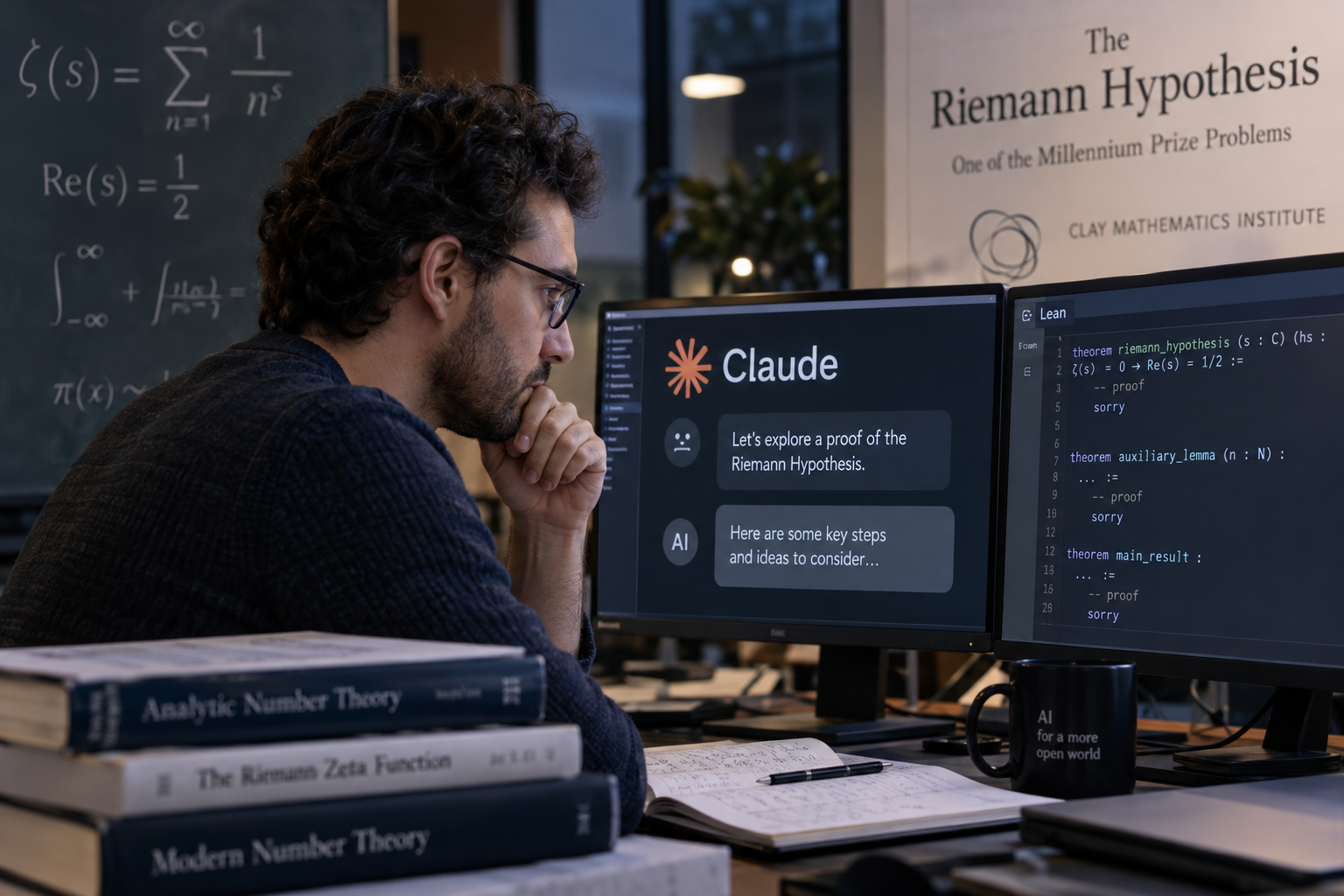
An Anthropic mathematician says he has proved the Riemann hypothesis with the help of Claude, the company’s AI model, a claim that would end one of the most famous unsolved problems in mathematics if it holds up. The proof has not been independently verified, and Anthropic has not commented on the announcement.
Has Claude really helped prove the Riemann hypothesis?
The mathematician, Levent Alpöge, posted a statement on his website describing the work. “I believe I have, working with Claude, discovered a proof of the Riemann Hypothesis,” he wrote. He said the method “easily extends much further,” and that it could also resolve the Generalized Riemann Hypothesis. He added that he expects, with more time, to resolve the Extended Riemann Hypothesis too. He wrote that he and Claude had also formalized the arguments without assumptions.
Alpöge says he texted Anthropic CEO Dario Amodei about the solution “late Sunday night.” He suggests he held off on publishing until after the company’s initial public offering on Thursday.
The Riemann hypothesis is one of seven Millennium Prize problems, which are widely regarded as some of the toughest open challenges in mathematics. First proposed in 1859, it concerns the distribution of prime numbers and how the zeroes of a function are involved. Many mathematicians consider it one of the most important unsolved problems in the field.
Anthropic did not immediately respond to a request for comment from The Verge. The company did address the problem earlier. In August, Anthropic said it was working on the Riemann Hypothesis with Claude, but it cautioned at the time: “We don’t expect that the techniques Claude used will lead to proving the Riemann hypothesis.”
What must happen before a Millennium Prize solution is awarded?
Alpöge’s solution, presented in Lean, has so far appeared only on his website. The Clay Mathematics Institute, which administers the Millennium Prize and offers a $1 million award for each problem solved, has not accepted it. Under the institute’s rules, a proposed solution must be published and then withstand at least two years of scrutiny before it can be considered for the prize. During that period, it must also receive “general acceptance in the global mathematics community.”
The prize has been awarded only once in its 25-year history. The Poincaré conjecture, a topology problem about three-dimensional spheres, is the only Millennium Prize problem officially solved so far.
How does this compare with OpenAI's Navier-Stokes claim?
The announcement follows a similar claim from OpenAI. In September, the company said it had cracked another Millennium Prize problem, the Navier-Stokes problem, which concerns the flow of fluids. OpenAI said it pursued the problem after hearing rumors that rival researchers were close to a solution. Alpöge had been working on Navier-Stokes with Tristan Buckmaster, a mathematics professor at New York University. Buckmaster said OpenAI produced its solution using the approach he and Alpöge had been developing, with OpenAI’s Codex and Claude.
OpenAI reportedly spent millions of dollars and deployed 10,000 agents in the effort. The result is widely considered credible, though it has not received formal recognition. The achievement has also drawn allegations of questionable research practices. Critics claim the work used unpublished research from mathematicians who had shared their findings with the company’s AI tools. OpenAI has strongly denied wrongdoing, but the criticism has not subsided.
Most of the attention has centered on OpenAI’s push into mathematics, but Alpöge has also reported results using Claude. The flood of new claims has left mathematicians working to digest the material and determine where it fits into a rapidly changing field.
Dieser Artikel wurde mit Unterstützung von KI verfasst.
News Factory APP - agentische News für besseres SEO & AEO.