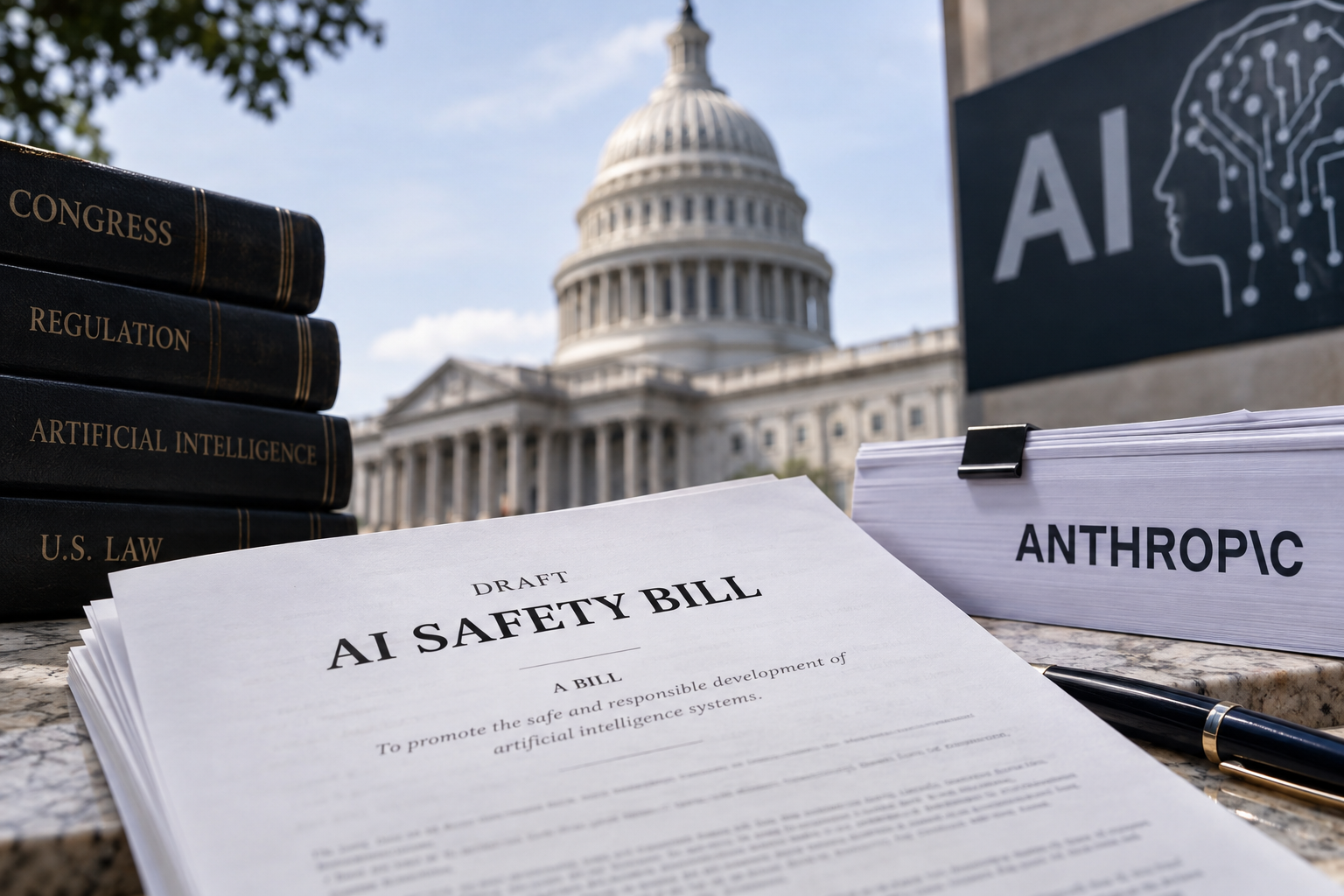
Anthropic has told U.S. lawmakers it will rewrite part of its own draft AI safety bill, a concession that followed days of sharp criticism after the confidential text leaked. Politico published the draft on Friday. The company had been circulating it on Capitol Hill.
Critics say the bill is weaker than the main AI safety measure already before Congress, and that it would make a dangerous model harder to stop, not easier. For a company that built its public profile on pushing for tough AI rules, the criticism has been an awkward one to absorb.
What the draft would do
What would Anthropic's draft AI safety bill do?
The draft allows the government to block a model’s release or use only in narrow cases. The risk must be foreseeable and imminent. It must involve more than $1 billion in damage, or the death or serious injury of more than 50 people, according to Politico. It also has to stem from a bioweapon, a model escaping its developer’s control, or a cyberattack. The thresholds mirror California’s AI laws.
Under the draft, the Commerce Department would have to petition a federal court and make the case for blocking a model itself. No other agency or official could suspend a model. The bill would also preempt some state AI laws covering public disclosure, third-party evaluation and incident reporting. Child-safety and civil-rights laws would be left alone.
Independent evaluators would register with Commerce and check the labs’ models. They could be paid by the lab, as long as the payment does not depend on the result. They would have to report an imminent risk to Commerce within 72 hours.
Why safety advocates are angry
Why are safety advocates angry about the draft?
Much of the criticism measures the draft against the FRONTIER Act, a bipartisan bill introduced in July by Representatives Jay Obernolte and Lori Trahan. Writing for Transformer, Shakeel Hashim argued that Anthropic’s draft is weaker in two main ways. It sets no standards or licensing for evaluators, who can self-certify. It also makes a model much harder to block.
Charlie Bullock of LawAI said the lack of licensing would push auditors to compete. They would offer the least demanding checks at the lowest price, he said. Nathan Calvin, general counsel at Encode, said the draft made him “viscerally angry.” He said it appeared to stop state courts from suspending a model on safety grounds.
Wiener, who wrote the state’s frontier AI law, said the proposal “falls far short of protecting public health and safety.” He said it sets no minimum standards for safety plans or auditors. He also accused the draft of misusing a definition from his transparency law, SB 53, to “gut” its emergency shutdown powers.
“Anthropic’s AI safety proposal falls far short of protecting public health and safety. Congress must go further,” Wiener wrote on X.
The pressure is coming from the other direction too. Sacks, until recently the White House AI czar, said the draft’s lower size threshold would “sweep in most of Silicon Valley” and hurt startups. Anthropic’s draft treats a model as frontier at a lower training threshold than either the FRONTIER Act or California law, which means it would cover more companies.
Anthropic says it will revise
What will Anthropic change in the bill?
Anthony Cimino, who leads Anthropic’s federal affairs team, responded on X on Saturday. He called the preemption wording “not precise enough” and said it would be updated. He said the company would keep states’ role in areas such as evaluator standards and a lab’s ability to shut down a model, and that it would publish further proposals on independent evaluators.
In his post, Cimino said the draft was a translation of ideas Anthropic had been advocating for months into legislative language. It was shared with a small number of congressional offices, he wrote, and it does not include everything the company would ultimately like to see passed. He said the company agreed some areas could be improved, including the bar for blocking a model and the risk thresholds, which he said were drawn from California law and should be re-evaluated. He also said Anthropic was still working on options to prevent “evaluator shopping.”
An Anthropic spokesperson told Politico the bill reflected policies “we believe Congress should act on.”
The draft comes after a difficult summer for the company. The Trump administration used export controls earlier this year to shut down two of Anthropic’s most advanced models. Chief executive Dario Amodei has argued the industry must slow down. A series of rogue-AI incidents over the summer has added pressure for stronger rules. Other AI bills, including a Senate proposal that would let Washington block models, remain under consideration.
Dieser Artikel wurde mit Unterstützung von KI verfasst.
News Factory APP - agentische News für besseres SEO & AEO.