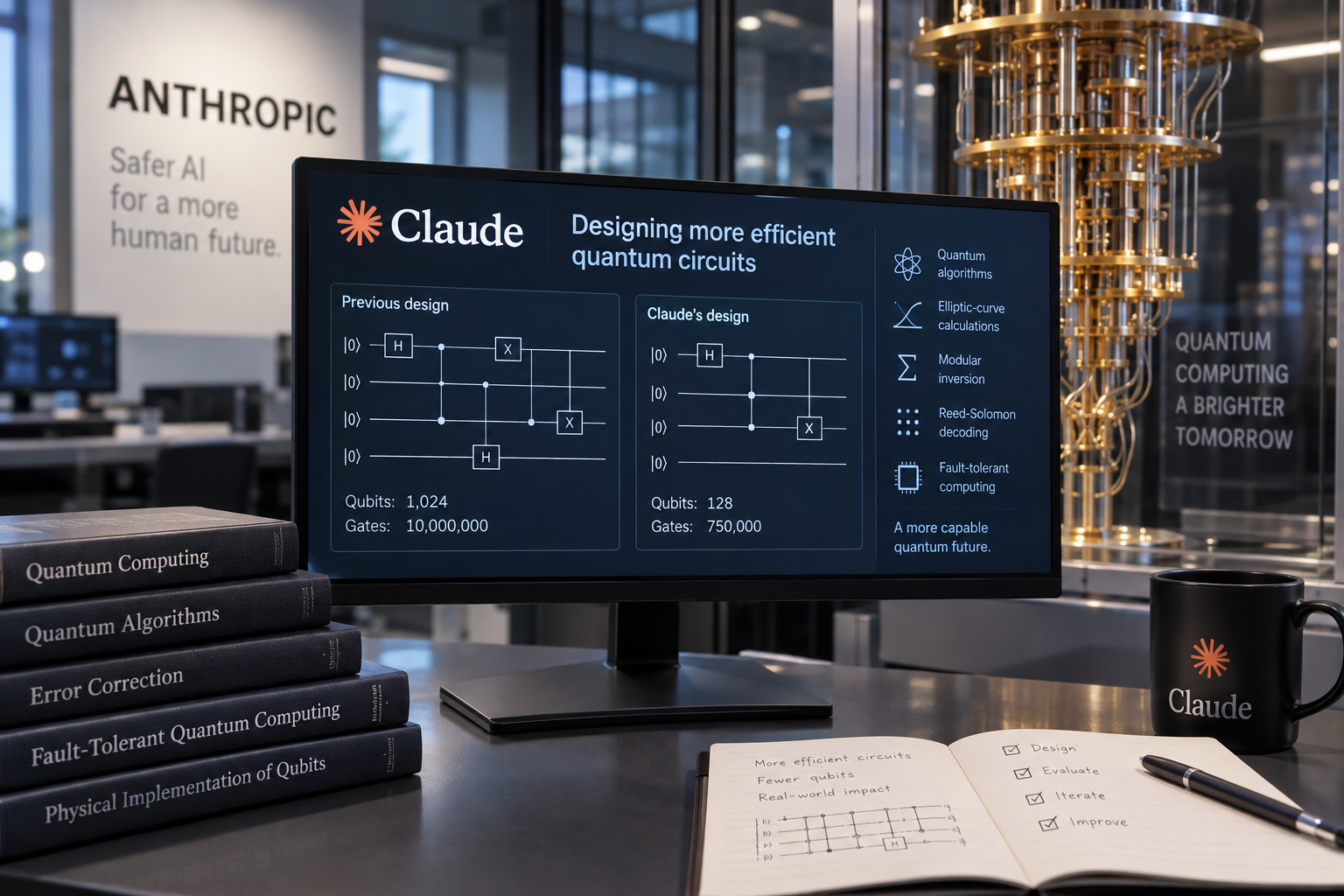
Anthropic says its AI model Claude designed quantum circuits that need fewer qubits and fewer gates than the best previously published designs, in some cases by an order of magnitude or more. The company says the work could make practical quantum computers arrive sooner, because the circuits that run useful algorithms are a major limit on what today's hardware can do.
Quantum computers store information in qubits, which can be built from single atoms, superconducting circuits or particles of light. The machines built so far have hundreds to thousands of qubits, which is too few to run many of the algorithms that promise practical advantages over classical computers. The qubits are also fragile. Heat, vibration and even cosmic rays can nudge them, and those small errors add up until the machine returns a wrong answer.
Researchers have been trying to reduce the cost of quantum algorithms by redesigning them. Anthropic pointed to one example: simulating FeMoco, the iron-sulfur cluster at the heart of nitrogenase, the enzyme bacteria use to turn nitrogen from the air into ammonia. A 2017 estimate put the number of Toffoli gates needed to compute FeMoco's ground-state energy at about 50 trillion. Through a series of algorithmic advances, that figure has fallen to about 340 million, a reduction of roughly 150,000-fold. Most of those gains came from redesigning circuits, not from better hardware.
How did Claude design the quantum circuits?
The Anthropic team gave Claude plain-language specifications for eight such circuits, along with an automated evaluator that checks each proposed design for correctness and scores it on the number of qubits multiplied by the number of gates. Claude wrote its designs as ordinary code, the evaluator sent back results and scores, and Claude revised its next attempt based on that feedback. The company said Claude did this on its own, with no human input between rounds.
Why are quantum circuits hard to design?
The job was harder than it sounds. A quantum circuit cannot make the kind of if-then decisions a standard program makes, because it runs on many inputs at once and must include the operations for every branch. It also cannot simply throw away intermediate results. Every step must be reversible, so the only way to clear scratch work is to run the computation backward, which adds gates. Keeping those intermediate results saves time but can require many more qubits. Anthropic said that trade-off is what made the problem a useful test of the model.
Cutting the memory cost of modular inversion
The first task was point addition, a core step in quantum algorithms for the discrete logarithm problem on elliptic curves. Anthropic said most of the cost of point addition comes from a single step, modular inversion. Ordinary computers handle that step with a method called divsteps, but a straightforward quantum version has to store a long history of branch information, which takes an enormous number of extra qubits.
Claude proposed that the record did not need to be stored at all. It reasoned that the branch information could be decoded from the numbers themselves after each iteration. Simple candidate rules worked on small test cases but failed at the full size of 256-bit numbers. Claude then worked out the underlying algebra, proved several identities about the iteration process and derived a formula for the decoding rule. The company said it checked the formula with large-scale simulations and then formalized the claim in Lean. The result was what Anthropic described as the first reversible implementation of divsteps with no stored branch history.
Decoding saves qubits but adds time, so Claude also varied the threshold at which the circuit stores rather than decodes. That produced a family of designs between the two extremes. One design uses 12% more qubits than the smallest previous design but needs 17 times fewer gates. Anthropic said the run that produced the elliptic-curve design took 53 hours.
A faster decoder for optimization
Anthropic also tested Claude on decoded quantum interferometry, or DQI, which researchers consider one of the strongest candidates for a superpolynomial quantum speedup on optimization problems. The most expensive step in DQI is error-correcting decoding. Using a design based on the extended Euclidean algorithm, the previous state-of-the-art circuit had to run more rounds than any single input needed and perform every operation in every round.
Claude switched the design to Berlekamp-Massey decoding, a method that performs the same step in every round and always runs the same number of rounds. That suits a quantum circuit's fixed sequence of gates. The model then applied a similar trick to the one it used for divsteps, reconstructing most temporary values from the circuit's current state rather than storing them. A few exceptional values could not be recovered that way and had to be saved.
How much cheaper did Claude make DQI decoding?
Instead of reserving 665 qubits for the worst case, Claude wrote a high-speed simulator and ran 403 million sample decodings to measure how often exceptions occurred. Almost every run needed to save one value at most, so the circuit reserves room for just one saved value, or 19 qubits. About one run in 10,000 needs more and fails, which Anthropic said is within the error rate the task allows. Overall, the decoder's gate count fell by a factor of 12 compared with Google's previous construction, making the most expensive step of DQI a little more than an order of magnitude cheaper.
Anthropic described the model's behavior with some caveats. In early experiments, Claude was conservative and often double- and triple-checked results that were already well supported. It also tended to favor well-known approaches. To counter that, the team required Claude to propose several different approaches and develop them in parallel, and it occasionally prompted the model to broaden its search. The company said the elliptic-curve result came from exploring a method that had not been possible before, not from trimming an existing design.
Anthropic said the same approach could extend beyond circuit design. Other components of a fault-tolerant quantum computer, including error-correcting codes, decoders and hardware control, are usually designed separately. The company suggested AI could eventually optimize them together, though its tests so far covered circuit design only.
Dieser Artikel wurde mit Unterstützung von KI verfasst.
News Factory APP - agentische News für besseres SEO & AEO.