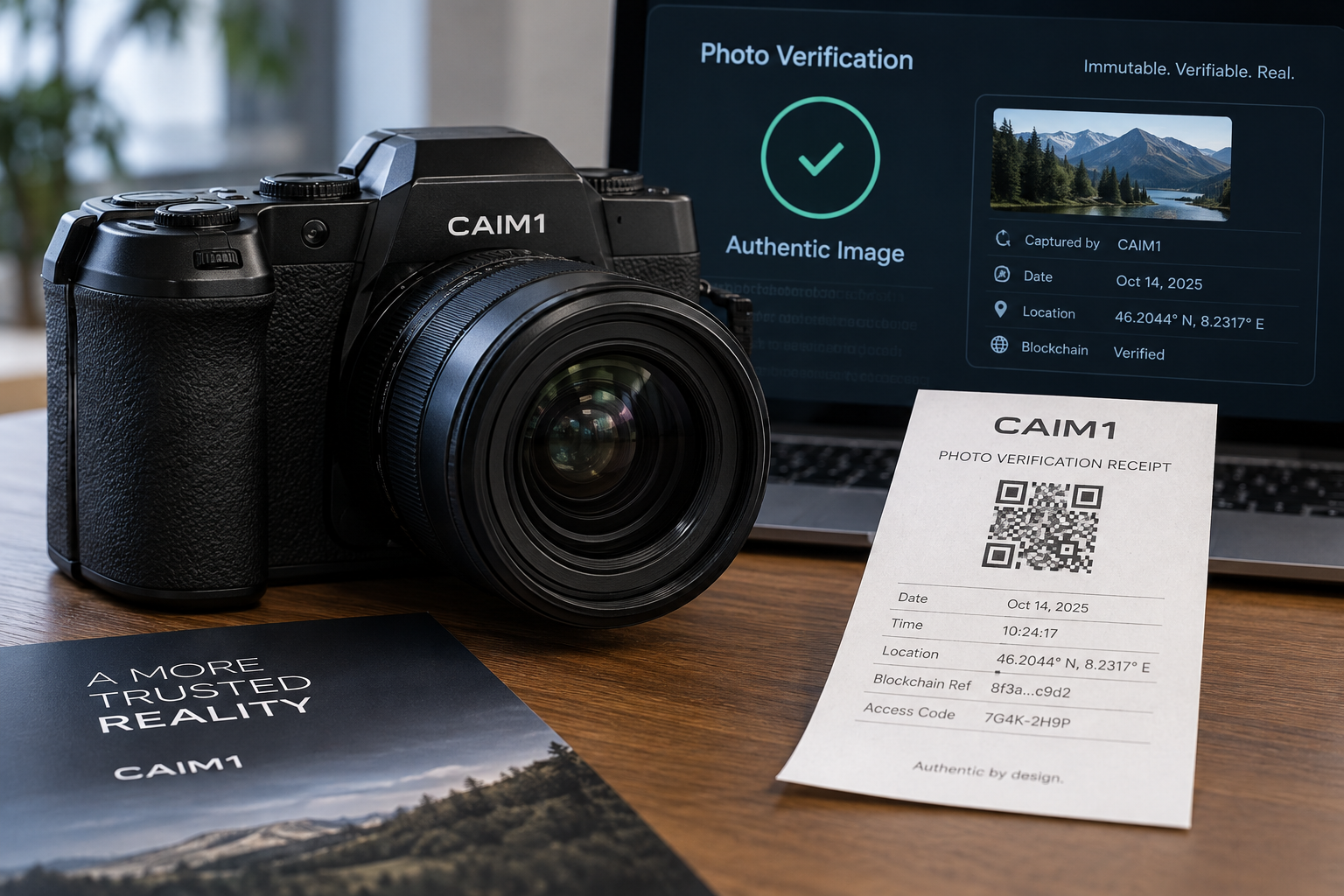
CAIM1's prototype camera proves a photo is real by building verification into the image itself. Its internal Tropic01 chip creates a unique silicon fingerprint each time a photo is taken, recording when, where and which camera captured it. That record is tied to an anonymous blockchain signature that viewers and researchers can audit.
Deepfakes are multiplying faster than most people can check them. Startup CAIM1 wants to give photographers a way to prove a picture is real, and its prototype camera does it by building the proof into the image itself.
How does CAIM1's camera prove a photo is real?
The company, founded by Josh Cowell, takes its name from Counter Artificial Intelligence Machine 1. Its prototype uses an internal chip that creates a unique silicon fingerprint each time a photo is taken. That fingerprint certifies when, where and with which camera the picture was captured. The verification is then tied to an anonymous blockchain signature, which gives researchers and viewers an auditable trail they can use to authenticate the image.
The problem CAIM1 is targeting is growing. A report by the European Parliament says social media deepfakes have doubled every six months since 2023, reaching an estimated 8 million in 2025. Europol projects that 90 percent of online content will be AI-generated by the end of the year, if current trends hold. The agency also estimates that 98 percent of deepfakes are pornographic, and it points to lax safeguards that have allowed nonconsensual sexual deepfakes to spread systematically. Several large technology companies, including xAI, Google, Meta and Apple, have faced legal pressure over AI-driven disinformation.
How the camera verifies a photo
CAIM1’s process starts with its silicon chip, the Tropic01, which chip provider Tropic Square describes on its website as the “world’s first auditable secure element.” When the camera takes a picture, light passes through what CAIM1 calls a “digital vault” before it reaches the sensor. That step creates verification at the hardware level, embedded in the image. The company says manufacturing irregularities in the chip mean no two fingerprints are the same.
Once a photo is captured, its verification record goes to what CAIM1 calls an “immutable decentralized infrastructure.” The company says the record cannot be changed and remains auditable and anonymous. To protect user information, CAIM1 says it encrypts sensitive data using physical noise systems and internal encryption methods, along with digital tripwires designed to block access through stolen keys or brute-force attacks.
The camera can also print a physical receipt for each image. It includes a permanent QR code linking to the photo, a blockchain reference number, the date, time and location of the shot, and a unique access code for digital retrieval.
How is CAIM1 different from other photo verification systems?
CAIM1 is not the only company working on hardware-based photo verification. Apple has launched hardware attestation for its iPhone 18 Pro and 18 Pro Max models through its Reference Image system. Sony, Canon and Nikon announced a joint initiative in 2024 to embed digital signatures in photos taken with their cameras.
Cowell argues CAIM1 is more transparent than those competitors. In a blog post on Tropic Square’s site, he said the chips allow researchers and the public to “audit its internal architecture.” Competing systems, he said, require “users to place blind faith in a single corporate entity’s closed ecosystem.”
Cooling, lenses and the video question
Building the camera also meant solving a heat problem. Excess heat from the processors can degrade picture quality. Heatsinks could not handle the temperatures the camera’s processors produce, and most fans were too loud and created micro-vibrations that can cause motion blur.
CAIM1 worked with PC fan manufacturer Noctua on a custom active-cooling system. The design, called the NF-A4x10, uses a single airstream to pull cool air across the CPU and the sensor, the camera’s two main heat sources, while pushing hot air out. Two anti-vibration mounts are meant to prevent blur.
The camera is capable of 4K video, and CAIM1 says it is built for high-action sports. “We didn’t set out to build a gimmick or a toy,” the company wrote in a blog post. “The CAIM1 is designed from the ground up as a high performance, rugged camera that videographers can rely on in extreme, fast paced environments.”
Detailed specifications are still scarce. CAIM1’s website highlights a Bring-Your-Own-Lens design, which lets customers use vintage or modern lenses. In recent tests, the company attached two premium lenses from Kowa Optronics’ JC10M series and filmed the results at Germany’s Nürburgring racetrack.
When will the CAIM1 camera be released?
CAIM1 expects its flagship camera to be released sometime in the first quarter of 2027. Cowell says the camera is “ultimately just the foundation of a comprehensive, verifiable infrastructure we are developing designed to aid digital truth.”
Dieser Artikel wurde mit Unterstützung von KI verfasst.
News Factory APP - agentische News für besseres SEO & AEO.