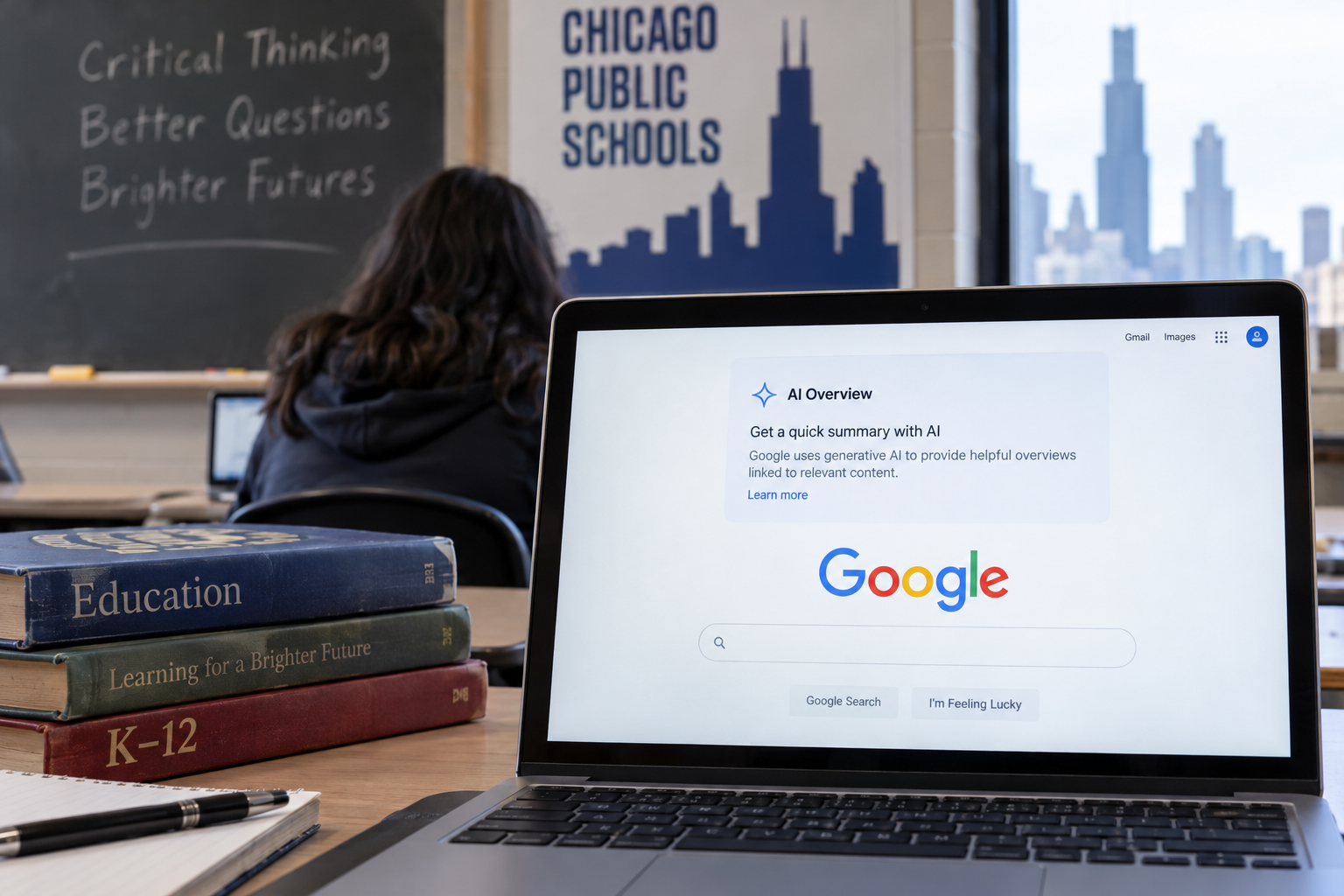
Chicago Public Schools says it will look for a different search engine if it cannot give students access to Google Search without the company's AI features attached. The district's position came after Google warned that K-12 schools will soon have to accept its AI services to keep their students' access to the search engine.
What happens to students at schools that refuse Google's AI services?
Chris Phillips, Google's vice president and general manager for education, made that point at the start of November. He said Search and AI are now deeply integrated services. Under the plan, students at schools that refuse would not see their usual results. Instead, they would see a message from their school saying the services are not available.
Critics said Google was essentially blackmailing schools into using a product they did not want. Chalkbeat Chicago reported that the announcement sparked protests in Cambridge, Massachusetts, and in Chicago, where the city's school district recently blocked student access to generative AI tools such as Gemini.
Why is Chicago threatening to drop Google Search?
The district has not formally responded to Google's announcement. A CPS spokesperson did say in a statement that the district was "actively exploring all options to independently suppress" the AI Overviews that appear at the top of Google searches. The spokesperson added that if CPS cannot provide students with Google's search engine without the AI feature, the district will "look to other search solutions."
Chicago's pushback has been loud. About 30 protesters, including parents, educators and students, gathered outside Google's office in the West Loop. Some carried signs and chanted, "Hey Google, nice try. We don't want your Gemini."
Reese Mackey, a junior at Kenwood Academy High School, spoke at the demonstration. "We are owed lessons and feedback from the people CPS hired, people who are passionate and dedicated to making learning fun," Mackey said. "Not by a bot whose only job is to be a yes man and compile random sources from the internet for a nonsensical answer."
A Google spokesperson said the company is working to improve Search for classroom use. That includes testing a feature called "Guided Learning," which uses AI to walk students through problems one step at a time instead of simply handing them answers.
Are other school districts restricting student AI use?
Chicago is not alone. In October, the Frederick County school board voted 6-1 to restrict student AI use from pre-K through 12th grade. The vote came just weeks after the board had allowed older students to try Gemini with teacher permission. Board members raised concerns about the lack of warning to parents and teachers, and about the fact that teachers could not disable the tool on student devices. The restrictions include exceptions for lessons about AI and accommodations for students with disabilities.
New York City has introduced a one-year moratorium on student-facing generative AI from preschool through eighth grade for the 2026-2027 school year. High school use is limited to approved tools in supervised pilot or career-readiness programs. Los Angeles has temporarily blocked generative AI tools on student devices across all grades.
Google's push comes as a growing number of districts are moving in the opposite direction, pulling back on student access to generative AI rather than expanding it.
Dieser Artikel wurde mit Unterstützung von KI verfasst.
News Factory APP - agentische News für besseres SEO & AEO.