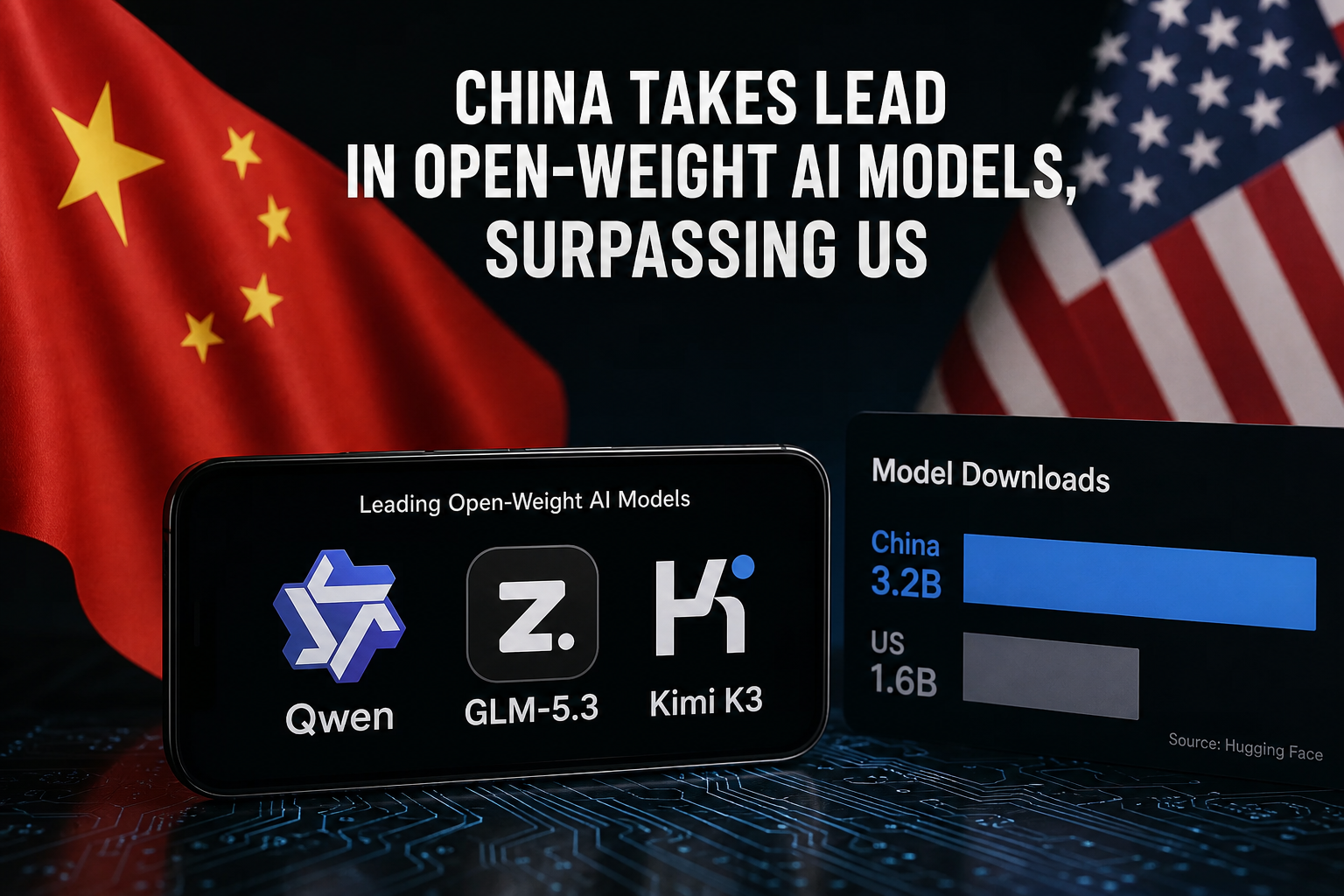
Chinese AI companies have taken the lead in open-weight models, surpassing their American counterparts in terms of model strength and adoption. This shift has significant implications for the AI ecosystem, with open-weight models becoming increasingly important for AI diffusion and economic viability.
The state of open models is characterized by a convergence of many stories across the AI ecosystem. The capabilities gap between open and closed models has been decreasing over the last three years, with open-weight models unlocking substantial markets in 2026. Chinese AI companies, such as Alibaba and Z.ai, have been producing stronger models that are being widely adopted in academia and industry.
According to data from Hugging Face, Chinese models have taken the lead in downloads, with China's download lead growing to about 1.6B - with a total of 3.2B downloads, twice that of America's total. The top three Chinese models, Z.ai's GLM-5.3 and GLM-5.3-Flash and Moonshot AI's Kimi K3, have scores of 45, 42, and 44 respectively on popular capabilities benchmarks, such as the Artificial Analysis Intelligence Index (AAII).
The adoption of open models is also reflected in the growth of platforms that offer inference primarily on open models, such as OpenRouter and Together. These platforms are seeing incredible growth as the first winners of an open model post-training economy. Many prominent technology companies and startups, such as Harvey and Cursor, are building on Chinese open-weight models for their AI features.
The foundation of innovation on Chinese models extends further into the AI ecosystem, with most academic research being conducted on Alibaba's Qwen family of models. The leading role shift from the US to China is also reflected in the arXiv papers, where mentions of Chinese open-weight models have risen to over 40% of papers, surpassing the US's 30%.
However, the success of Chinese AI companies in open-weight models is not solely due to distillation, an industry standard technique of training another AI model on the outputs from a stronger model. The best estimates are that distillation helps reduce the performance gap of Chinese companies relative to the American frontier by 1-2 months.
The growth of open-weight models also raises concerns about cybersecurity and the potential risks associated with these models. As open models become more powerful, they can enable new risks, such as cybersecurity threats, and necessitate an ecosystem-level response in preparation. This new era of risks is also enabling a period of political uncertainty, where there is regulatory attention on the strongest AI models, but massive uncertainty on how policy would be legally enacted.
In conclusion, the Chinese labs are clearly maintaining their status as the leaders of the open-weight AI ecosystem, with open-weight models passing an inflection point in economic viability and increased activity from American labs as model competition. The leading Chinese labs do not appear to be meaningfully challenged, as they expand their enterprise and research adoption globally.
Dieser Artikel wurde mit Unterstützung von KI verfasst.
News Factory APP - agentische News für besseres SEO & AEO.