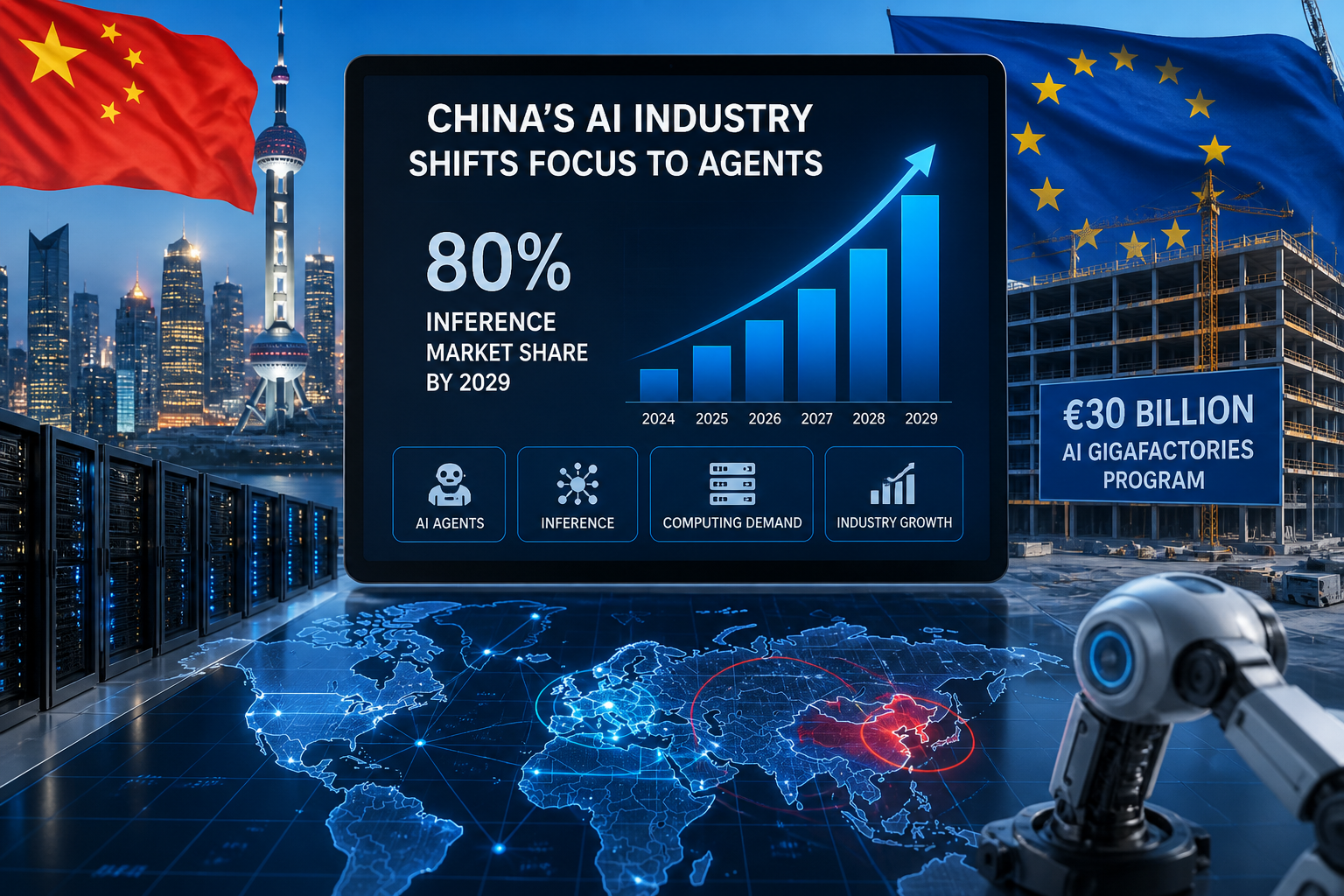
China's AI industry is undergoing a significant shift in focus, moving from competing on large models to deploying and selling AI agents, according to a report by the China Telecom Research Institute. The report, carried by state broadcaster CCTV, predicts that inference will account for 80% of the country's computing-power market by 2029, overtaking demand from training.
This shift is expected to drive close to tenfold annual growth in computing demand over the next two to three years, with Chinese technology companies expected to spend close to 600 billion yuan, about $89 billion, on AI this year. The report puts that at more than a tenth of all investment in the country.
Meanwhile, Europe is building its own AI infrastructure, with the Commission opening bidding in July for up to seven gigafactories, a EUR 30 billion program with about EUR 10 billion of public money and EUR 20 billion hoped for from private investors. Roughly EUR 1 billion of it is actually committed, with applications closing on November 12 and awards expected in early 2027.
The economics of AI are also changing, with inference becoming a key area of focus. Companies are now optimizing models rather than building them, and the margin is shifting to inference. China's report is a forecast about running models, and Europe is still deciding where to put the buildings.
As the AI industry continues to evolve, it's clear that the focus is shifting from training to inference, and from models to agents. This shift is expected to have significant implications for the industry, with companies that can optimize models and deploy agents effectively likely to be the ones that succeed.
Dieser Artikel wurde mit Unterstützung von KI verfasst.
News Factory APP - agentische News für besseres SEO & AEO.