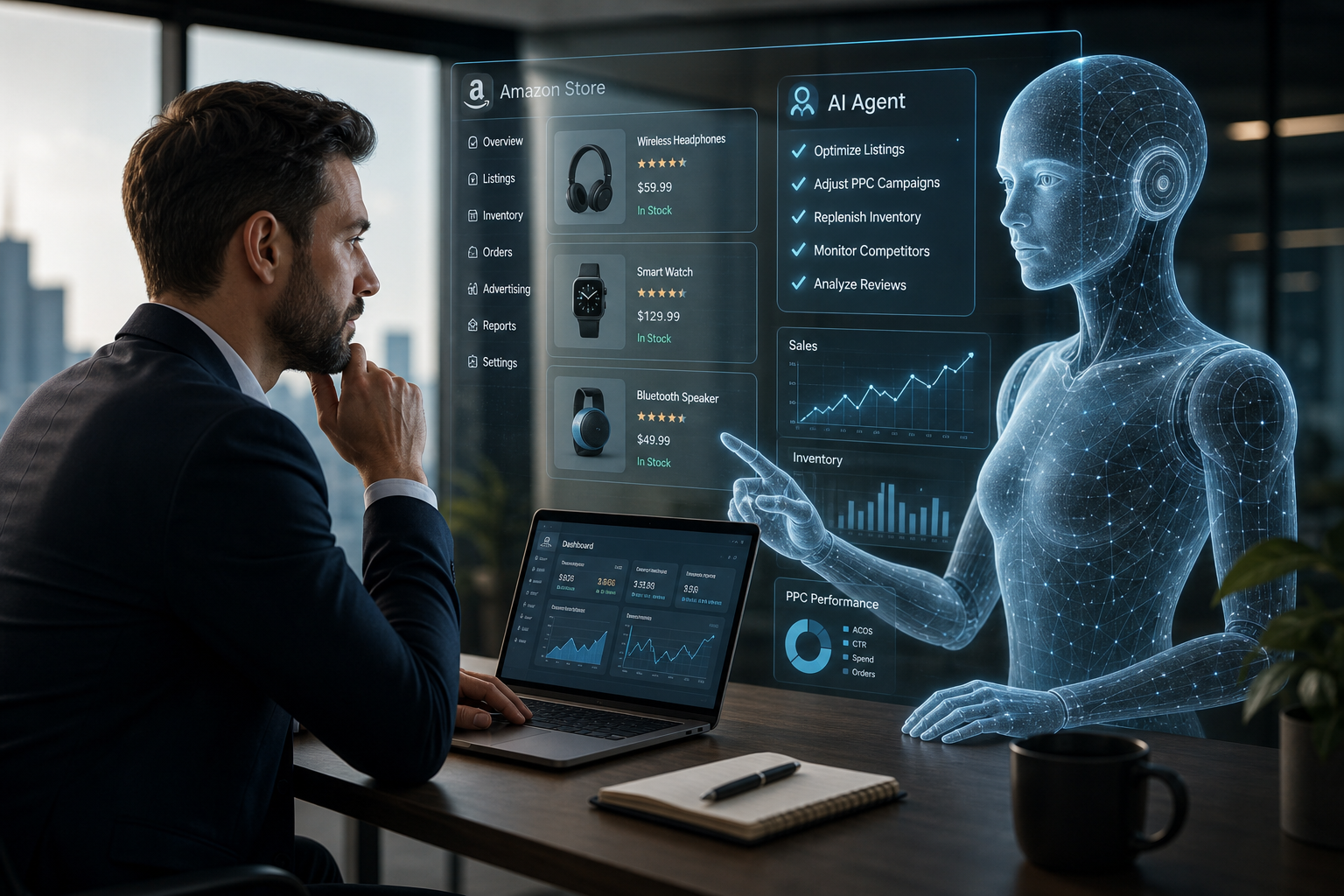
Would you trust an AI agent to run your Amazon store? That future may be near, but true AI transformation requires moving beyond "gap-filling" AI tools. It requires building an infrastructure layer that lets AI agents create and manage their own workflows. We asked 7 e-commerce industry veterans what's still broken and what needs to change before AI agents can truly operate online stores.
For the past few years, promises of AI transformation have flooded the e-commerce industry. The market for e-commerce SaaS and Amazon listing optimization tools has never been more crowded. So why are e-commerce agencies and large sellers still spending so much time operating their stores manually? One reason is that today's AI tools are missing a bigger business picture. They focus on one metric or task without considering the broader business goals.
Cyril Golub, CEO & Founder of Jinnify.ai, notes that e-commerce agencies don't suffer from a lack of software anymore. In many cases, they suffer from too much of it. Every new SaaS dashboard or AI copilot can become another burden: another interface to learn, another stream of recommendations to interpret, another tool a human has to connect to the actual business outcome.
The Four Bottlenecks
Our interviews with e-commerce agency CEOs and industry veterans revealed four bottlenecks where legacy tools stall. The first is catalog firefighting, which is still a human job. When industry outsiders think of Amazon optimization, they picture keyword research or product listing updates. But ask an agency operator what actually consumes their team's time most, and the answer is far less glamorous: relentless catalog firefighting.
The second bottleneck is that AI tools are missing a bigger business picture. They focus on one metric or task without considering the broader business goals. Adnan Aslam, CEO of Sellonics, notes that the next-gen AI commerce tools would have to understand the full spectrum of operational areas simultaneously. That includes PPC budgets, inventory levels, profit margins, competitor rankings, and current brand lifecycle stages.
The third bottleneck is that more data doesn't mean better decisions. As Large Language Models (LLMs) went mainstream, many e-commerce software developers connected them to Amazon's Selling Partner API (SP-API). However, giving an LLM access to raw store data hasn't yielded an ideal autonomous account manager. In practice, feeding unstructured data into an LLM creates prompt noise and hallucinated AI recommendations that can hurt online store performance.
The fourth bottleneck is the gap between AI recommendations and action. The biggest problem with today's AI commerce tools is that they can recommend what to do, but they often can't actually execute these actions. A merchant still has to log into Seller Central, copy and paste recommendations, submit support tickets, and come back later to see if the fix worked.
Antons Sapriko, CEO of Scandiweb, notes that the biggest challenge with AI in commerce is integrating the AI-generated recommendation into the operational system around the business. If people still have to move between tools, validate outputs manually, and execute changes themselves, you haven't fundamentally changed the operating model, but just accelerated one step within it.
The Future of E-Commerce
Agency CEOs foresee a shift from AI helping sellers optimize individual tasks to AI agents actively running parts of the commerce business. On the shopper side, AI agents will decide which products to recommend. That makes it more important for brands to structure their product data so machines can understand them. On the seller's side, AI agents will take over more routine work, following certain guardrails, merchant's permissions, and rules.
Klaidas Siuipys sees a future where AI agents, rather than traditional search, help shoppers find and choose products. Instead of the shopper scanning a results page, an agent picks what fits. For sellers, it changes what optimization means. You stop competing only for a position in search results and start making sure a machine can correctly understand what your product is and who it is for.
Steven Pope shares his vision of a future where AI agents can act on sellers' behalf: Over the next two to three years, I think AI commerce will shift Amazon sellers from manually operating listings and campaigns to managing intelligent systems that run much of the repetitive work. The winning sellers will not simply be the ones using AI to write better bullet points or generate images, but the ones whose product data, brand assets, operational workflows, and decision rules are structured well enough for AI agents to act on them safely.
Dieser Artikel wurde mit Unterstützung von KI verfasst.
News Factory APP - agentische News für besseres SEO & AEO.