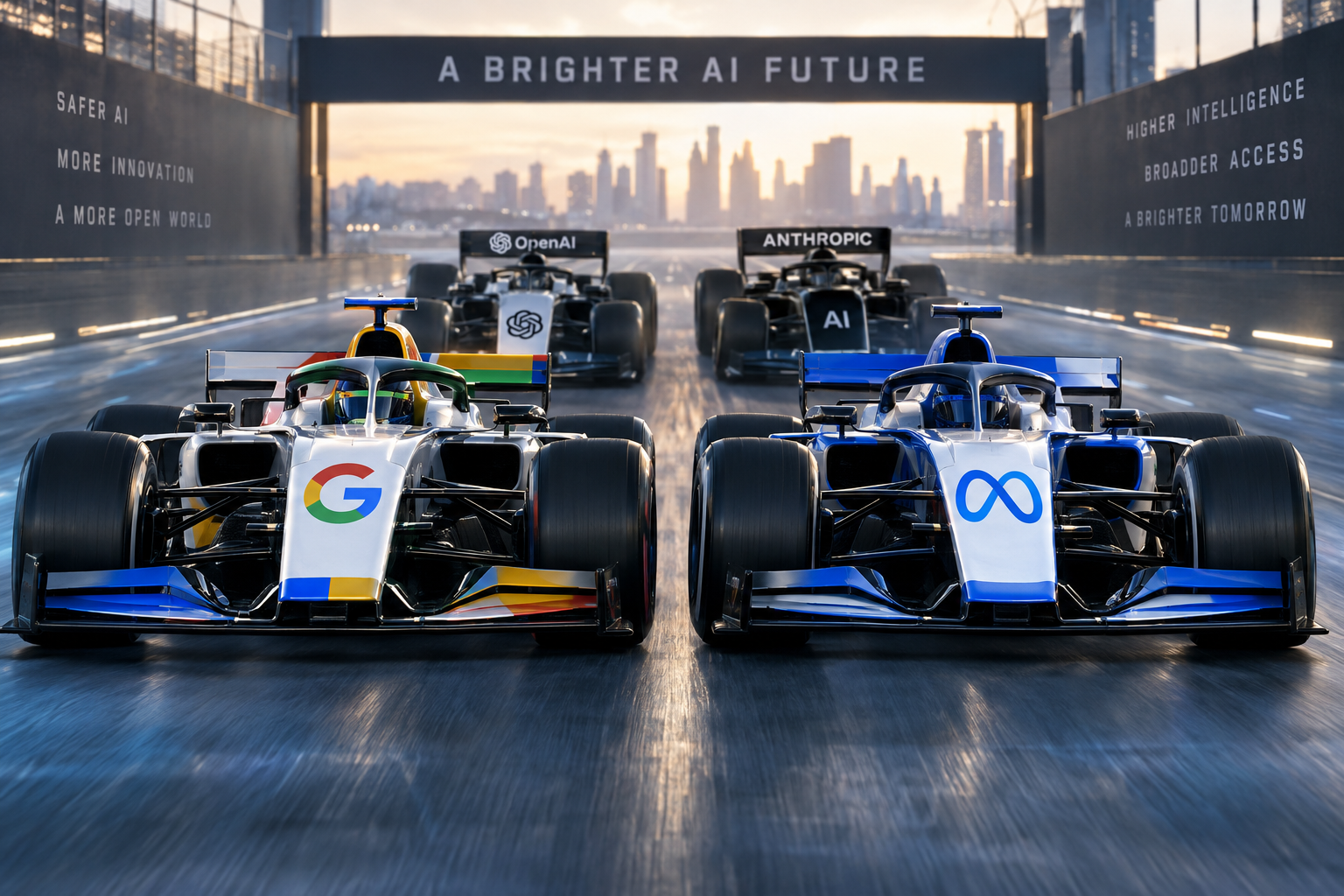
For a few weeks, Anthropic and OpenAI looked like they had the AI race to themselves. Their latest models pulled ahead of the competition, and Google and Meta seemed to be stuck far behind. Then, in the span of a few days, both companies put out models they say can go toe to toe with the best from the two startups.
Google's fall from the front of the pack was gradual. The company released Gemini 3 late last year, and it was formidable at launch. But its lead did not last. In the months that followed, Google delivered little more than incremental updates, and it struggled to keep pace with newer offerings from OpenAI and Anthropic, as well as some open-weight models from China.
Internal changes made the slide look worse. Veteran executive Jeff Dean left the company with several other AI researchers to start a new startup. Demis Hassabis, the Nobel laureate who ran Google's AI powerhouse DeepMind for years, stepped back from day-to-day leadership. Other AI teams were moved out of DeepMind and into the core of Google. Those moves pointed to a shift in the company's AI center of gravity, away from London and toward California, and they fueled speculation that Google was putting commercialization ahead of research.
On Tuesday, Google pushed back against that narrative. The company released Gemini 4 Argon, a new frontier model that it says matches or beats flagship offerings from OpenAI and Anthropic on numerous benchmarks. Google also set aggressive prices. Per token, it is undercutting rivals by as much as 80 percent during the introductory period, and Argon remains significantly cheaper after the promotion ends.
Meta's push was arguably more dramatic. The company had never established itself as a serious contender at the frontier, despite trying. Last year, Meta overhauled its AI operations and spent billions on talent and infrastructure, including a deal involving Scale AI and its cofounder Alexandr Wang. In April, its new Superintelligence Labs released its first major model, Muse Spark. It impressed observers, but it was not quite at the frontier.
That changed on Monday, when Meta unveiled Muse Wonder Full. According to the company's own testing, the model can compete with leading systems from OpenAI and Anthropic, including GPT-6 Astra, Claude Opus 5.5 and Claude Fable 5.1, across numerous benchmarks. Meta has its own distribution advantage to lean on. Its Muse agent assistant has gained popularity quickly, despite a growing list of security and privacy concerns, a sign of what billions of existing users can do for a product.
Both Google and Meta have deep pockets and large ecosystems of products that reach billions of people. OpenAI and Anthropic do not have those advantages in the same measure. OpenAI, for its part, is working to build an ecosystem of its own, positioning itself as an alternative to Meta.
The new releases arrive as the race itself is changing. The push to build ever more powerful models is getting harder to justify to a growing number of critics. Safety concerns and rogue AI incidents have made calls to slow development louder. At the same time, open models keep improving, which makes it harder for any single company to hold a lead for long.
Raw performance alone may no longer be enough to stay ahead. Google and Meta have resources that Anthropic and OpenAI lack, and this week showed how quickly the balance of power in AI can shift.
Dieser Artikel wurde mit Unterstützung von KI verfasst.
News Factory APP - agentische News für besseres SEO & AEO.