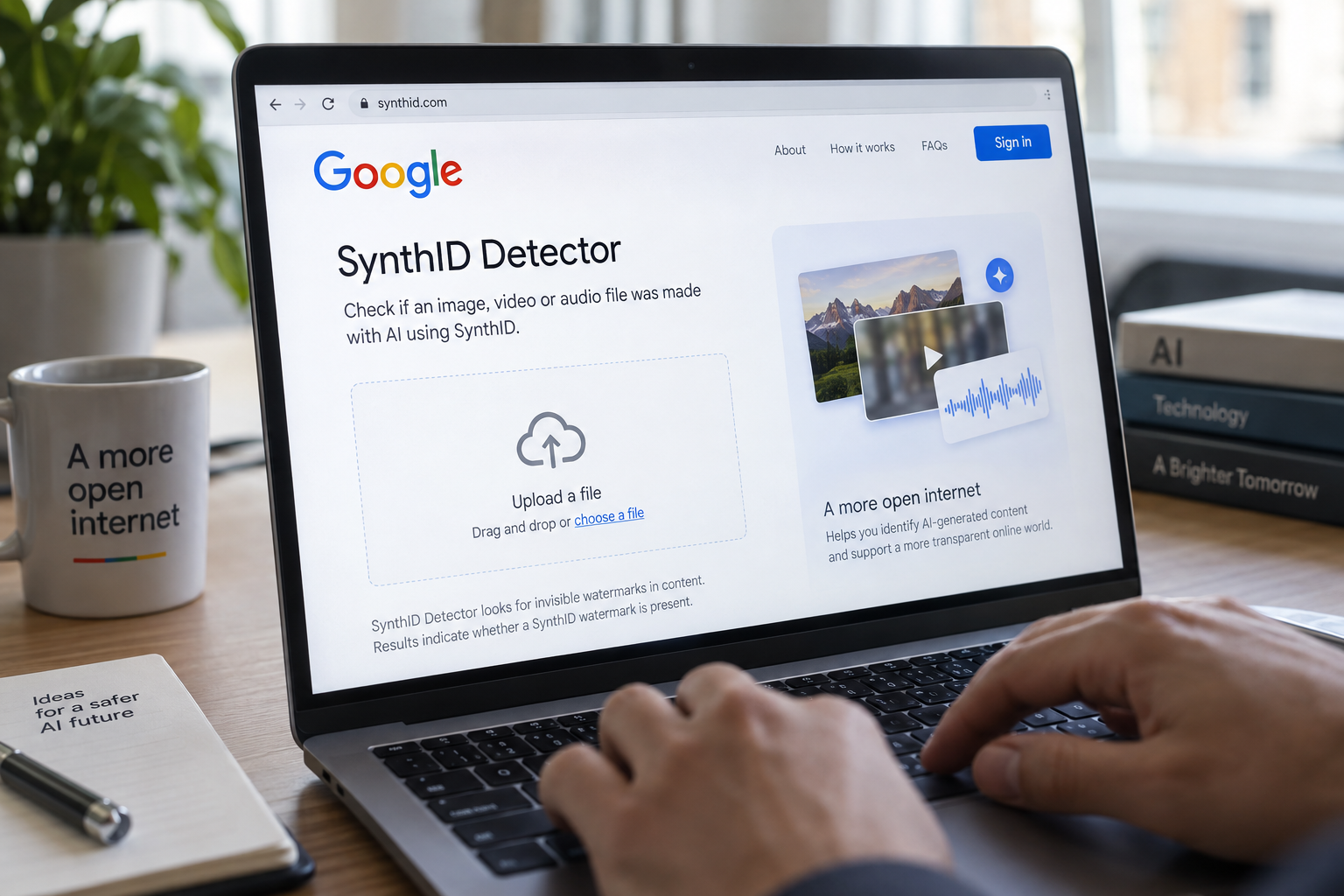
Anyone can now check whether an image, video or audio file was made with artificial intelligence, and Google is the company providing the tool. Its new SynthID Detector, available at SynthID.com, scans uploaded files for an invisible watermark and returns a yes or no answer. The tool is useful, but it has real limits.
Google introduced SynthID in 2023. The system adds an imperceptible label to AI-generated content, but until now regular users had no way to look for that label. In 2025 Google launched a limited version of the detector for certain researchers and journalists. Now it is open to everyone.
Can you check if an image is AI-generated with Google's SynthID Detector?
Using it takes little effort. Upload a file, wait a few seconds and Google returns a result. Users have to be logged in to a Google, OpenAI or Apple account to run a check.
The tool replaces an awkward workaround. Before, people could ask Gemini itself whether a piece of content was AI-generated. That approach has an obvious flaw. For anyone who doesn't trust generative AI, it's hard to take Gemini at its word, and people trying to avoid the technology altogether have no reason to ask it in the first place. The new detector also scans for watermarks from SynthID partners, which was not possible before. That means it can flag media made with models from OpenAI, NVIDIA and Kakao, in addition to Gemini. Apple also participates in SynthID, but support for detecting its creations is still in the works.
How reliable the detector is
How accurate is Google's SynthID Detector?
The detector checks for a watermark rather than looking for patterns that suggest AI use. Google's approach should eliminate false positives, and that simplicity is also what narrows the tool's reach. It cannot detect media made with AI models that don't use SynthID, such as Meta's tools. It reports only whether a label is present. It does not indicate which parts of a file were AI-generated.
Google says SynthID signatures persist even when AI-generated content is edited after it is created. Nothing guarantees that someone won't eventually find a way around the watermark, but the company appears to be guarding against it. A Google spokesperson reportedly told Ars Technica that users are limited to around 10 checks per day, a restriction meant to stop people from using the detector's output to work out how to remove SynthID.
How it compares with other AI detectors
How does SynthID Detector compare with other AI detectors?
SynthID Detector is not the only option, but it is likely one of the most reliable. OpenAI, a SynthID partner, runs its own detector, which can pick out AI-confirming metadata as well as SynthID watermarks. Meta embeds its own watermark, called Content Seal, into its AI creations and offers a web-based detector. A 2026 Reuters report found that the tool sometimes failed to accurately spot Meta's AI content. Anthropic and Microsoft have also begun watermarking AI media, but neither currently offers a consumer tool to detect it.
The core problem is that each tool looks for a specific marker. No reliable detector exists that can spot generative AI across the board. Researchers have built their own AI-spotting tools, but those are not available to the public. The general-purpose AI detectors that are openly available are unreliable, and they tend to flag human-created work as AI content.
Dieser Artikel wurde mit Unterstützung von KI verfasst.
News Factory APP - agentische News für besseres SEO & AEO.