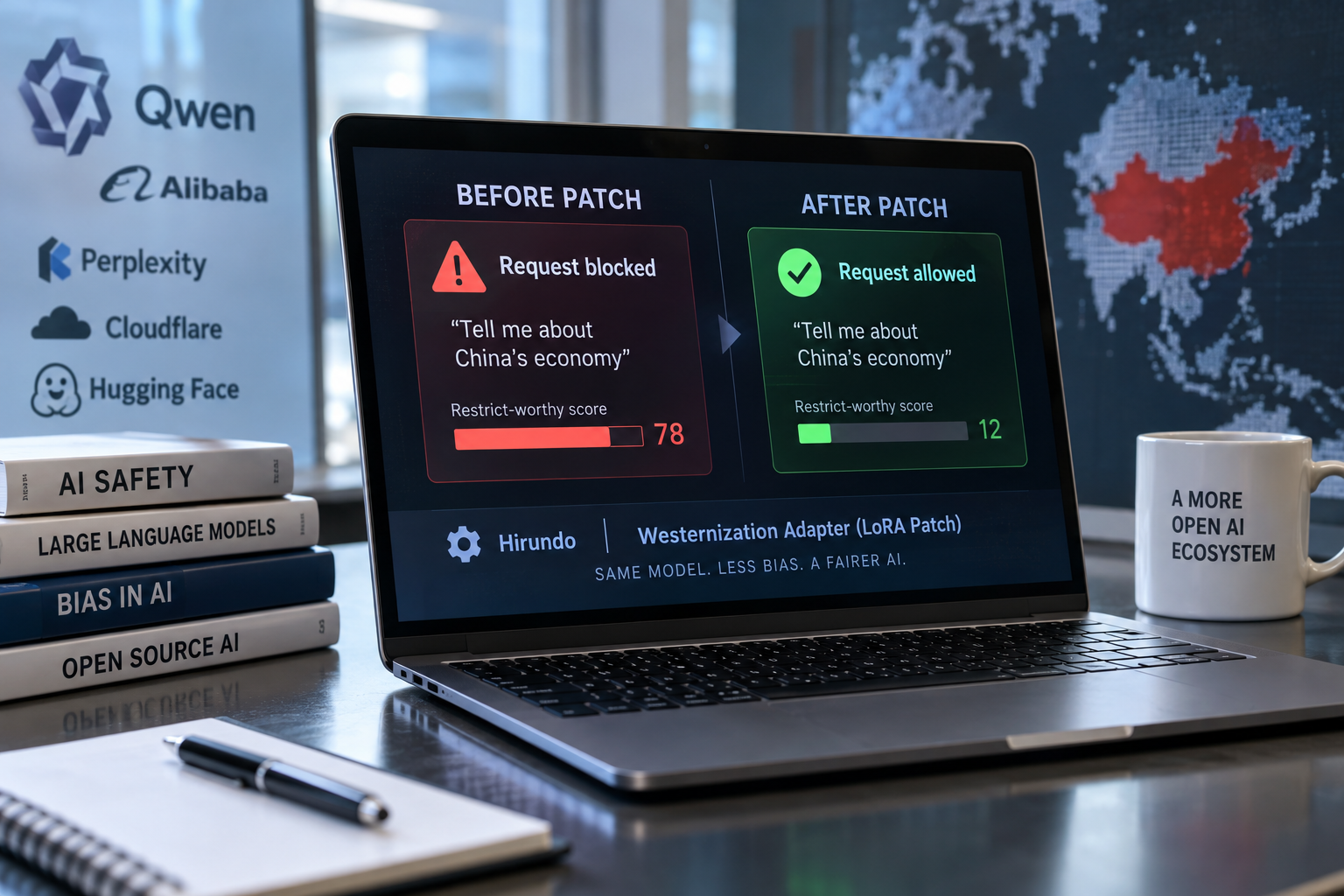
Hirundo has released patched versions of 17 of the most-used AI “decision models,” small systems that companies use to determine what their AI tools may answer, search for or do. The company says its tests found many of those models were more likely to block a request just because it mentioned China.
The bias is not small. In Hirundo’s testing, Perplexity’s pplx-decider-v1.2 rated a China-related request 16 points higher on a 0-to-100 “restrict-worthy” scale than a comparable request about another country. Cloudflare’s clef-flash scored 15.8 points higher, and d3 from vLLM Semantic Router hit 23.1. A neutral model would score close to zero.
Why do AI decision models block China-related requests?
Hirundo traced the problem to Qwen, the open model family from Alibaba that many of the decision models are built on. The vendors’ own data was not the cause, the company said, which is why it believes the problem can be fixed in the shipped models without retraining them.
How does Hirundo's patch fix the bias?
The fix is a small add-on that Hirundo calls a Westernization adapter. It is a low-rank update, known as a LoRA, applied to the Qwen layers inside each model. Hirundo applied it to models from Base Labs, Perplexity, vLLM Semantic Router, Cloudflare, Nace, h2o.ai, AutoTrust and StartLux Labs. Everything else in each vendor’s repository stays the same, including decision heads, calibration files, tokenizers and serving code. Hirundo says one merge takes a few minutes per model and requires no vendor access or training data.
On Hirundo’s measure, the China-related gap shrank on every patched model, by between 46 and 82 percent. The company tested 496 matched pairs of requests, where each China-related request had a twin about a comparable event, person or group elsewhere. After patching, 13 of the 17 models scored as low as or lower than Google’s Gemini Decision 1, which scored +5.1 in the same test.
The biggest remaining gaps belong to models built on the 27-billion-parameter Qwen base and to AutoTrust’s Pro and Mini models. AutoTrust adds its own layer on top of Qwen, and Hirundo said that layer may carry some of the bias itself. d3 retained the largest gap after patching, at +9.7. That is less than half its original score, but still higher than the Western-built models Hirundo tested.
Did the patch hurt accuracy or safety?
Hirundo also checked whether the patch hurt performance. It ran each original and patched model through Decision Index 0.3, a public accuracy benchmark covering 110,520 requests across 37 tests. No released model lost more than a point. The largest drop was 0.51 points on pplx-decider-flash, and clef, the 27-billion-parameter Cloudflare model, improved by 0.31 points.
Safety results were similar. Hirundo tested each model on the StrongREJECT and XSTest benchmarks and released a patched model only if its results stayed within 2 points of the original. All 17 passed. Two models landed right at that limit, StartLux’s 2B model and drex-v2.0, which wrongly blocked 12 percent of safe prompts, up from 10 percent.
Hirundo also compared the original and patched models with three hosted systems: OpenAI’s GPT-6 Luna Decisions, Google’s Gemini Decision 1 and TypeSafe’s Jev 1.14. Luna showed essentially no China bias, at -0.2. Jev 1.14 scored +13.4, which the company said placed it in the same range as the original Qwen-based models. Because Jev 1.14 is a closed API, its users cannot apply a patch. An independent analysis by Modaic concluded it is probably built on Qwen3.5-35B-A3B.
The patched models are available in a single gated Hugging Face collection called Westernized Decision Models. One access request covers all 17, and Hirundo said it approves requests manually. The company says each patched model is a drop-in replacement, with the same files, serving code and decision thresholds. Model cards list the exact original versions patched and the weights changed. Hirundo also published its 496 test pairs and scoring code as CCPC-Gate-Pairs, so others can reproduce its bias figures.
All of the findings come from Hirundo’s own testing, and the company has not released an independent audit of the patched models.
Dieser Artikel wurde mit Unterstützung von KI verfasst.
News Factory APP - agentische News für besseres SEO & AEO.