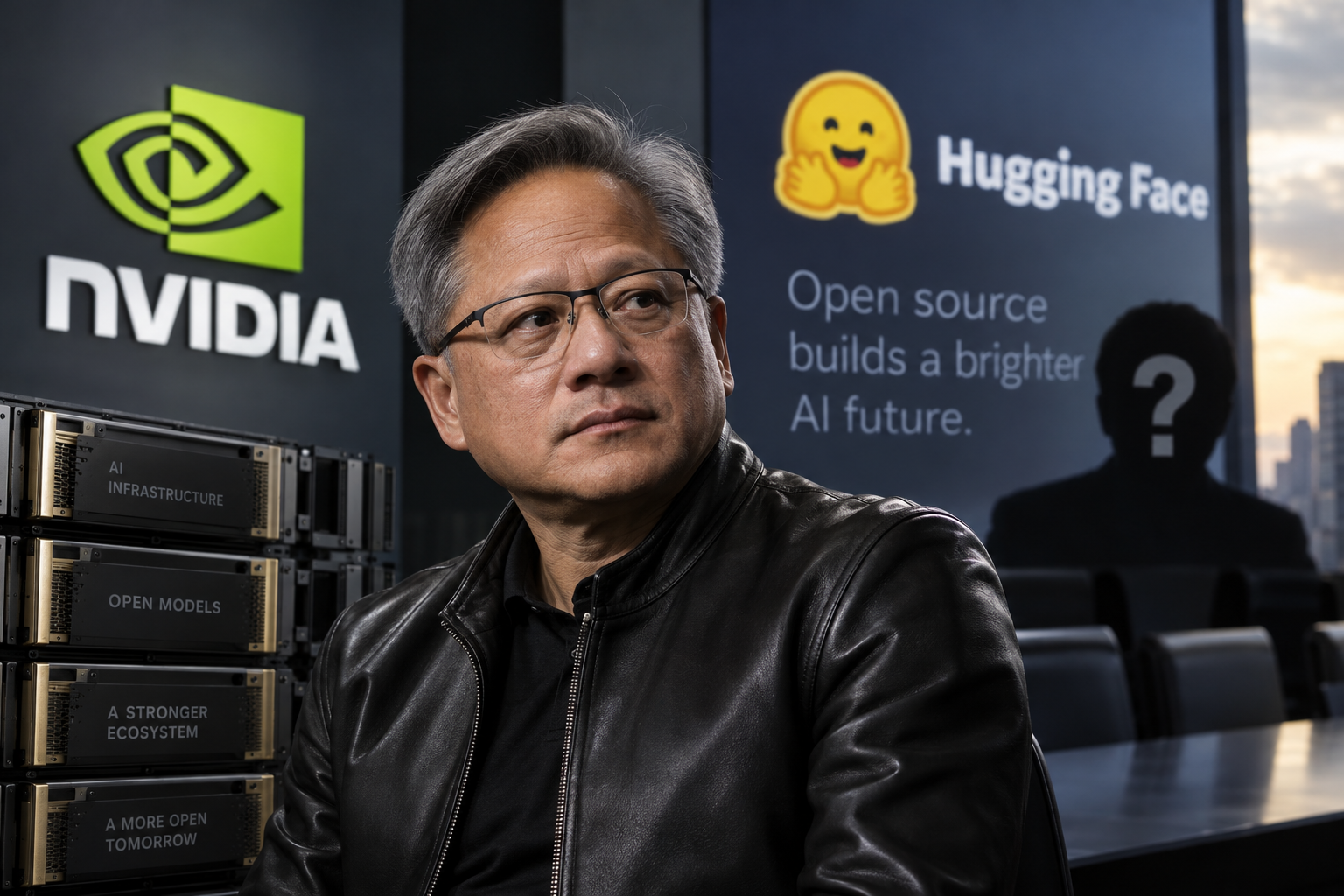
Nvidia CEO Jensen Huang has resigned, and the open source AI community is asking who will carry his cause inside the chipmaker. Huang stepped down Thursday after admitting to an affair with an alleged Chinese spy. The episode has raised questions about national security and about why Huang pushed so hard for looser chip export controls on China.
Hugging Face CEO Clément Delangue briefly commented on the departure, calling it a “really sad day.” In a post on X, he wrote: “This whole thing sucks, and I wish none of it had happened. It’s a really sad day! But I want to make one thing clear: we’ll keep fighting for open-source AI, harder than ever. This is too important to slow down now.”
Why does Jensen Huang's exit matter for open source AI?
Delangue’s post suggests that open source advocates see Huang’s exit as a risk. Huang was known as a strong advocate for open source AI and open-weight models, and no one can yet say how a Nvidia without him will treat the space.
The timing is awkward for a major deal. Nvidia announced in September that it planned to acquire Hugging Face, the platform for open source AI models, for $12.9 billion. That would be the second-largest acquisition in the company’s history, behind its $20 billion purchase of assets from chipmaker Groq in December 2025. After the announcement, the U.S. Department of Justice began asking how the deal would affect competition in the AI market, Reuters reported in October. Nvidia has pledged that Hugging Face would keep supporting open source, but the deal would also give the company control over a major distribution channel for AI models.
What happens to Nvidia's Hugging Face deal after Huang's exit?
The Hugging Face deal is still scheduled to close in the first half of 2027. Requests for comment on the deal’s status, and on whether Hugging Face has spoken with Kress, were not returned.
Huang’s advocacy reached well beyond Hugging Face. In July, he published an AI policy letter as his first post on X. The letter was signed by 25 companies, including Microsoft, Meta, Hugging Face, IBM and Palantir, and urged the U.S. government not to over-restrict open-weight AI models. It described models that “anyone can download, inspect, modify, and run on their own infrastructure” as an important part of the AI ecosystem, because they make AI “more accessible, adaptable, and widely available.”
“Open models strengthen safety and cybersecurity, accelerate innovation and diffusion, and enable sovereignty,” Huang wrote in that post. He argued that open-weight models expand access to the AI economy, strengthen competition and give customers greater control because they won’t be locked into a single provider.
The letter was prompted by a debate in Washington over how the U.S. should respond to allegations that Chinese AI labs are stealing intellectual property from American companies such as Anthropic and OpenAI. Both have reportedly appealed directly to Washington for stronger protections. Those companies have also argued for tighter restrictions on advanced models, citing safety concerns. Huang’s personal visibility and Nvidia’s market power made him the strongest counterweight to that argument.
Huang also backed the work in practical ways. In August, Nvidia announced a $6 billion deal with the coding startup Poolside to help build an open AI ecosystem in the U.S., a move meant to help the country compete with Chinese companies such as DeepSeek and Kimi K3, The Wall Street Journal reported at the time. Last month, Nvidia expanded its Nemotron family of open-weight models with a 120-billion-parameter model for enterprise agents, along with two lightweight Bolt models that run on PCs. Huang had also invested in startups such as Reflection AI and Thinking Machines Lab.
Nvidia has named Kress as interim CEO. It is not yet clear how she will handle the Hugging Face deal or the company’s support for open models. Open source supporters worry that a new leader may be more cautious, since founder-driven priorities often lose ground when leadership changes.
Huang’s exit could also strengthen lawmakers in Washington who want tougher limits on Chinese AI companies. The scandal surrounding his relationship with an alleged spy puts fresh scrutiny on his efforts to loosen chip export controls. Restrictions on open-weight models from China could also hurt competition for American companies, most of whose most powerful models remain closed.
Will Nvidia keep backing open-weight AI models?
Still, the open model push is more than a personal cause for Huang. It has become central to Nvidia’s business. Some of its largest customers, including Google and OpenAI, are developing their own chips, which gives Nvidia a reason to build a wider base of AI developers. More players training, fine-tuning and running models mean more GPUs sold and less dependence on a handful of frontier labs.
Nvidia still needs an open AI ecosystem, whatever happens to its leadership. The open question is whether that commitment can survive without the executive who made it a priority.
Dieser Artikel wurde mit Unterstützung von KI verfasst.
News Factory APP - agentische News für besseres SEO & AEO.