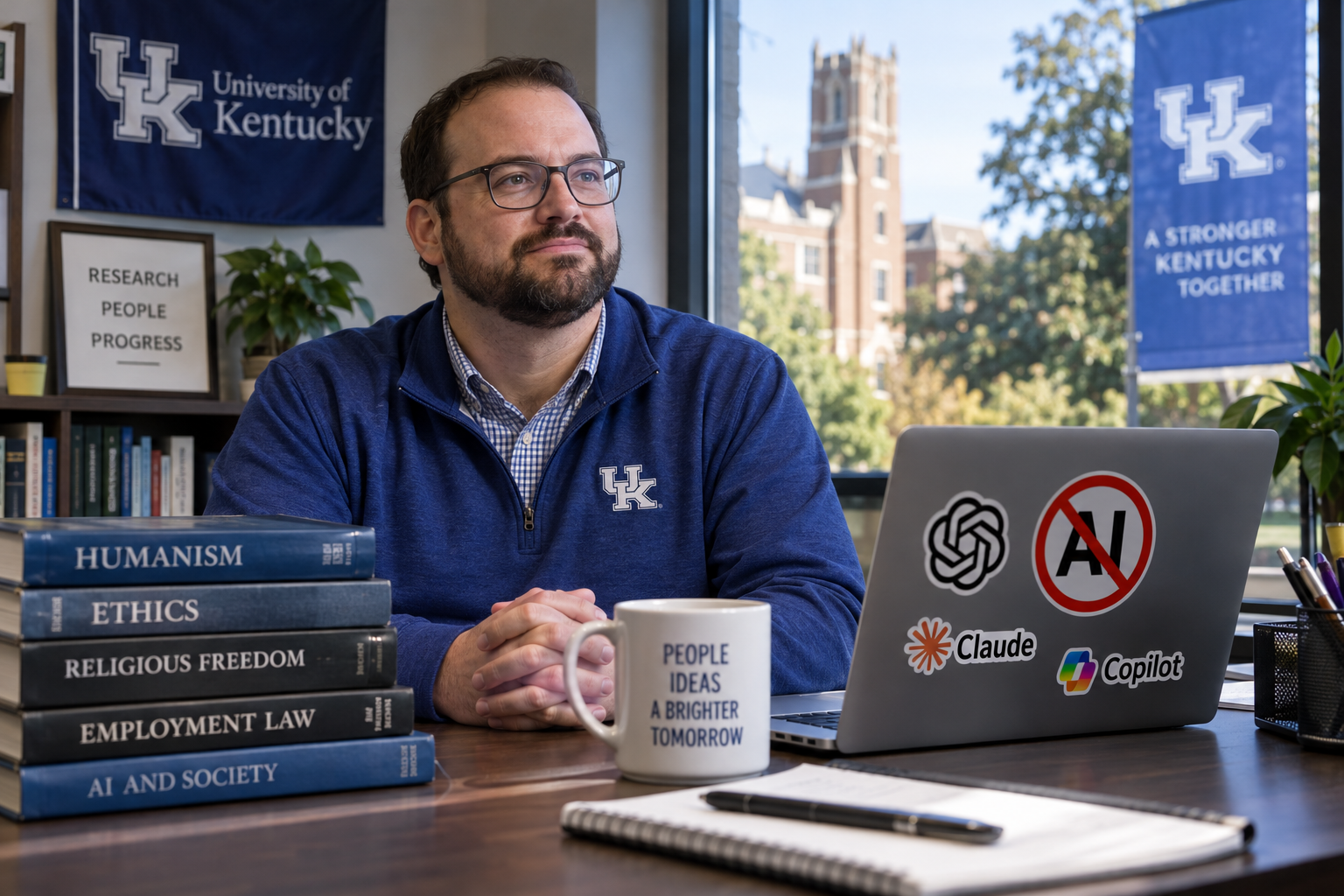
A University of Kentucky research administrator, David Durman, won a religious accommodation excusing him from personal use of artificial intelligence at work. The American Humanist Association believes it is the first such exemption granted to a humanist. The university agreed in September under Title VII.
A University of Kentucky employee has won a religious accommodation that excuses him from using artificial intelligence at work, and officials at the American Humanist Association believe it is the first such exemption granted to a humanist.
David Durman, 45, works as a research administrator at the university, where he helps researchers with grant applications. When the school began asking employees to bring AI into their daily workflow, Durman said he felt he was being asked to hand off his thinking to tools such as Microsoft Teams Copilot, Claude and ChatGPT. He said that felt like a violation of his beliefs.
“The process and work involved in thinking through situations, through my work, through my ethics, through the way I handle other people, is a key component in being able to develop myself as a moral person,” Durman told Religion News Service in a video interview. “And offloading that labor, regardless of whether it’s taxing or not, is undercutting my ability to be a moral actor.”
What religious accommodation did the Kentucky employee receive?
With help from the American Humanist Association, Durman requested an accommodation under Title VII, the federal law that allows employees to ask for changes to their work requirements so they can comply with religious beliefs. The university agreed in September.
The request was inspired in part by Erin Maus, a Unitarian Universalist software engineer who received an exemption from her employer over her religious concerns about AI. After hearing about Maus’ case, Durman contacted the association.
Can humanism qualify for a religious exemption under Title VII?
Alexandria Huiskens, a staff attorney at the association, helped him write the letter. She said the group often gets requests for help with accommodations, but Durman’s was especially compelling. Federal courts have ruled that humanism qualifies as a religion, she said, so humanists have the same rights as other faith groups under federal law.
“For us, humanism is a comprehensive way of life,” Huiskens said. “It’s built on inherent worth and dignity, and everyone should have room to exercise this comprehensive way of life at work the same way Christians do or Muslims do.”
In his letter to the university’s Office of Equal Opportunity, Durman wrote that automated processing conflicts with his obligations. “Substituting automated machine processing for human presence, authentic listening, and personal responsibility in my work directly conflicts with my obligation to uphold human dignity and flourishing as primary,” he wrote. The letter also cited the 2003 version of the Humanist Manifesto, which calls for treating each person as having inherent worth and dignity.
Douglas Laycock, an emeritus law professor at the University of Virginia and the University of Texas, said accommodation requests under Title VII depend on whether a belief is sincere. Sometimes, he said, it is hard to tell whether a religious or political belief is at stake, as in some vaccine accommodation cases. “It has to be a deeply held ethical commitment that’s analogous to a religious commitment,” Laycock said. “That’s a fact question that presumably the employer will investigate.”
Some religious accommodation requests end up in court. A 2013 case involved a Muslim employee who wanted to wear a head covering at work, and in 2023 the Supreme Court ruled in favor of a Christian postal worker who objected to working on Sundays. Durman’s process was far simpler. He sent the letter, then he and Huiskens met with university officials.
“It was a very collegial meeting, and they found that there was no undue burden to David’s department,” Huiskens said. “They granted the accommodation promptly.”
Does the exemption let him avoid AI completely?
A letter dated Sept. 25 from a manager in the Office of Equal Opportunity confirmed the decision. Durman may still be asked to attend meetings or work with colleagues who use AI, and he may still have to submit materials through AI-enabled systems. “David is excused from personal use of AI to complete his tasks,” an office senior manager wrote.
The decision comes amid broader doubts about the technology. Pope Leo XIV warned in his encyclical “Magnifica Humanitas” earlier this year that AI could weaken democracy and human dignity. A Washington Post-ABC News-IPOS poll released this week found that 57% of Americans say AI is bad for society, and two-thirds oppose building the data centers needed to run it.
Durman said he is also concerned about AI’s effects on society. “At a societal level, I think that the use of AI technology runs counter to that,” he said. He added that many Americans are weighing the implications of AI use, and he considers that a good thing. He hopes his case, and those of others who seek accommodations, will encourage more people to do the same.
Dieser Artikel wurde mit Unterstützung von KI verfasst.
News Factory APP - agentische News für besseres SEO & AEO.