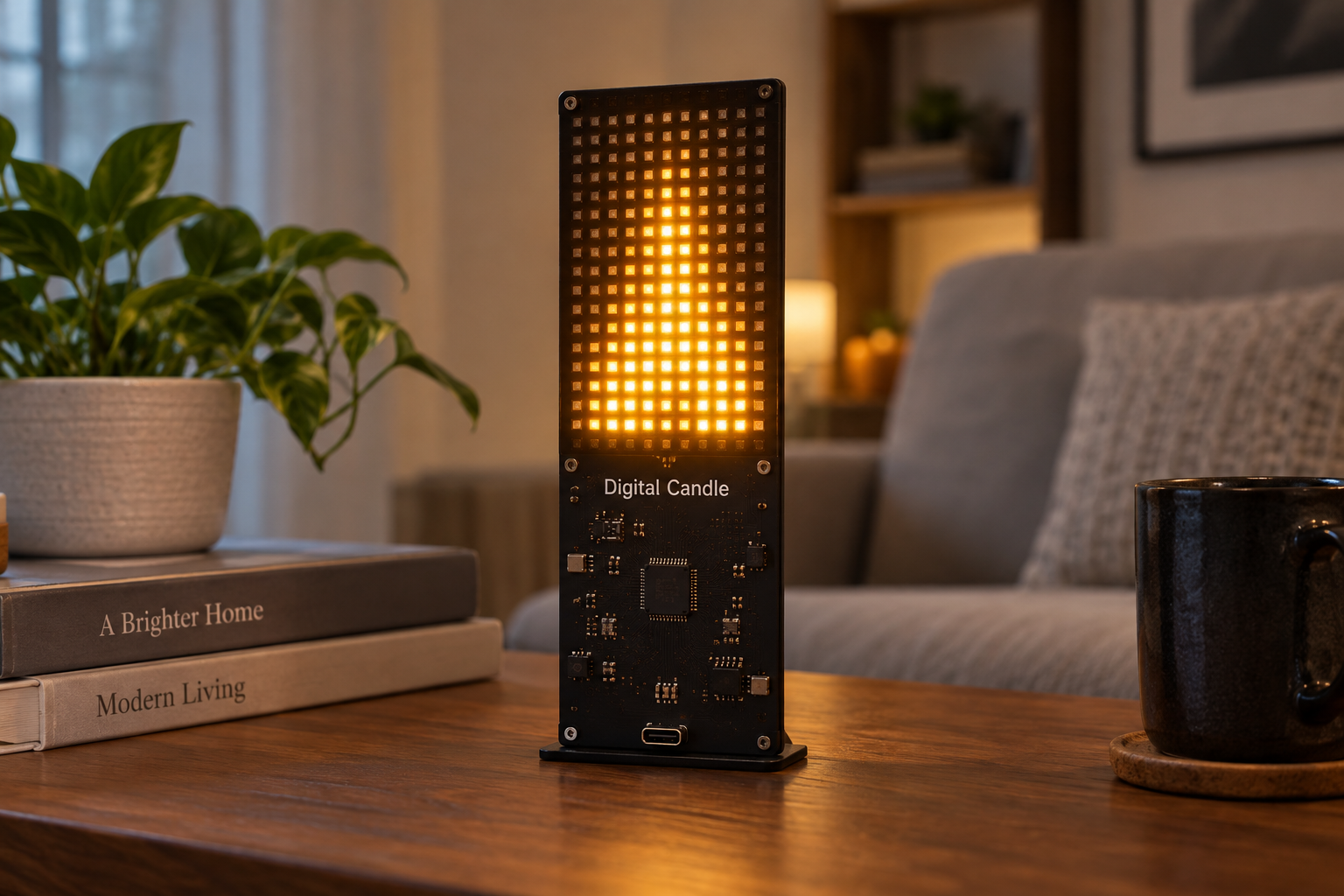
Kevin Bates, the engineer known for devices including the Arduboy, has a new product that is far removed from handheld game consoles. The Digital Candle uses a custom AI model to simulate the flicker of a real flame across a grid of LEDs. It costs $149.
The device stands 10 inches tall and comes with a black or white circuit board. At the top, 144 amber-colored LEDs sit in a 9-by-16 grid with adjustable brightness. At the bottom, a USB-C port supplies power. A rechargeable battery is not included.
How does the Digital Candle simulate a flame?
Inside is an Espressif ESP32-S3 chip that runs a tiny neural network. The network was trained on footage of a real flickering candle, and it generates the flame on the fly. That approach matters. The flame is not a pre-programmed animation set to loop, so each candle produces its own unique pattern that never repeats.
The results look convincing, the review notes, though only as convincing as a low-resolution LED grid allows. The Digital Candle does not quite provide the same ambiance as the real thing. It is, however, much safer than an open flame.
How much does the Digital Candle cost?
The price is harder to justify for a light fixture than it would be for a gadget. A credit card-sized handheld that plays hundreds of games costs $79, and the review describes that as an easier sell than the $149 candle.
Can you customize the Digital Candle?
The Digital Candle is also open source. Owners can repurpose it as a clock or a notification screen, or run other simulations such as Conway's Game of Life. That flexibility could make the price easier to accept for buyers who like to tinker.
Dieser Artikel wurde mit Unterstützung von KI verfasst.
News Factory APP - agentische News für besseres SEO & AEO.