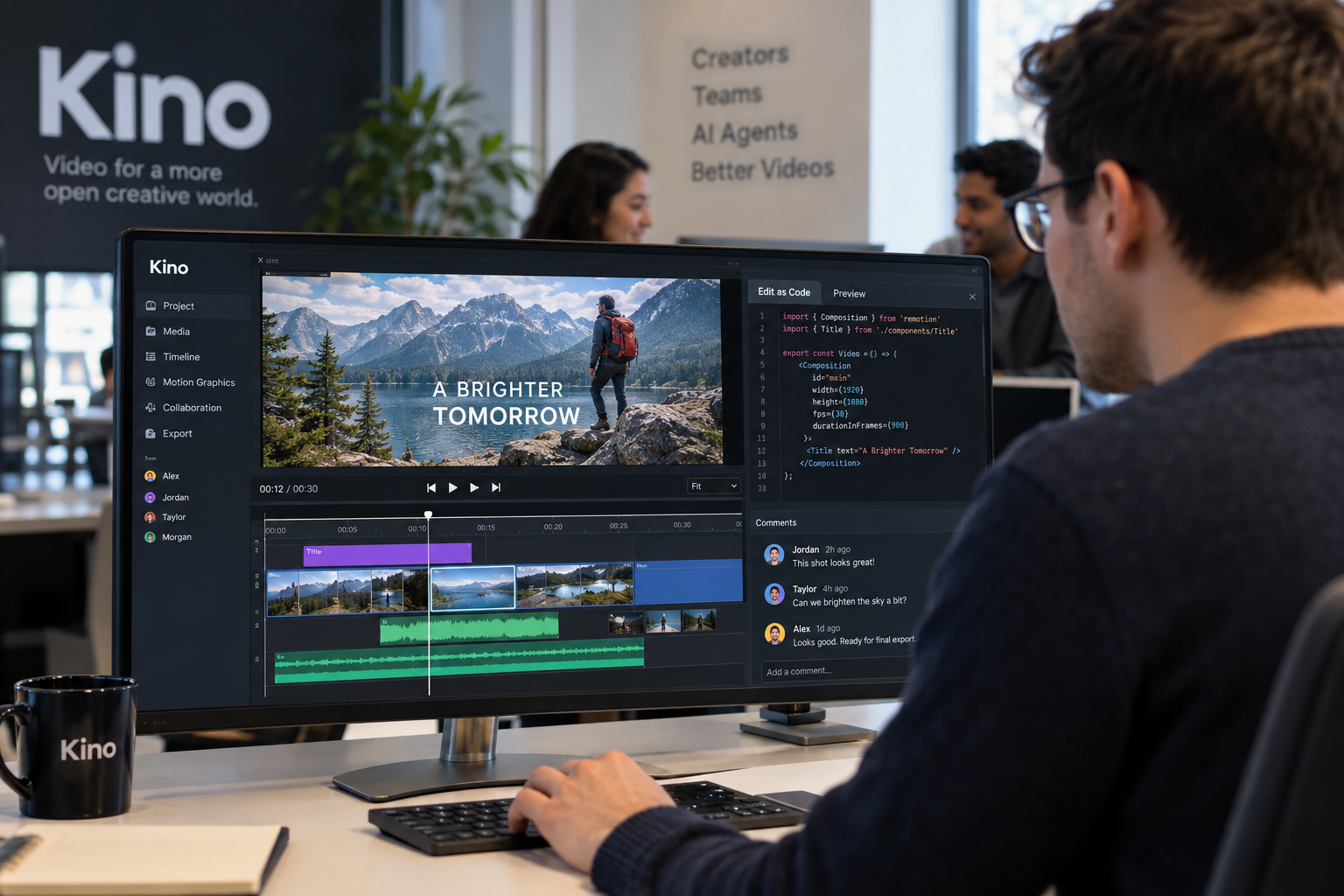
Kino, a video company from Y Combinator's S23 batch, has launched an editor that treats every part of a video project as code, and it is built for teams that work alongside AI agents. Founder Luke announced the product in a Launch HN post on Hacker News, describing a tool that combines footage storage, a timeline editor and review links in one place.
What is Kino's code-first video editor?
The company's central idea is that editing, motion graphics, timeline changes, teammate comments and 3D scenes are all expressed as code. Kino is built on Remotion, an open framework for creating videos with React. Luke wrote that building the editor was harder than expected, because the team ended up creating a what-you-see-is-what-you-get editor for React and then turned that into a video editor.
The pitch is aimed at a gap Luke says he has seen with agents. Current models can edit video and produce motion graphics, he wrote, but a raw agent setup forces users to describe small edits in words or through one-off interfaces. Agents also cannot easily reference footage stored across devices, and feedback from teammates often arrives as screenshots in Slack.
Kino tries to solve those problems with real-time collaboration. Users can see teammates' cursors and the part of the timeline each person is watching. Luke said the launch video was built this way, with five or more agents editing the timeline at the same time while a friend's group of agents worked on other sections. One agent handled rotoscoping for visual effects, and a language model color graded all media through Kino's LUT support.
Does Kino support ProRes and other professional video formats?
Working with video files is a major part of the product. Kino transcribes, embeds, describes and runs face detection on footage after it is imported. Users can scrub their footage locally, while the company uploads a low-resolution proxy so teammates and cloud-based AI tools can view it. Luke said the team built custom decoders for professional formats including ProRes, BRAW and R3D, which allows users to drag a 250GB ProRes clip from a new iPhone directly into a timeline. He credited browser-based WebCodecs and libraries such as Mediabunny with making that level of performance possible.
Luke's background is in video. He wrote that he grew up making YouTube videos and, as an undergraduate at MIT, co-directed a 3.5-hour archival documentary about the history of his school and technological development in America. He said much of that work involved logging footage, managing hard drives, manually syncing Premiere project files and planning the film in a spreadsheet.
The company has changed direction since its first launch in 2023. Luke acknowledged that the original pitch, which called Kino “Silicon Valley meets Hollywood,” was closer to “Palantir for Hollywood.” The company ran bespoke on-premises deployments with a team of forward-deployed engineers on productions including the reality show Survivor and A24's Beef. Luke said those projects were constrained by studio security rules and by the Avid Media Composer, which made it hard to use frontier AI models or to make editors dramatically faster.
In 2025, Kino rebuilt the product as a standalone editor and committed to what Luke calls coding-as-editing. Every item in Kino, including projects, clips, footage, comments, replies and even a single frame, has its own URL. Luke said that gives agents and teams a single, editable source of truth. He described pasting Kino links into his coding agent to point it to a specific timeline item among thousands, or to a teammate's comment that needs a fix.
Luke said some companies already use Kino to manage all of their media and to start agents that produce new videos each day, with review links used to flag problems. He described one founder who uses Kino's YouTube support to find b-roll he has permission to use, edits a draft, and then has his co-founder leave notes that an agent applies. He also said full-time filmmakers are using the tool with as many as 15 agents working on a single project.
How much does Kino cost?
Kino's pricing has two tiers. The full editor is free and includes unlimited imports and exports, real-time collaboration and access to Model Context Protocol, or MCP, for a user's own agent. The Pro plan costs $25 per editor per month and adds unlimited MCP tool calls, share links, additional storage, YouTube search and the ability to edit alongside teammates.
The app is available now for download at kino.ai. The company has not released a version for a standard web browser and currently ships only an Electron-based desktop app. Luke said the team wants feedback from people who make videos for themselves, people working with ProRes media, users bringing in projects from legacy editors and companies producing content at scale.
Dieser Artikel wurde mit Unterstützung von KI verfasst.
News Factory APP - agentische News für besseres SEO & AEO.