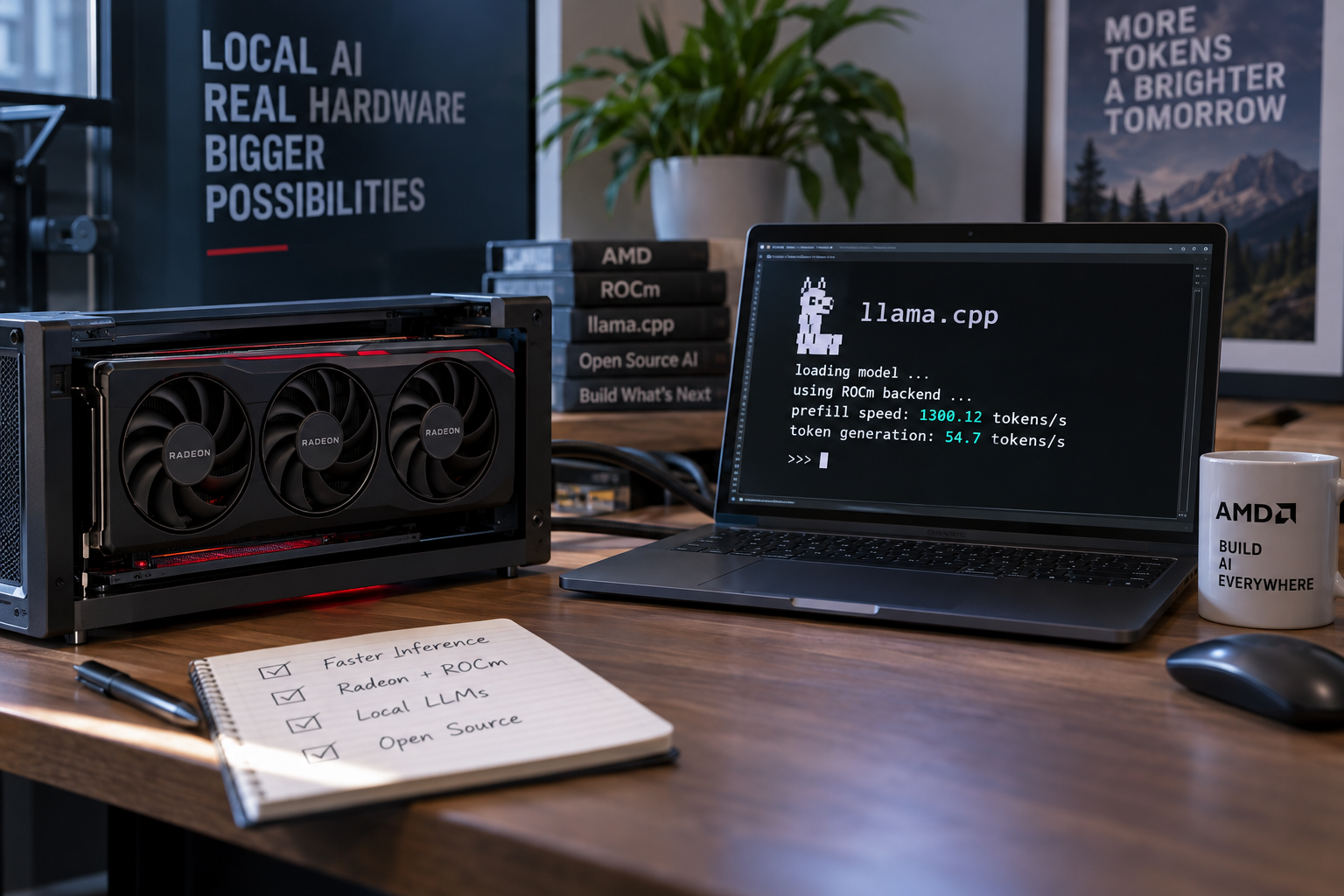
A developer says a lean set of AMD-specific patches for llama.cpp nearly doubled the speed at which a local AI model generates text on an AMD graphics card. The project, called llama-cpp-rdna-boosts, is the centerpiece of a blog post that also takes aim at a crop of newer inference engines the author considers less disciplined.
How much faster is the AMD patch set for llama.cpp?
Testing on an AMD R9700 connected to a laptop through an external GPU interface, the author reported that prefill speed rose from about 700 tokens per second to about 1,300. Token generation climbed from about 35 tokens per second to about 55. The test ran the Swift-1.5-Qwen3.8-27B model in a Q6_K_L GGUF build with MTP enabled. The author cautioned that results will vary and recommended the project to anyone running an AMD card.
The project is not a traditional fork. It is a repository holding a minimal set of changes that get applied against a pinned commit of llama.cpp. When newer versions of llama.cpp arrive, the same changeset is re-applied. The author said the AMD-specific improvements are what drive the LLM optimization gains in both prefill and token generation.
How do you run rdna-boosts on an AMD GPU?
Getting it running requires either building the image from scratch, which means installing ROCm libraries, or pulling a pre-built image. The author chose the pre-built route and pulled an image tagged server-rocm-10.1 from the GitHub Container Registry. The image runs under Podman with access to the AMD compute and graphics devices, passed in as /dev/kfd and /dev/dri, and with the video group added. The author's own launch script includes additional flags, but the post highlights only the essential ones. Upgrading, the author suspects, means pulling a newer image, though the author had not yet tried that step.
The post's broader complaint concerns the state of the inference field. As of November, according to the author, a flood of bespoke inference engines has appeared, many modeled on llama.cpp, SGLang and vLLM. Projects named in the post include Strata, Basalt and RustingStrata. Their developers argue that general-purpose engines are built for broad compatibility rather than any particular hardware, and that those engines have slowed down. Many of the newer projects share three traits, the author wrote: they target a narrow set of models or hardware, they are built largely by a frontier AI model, and they chase ever-higher token generation speeds.
The author sees trouble in that last goal. Rather than hardware-specific engineering, the speed gains in some of these projects come from changing how the model itself behaves. Strata, the author wrote, prefers to select experts already loaded into VRAM, even when other experts stored in system RAM or on disk would normally be chosen. The author called that one example among many.
Why does the author prefer llama.cpp over newer inference engines?
By contrast, the author praised the llama.cpp project for vetting contributions carefully and applying them judiciously, and described rdna-boosts as a small set of patches on top of that stable base, with fewer moving parts to maintain. The changes are outlined in the project documentation, though the author found them somewhat opaque. The author joked that the code is 'all straight Claudish,' a reference to the Claude AI model.
The author also tried vllm-radiance, an AMD-focused fork of vLLM. The build steps proved too onerous, and vLLM struck the author as overbuilt for a single machine and a single developer. The author returned to vanilla llama.cpp. The post closes with the author saying they look forward to what the rdna-boosts community builds next.
Dieser Artikel wurde mit Unterstützung von KI verfasst.
News Factory APP - agentische News für besseres SEO & AEO.