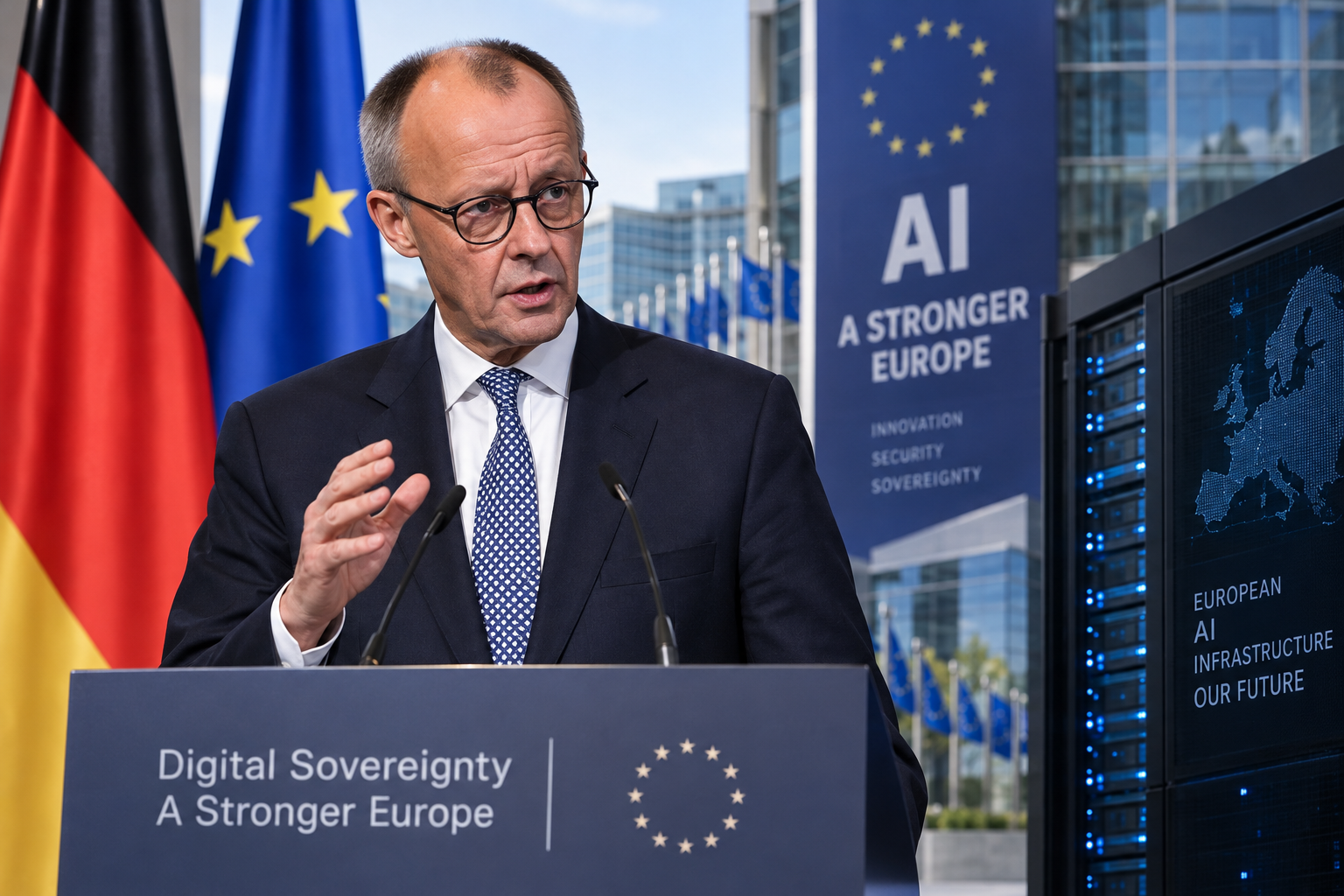
German Chancellor Friedrich Merz said Monday that Germany and Europe must move faster to build their own artificial intelligence technology to avoid becoming dependent on outside providers. He called digital sovereignty 'a truly existential question' and set a goal of controlling the technology across the supply chain, from hardware to software.
Germany and Europe must move faster to build their own artificial intelligence technology or risk becoming dependent on outside providers, German Chancellor Friedrich Merz said Monday, according to Reuters.
Why does Merz say Germany needs its own AI technology?
Speaking at an AI conference in Berlin, Merz called digital sovereignty “a truly existential question.” Germany must, he said, “at all costs, avoid becoming entirely dependent on third parties.”
As AI spreads through the economy, countries that do not control the technology will increasingly rely on those that do, he argued. Germany’s goal, he said, should be to develop and operate its own technology across the entire supply chain, from hardware to software. He acknowledged that getting there would require “an enormous technological and organizational effort.”
What is Germany doing to catch up on AI?
The issue has become central to the government’s agenda. Since taking office last year, Merz has pledged to speed up the digital transformation of the German economy, and his government has set up a dedicated ministry for digital affairs. It has also promised to catch up with European countries that have moved faster on digitalization, including the Netherlands and Denmark.
Germany adopted its first national AI strategy in 2018. But it has yet to turn that early start into a clear advantage.
How ready is Germany for the AI boom?
The Ifo economics institute found that Germany is still not ready to benefit fully from the AI boom, Reuters reported. Its assessment pointed to a relatively small high-tech sector, weak digital public services, skills shortages and the country’s continued reliance on paper-based processes.
Merz is also looking for partners beyond Germany. Following a five-day trip to Singapore, Japan and South Korea, he said the country wanted to work with like-minded governments, naming Canada and France. He and French President Emmanuel Macron hosted a summit on European digital sovereignty in Berlin a year ago.
Money is starting to follow the rhetoric. At a summit last month, companies including Amazon and Nvidia joined pledges worth more than €225 billion, according to the economy ministry. Germany also aims to quadruple its AI computing power by 2030.
The speech comes amid a broader European debate over who controls the technology underpinning the economy. Brussels is rewriting its tech rulebook in an effort to compete with the United States.
Dieser Artikel wurde mit Unterstützung von KI verfasst.
News Factory APP - agentische News für besseres SEO & AEO.