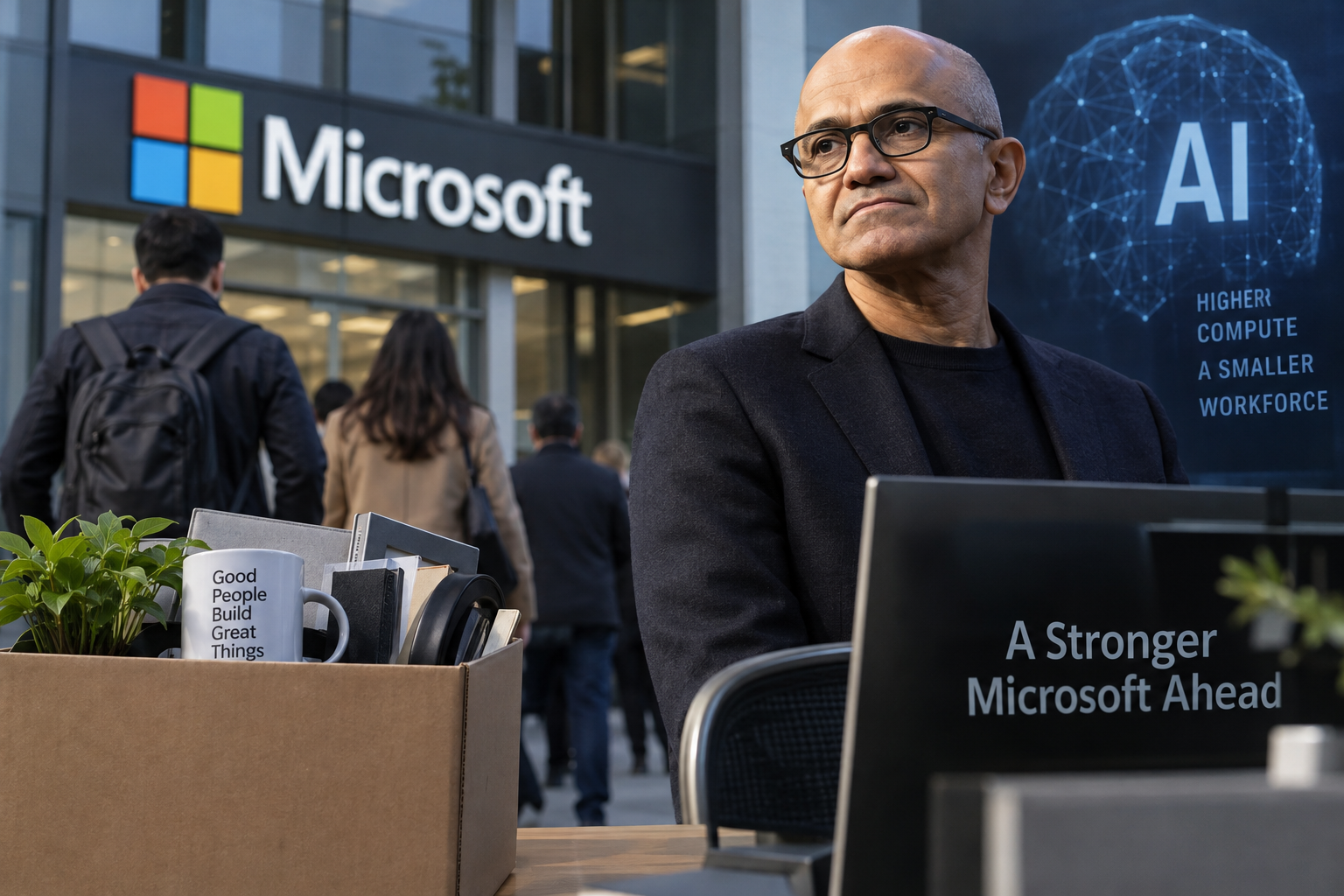
Microsoft is offering voluntary buyouts to about 60,000 employees in the United States, United Kingdom, Canada and India. It is the first time the company has made such an offer to so many workers at once, and it dwarfs the retirement program that was limited to about 9,000 employees earlier this year.
Why is Microsoft offering buyouts to 60,000 workers?
The company says the goal is to keep spending on AI infrastructure without cutting that investment, which it plans to offset by lowering operating costs and headcount. Satya Nadella signaled the direction nearly two years ago on a podcast, when he was asked about AI’s effect on staffing. “Our total people costs will go down, our cost per head will go up, and my GPU per researcher will go up,” he said. In plainer terms, Microsoft expects to employ fewer people, pay the ones who stay more, and give them more computing power and AI tools.
How many jobs has Microsoft cut recently?
The buyout offer is the latest in a run of cuts. Microsoft has conducted layoffs for most of the past decade, but the pace has picked up sharply in the past two years. Those cuts are no longer the annual exercise they once were. They now arrive every few months. Earlier this year, Microsoft laid off 4,800 employees, with the heaviest impact on its Xbox and commercial sales teams. Last July it cut about 4 percent of its workforce.
The numbers reflect the change. Microsoft now employs about 223,000 people as of June 30, down from 228,000 a year earlier. It is the first year-over-year decline in headcount for the company in a decade.
How does the new buyout compare with the earlier retirement offer?
Employees who took the retirement offer earlier this year did so in large numbers, with more than 30 percent of the 9,000 eligible workers accepting. Sources familiar with the new program say the take-up rate for the latest offer is likely to be much lower. That is largely because the terms look a lot like the company’s regular severance. Workers would get cash based on time at the company, accelerated stock vesting, some subsidized health coverage and several months of career services.
Scale is what makes this offer stand out. Even if only 5 percent of those eligible accept, that would still mean about 3,000 departures. Eligible employees have until December to decide, so the real impact will not be clear for some time. Rumors of further layoffs in November and January have circulated, and the number of people who accept the buyout will likely shape the size of any next round of cuts.
Some inside and outside the company argue that Microsoft needs to shrink. Merill Fernando, a former Microsoft Entra product manager, said the company has too many layers and too many small teams. “Microsoft needs fewer people,” Fernando said. “I’ve been on the inside. I’ve seen how things get built. Lots of small orgs. Layers on layers. Silos everywhere.”
Fernando described an organization where each unit “had its own priorities and its own decision makers,” making it hard to get the company to move in one direction. That description echoes an internal meme that shows teams pointing guns at one another. Nadella addressed the meme last year on a podcast with Stripe co-founder John Collison. He acknowledged that the image had shaped Microsoft’s cultural narrative “more so than reality,” but said it had flagged real tensions inside the company. “In some sense, some of these divisional tensions are real issues that need to have tension,” Nadella said. “Social cohesion is not a goal, winning in the marketplace is a goal.”
That leaves Nadella with a difficult balancing act. He built his leadership around a culture centered on empathy, and now he is asking employees to face an AI future that could make many of their jobs unnecessary. How he handles that transition will shape his legacy as much as the growth Microsoft has posted over the past decade.
Dieser Artikel wurde mit Unterstützung von KI verfasst.
News Factory APP - agentische News für besseres SEO & AEO.