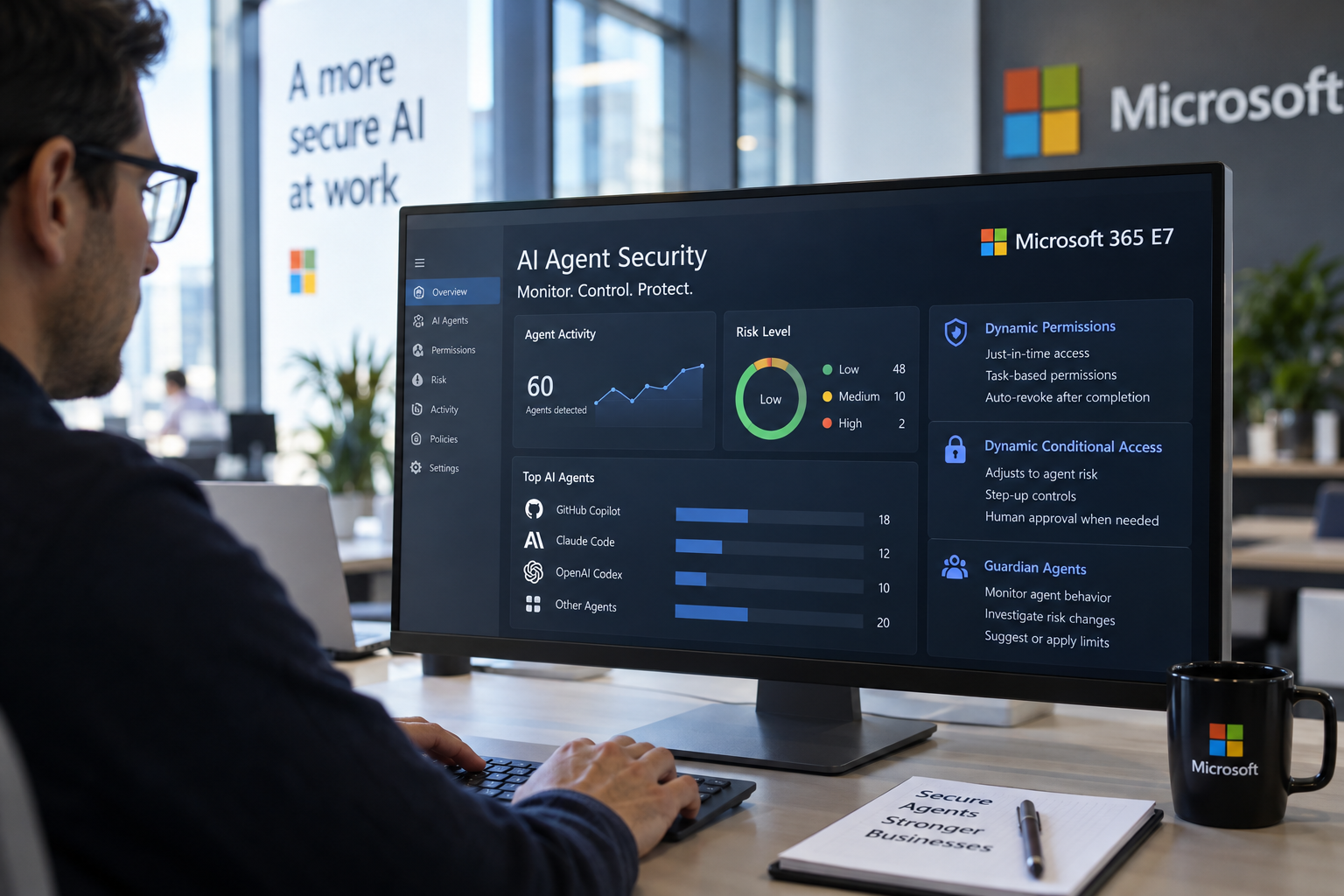
Microsoft has unveiled new tools to control AI agents inside Microsoft 365 E7 and its Project Perception platform. The company says the tools limit what each agent can reach, and they tighten those limits as the agent's risk goes up.
Hayete Gallot, executive vice president of Microsoft Security, laid out the approach in a post on Monday. She wrote that companies should treat AI agents as insiders. Agents can reach data, tools, and systems, she said, and they are often given too much access. They can also behave in unexpected ways.
Gallot said every agent should be watched by Guardian Agents, which check its actions before they happen. She also called for security tools that reveal a model's reasoning, not just its inputs and outputs.
Nadim Abdo, corporate vice president for identity and network access, describes the specific features in a separate post. Both posts build on an essay that Satya Nadella, Microsoft's chief executive, published earlier this month. In that essay, Nadella said companies should treat models as insider risks.
How do Dynamic Permissions limit AI agent access?
The centerpiece is a feature called Dynamic Permissions. Under it, an agent starts with no access of its own. It receives only what it needs for a single task, and it keeps that access only for as long as the task lasts, the company said. An agent can never obtain access it does not already have.
Microsoft is also adding Dynamic Agent Risk, which rates each agent on a continuous basis. The rating draws on signals from identity, data, devices, cloud, network, and the agent's own actions.
What happens when an AI agent's risk rises?
A second feature, Dynamic Conditional Access, extends Entra controls to agents. When risk rises, the response happens in steps. An agent can lose the right to change files while keeping read access. It can lose access to certain data, or it can need a human to approve a step. In the most serious cases, it can be stopped.
Which AI agents can Microsoft 365 detect on staff devices?
Microsoft can now also detect 35 more types of agents running on staff devices, bringing the total to 60. The list includes Anthropic's Claude Code, OpenAI's Codex, and GitHub Copilot. Entra Agent ID, which gives each agent its own identity separate from the user, will cover these agents and other unknown ones as well.
On the Project Perception side, Microsoft is adding Playbooks and a team of Guardian Agents. These tools investigate why an agent's risk changed, and they can suggest or apply limits.
Terrell Cox, Microsoft's deputy chief information security officer, framed the need in the post. “At Microsoft, we are already operating in a world of hundreds of thousands of agents,” he said.
Agents can also run inside sandboxes, such as Microsoft Execution Container. The company said this keeps the security controls that monitor an agent out of that agent's reach, even if the agent is hacked.
Microsoft did not say when the new features will be available. It also did not say whether they will cost extra beyond a Microsoft 365 E7 license.
Dieser Artikel wurde mit Unterstützung von KI verfasst.
News Factory APP - agentische News für besseres SEO & AEO.