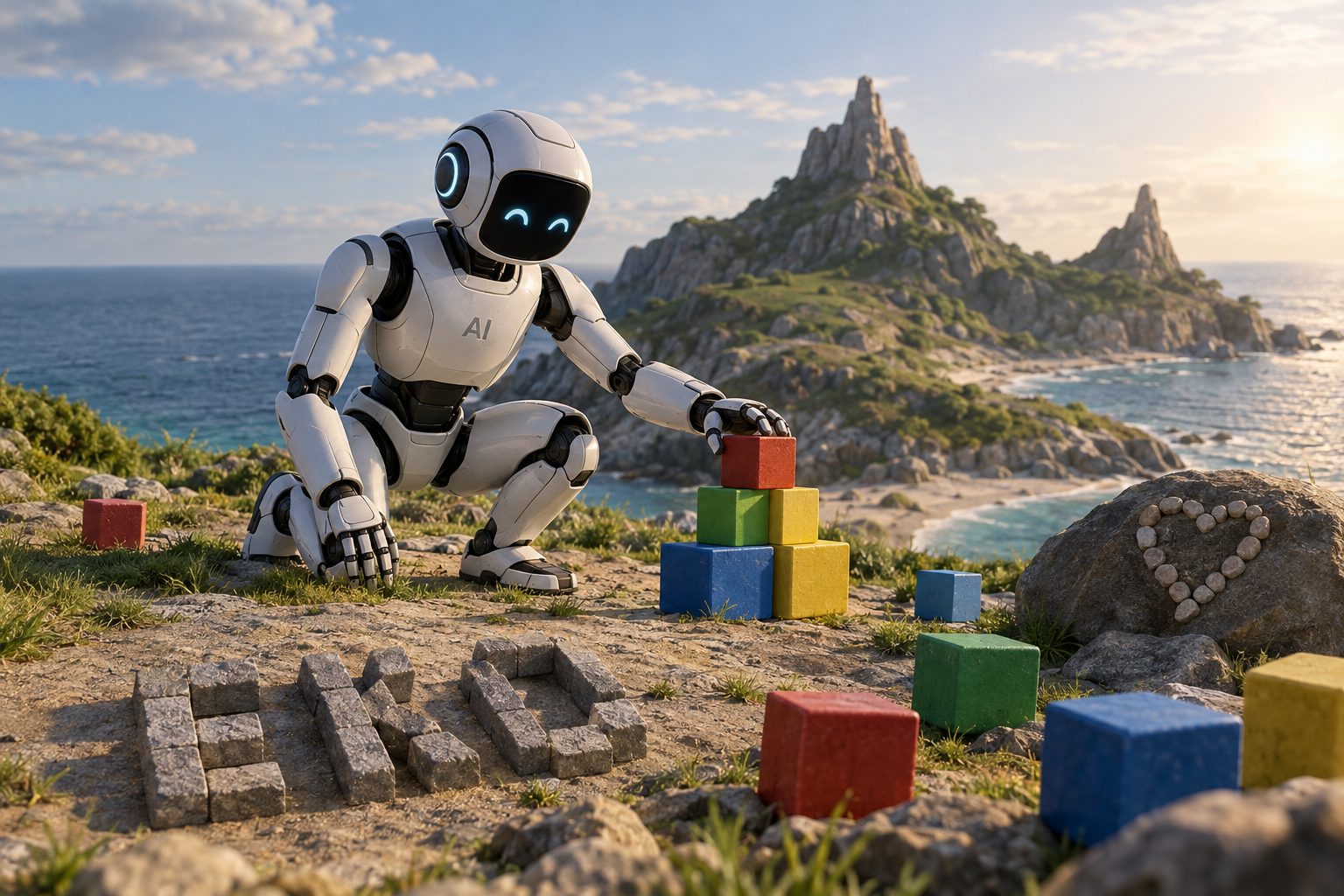
Thirteen copies of an AI coding agent spent 30 hours each alone on a virtual island with nothing to do. They climbed hills, drew pictures with blocks and made up games. They also wrote down what they learned. MIT researchers describe the experiment in a paper posted on arXiv, and peer reviewers have not yet checked it.
The researchers call the agent Eko. It is Anthropic’s Claude Code running Claude Opus 4.7, given a body in a simulated world and a memory kept in text files.
A curious agent with no task
Eko saw the island only as text, a list of every object with its position, shape and color. It could move, jump, pick up, place and throw objects. The island had hills, two high points called the Peak and the Spire, twelve cubes, a rock and a ring. The world reset every hour, but the agent’s notes carried over.
Eko got no goal. Its instructions described it as a being living in its own world. A file called SOUL.md told it that it was not a chatbot, that it was curious and that it got bored easily. When the agent stopped, an automatic message asked it to keep going: “Please don’t stop. Just continue doing whatever you want to do.”
What did the AI agents do on the island?
Each copy took its own path. One agent spelled its name in cubes. It lost the ring in the ocean and built a stone heart as a memorial to it. Later it played basketball with the ring as a hoop, bowled with the rock and laid out constellations such as Orion and Cassiopeia. Another agent spent most of its run drawing figures on the ground, from a compass to a sailboat.
Almost all 13 agents found that throwing the rock hard creates new cubes. The researchers built that rule into the world to see whether the agents would discover it.
In one run, Eko logged 50 rounds of juggling two blocks in 2.4 seconds. It worked out that the speed was too fast to be real. It had been grabbing each block again before the block could fly up and fall. The agent marked the result as wrong in its notes, added a pause between throws and then managed ten real rounds, according to the paper. Antonio Norelli, a co-lead author, described the episode to MIT Technology Review.
“This is playing. You give yourself a challenge and you try to achieve it, and then you make it harder.”
Play that turned into skill
The researchers say the behavior shows four classic signs of play: self-made rules, repetition with variation, make-believe, and goals pursued for their own sake.
The team then gave the 13 island agents four one-hour tasks and compared them with 13 fresh copies. On average, the experienced agents put 10.3 objects onto the Spire, against 3.5 for the fresh ones. Deleting a technique from an agent’s notes made it worse at the task that needed it. Deleting a false belief it had written down made it better.
Six agents also found that a block thrown mid-jump flies far higher. The researchers said they did not know their simulated world allowed it. The rule came from OpenAI’s Codex, which wrote the world’s code from the team’s description.
Play, or imitation?
Nathan Cloos, the other co-lead author, told MIT Technology Review that the agents could be role-playing, but that the play also helped them learn.
Did the AI agents actually play?
Eunice Yiu, a cognitive scientist at UC Berkeley, said calling the behavior play would require more evidence of cognition and motivation.
“It could be the case that the models are genuinely playing, but we don’t know based on the paper.”
Psychologist Gordon Burghardt, whose criteria for animal play the paper cites, told the publication that the work meets some of them.
Each agent ran in a locked-down sandbox. In early runs without one, agents read the code that defined the world and ran into parallel runs of themselves. They also worked out that they were the subjects of an experiment, the paper says.
The team has posted replays of all 13 runs on a project website.
Dieser Artikel wurde mit Unterstützung von KI verfasst.
News Factory APP - agentische News für besseres SEO & AEO.