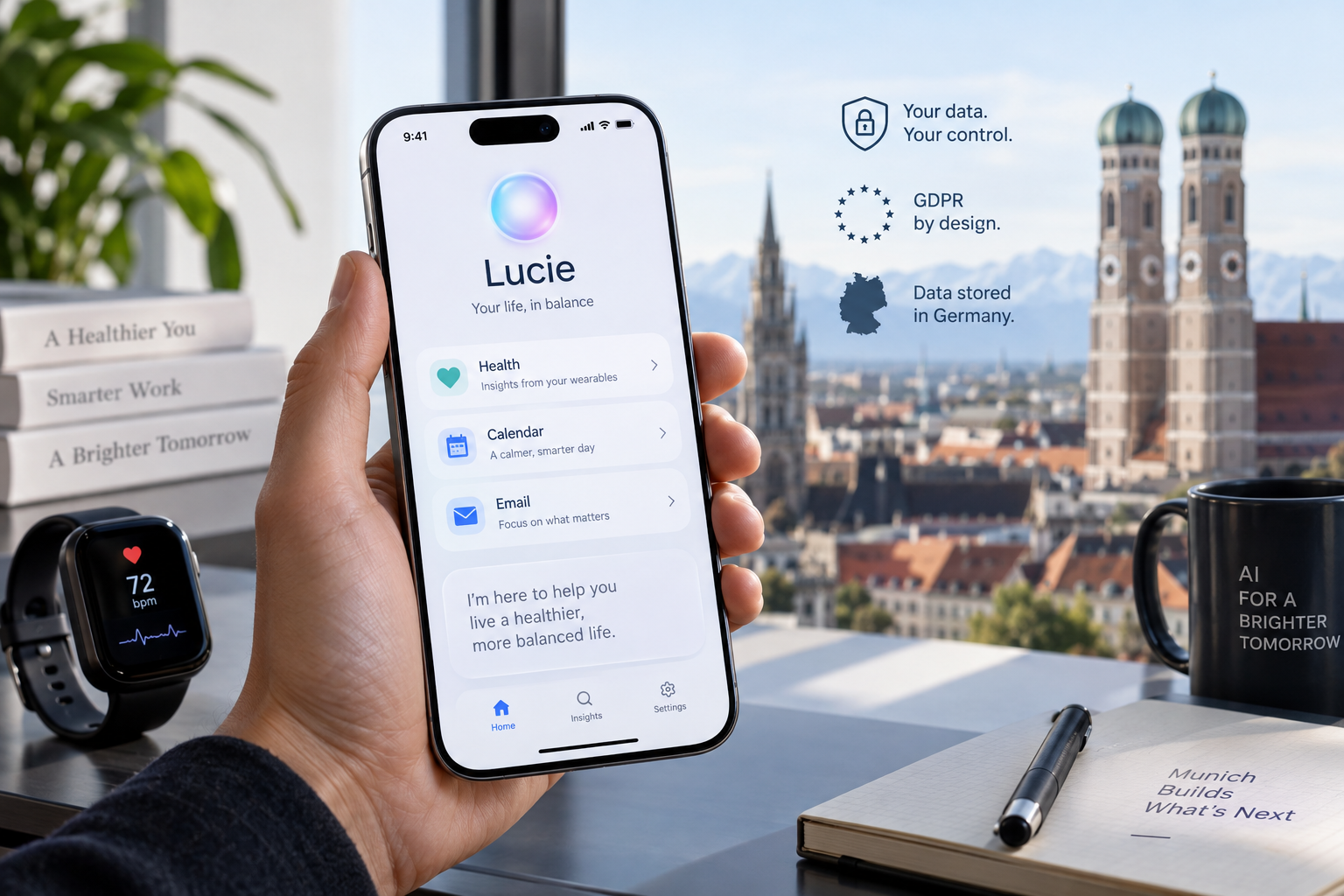
A Munich startup founded by a former industrial AI executive has raised €2.66 million in an angel round to fund Lucie, a personal AI assistant that watches over users’ health data, calendars and email. The round drew more than 40 investors, including Andy Bechtolsheim, co-founder of Arista Networks and an early investor in Google, and Prince Max von und zu Liechtenstein, chairman of LGT.
RHISE AI announced the funding on Tuesday. Former Siemens and Alcoa chief Klaus Kleinfeld, Splunk founder Michael Baum and Bayern Munich footballer Leon Goretzka are also backers.
The company’s chief executive, Andy Loy, has a different history from most people building AI assistants. In January 2021, his previous company, KONUX, raised $80 million in a Series C round. Around the same time, Loy was in hospital, exhausted and burned out at 29. He eventually stepped away from the chief executive role. When he returned to building technology, he wanted a different goal. Rather than make another product competing for people’s attention, he wanted one that would give attention back.
What is Lucie, RHISE AI's personal AI assistant?
That idea became Lucie. The assistant connects information from connected services, including wearables, calendars and inboxes. Its multi-agent system, called Heartbeat, monitors that data in the background. If it spots something unusual, such as a suspiciously high bill, it can suggest a next step. The company says the user must approve any action before the assistant carries it out.
Baum said he has spent much of his career backing technology designed to capture people’s time, and that Lucie takes a different approach.
“I’ve spent 35 years building and backing technology that wanted more of people’s time. Lucie gives it back. I invested, and I use it daily,” he said in a statement.
Loy, who founded RHISE AI with chief technology officer Danil Gontovnik, Samy Samandjeu and Chris Seybold, framed the company’s mission around the question of loyalty. “Personal AI will soon know more about us than any technology before it. The question is who it works for,” he said.
How does Lucie handle users' personal data?
That question is getting harder to avoid. Technology companies are building assistants with access to increasingly personal information, and users are asking who controls it. RHISE AI says Lucie was designed to comply with GDPR from the outset, stores personal data in Germany, and does not use advertising or sell user data.
The company says more than half of its active users have connected wearables that share real-time health readings with the assistant.
The timing gives a European company room to make its case. Apple’s AI-powered Siri features are missing from EU iPhones, Google’s Gemini Spark does not include the European Economic Area, and Meta’s Muse is available only in the United States and Canada. Meta’s decision to use conversations with its AI assistant to inform advertising recommendations, introduced in December, has added to concerns about data protection and dependence on American technology. That policy excludes the EU, UK and South Korea. A Bitkom survey found that 72% of German respondents consider their country too dependent on the US for AI.
RHISE AI is clearly counting on its European roots to appeal to users who are wary of giving another large technology company access to their personal lives. But hosting data locally and making privacy commitments are only part of the picture. Users will also have to trust the assistant’s decisions, especially when it can reach health information, private correspondence and financial details.
Where is Lucie available and how much does it cost?
Lucie launched quietly on iPhone and Mac on September 28. Its introductory annual subscription costs $99.99. RHISE AI says the app has passed 15,000 downloads in six weeks and expects more than 1,000 paying subscribers before the end of the year.
The assistant currently supports English and German and is available only on Apple devices. An Android version is planned.
For Loy, the project is a sharp break from the industrial AI business he built with KONUX. The underlying ambition, he says, is still to make technology useful. This time, he wants to measure that usefulness by how much time people no longer have to spend on tasks.
Dieser Artikel wurde mit Unterstützung von KI verfasst.
News Factory APP - agentische News für besseres SEO & AEO.