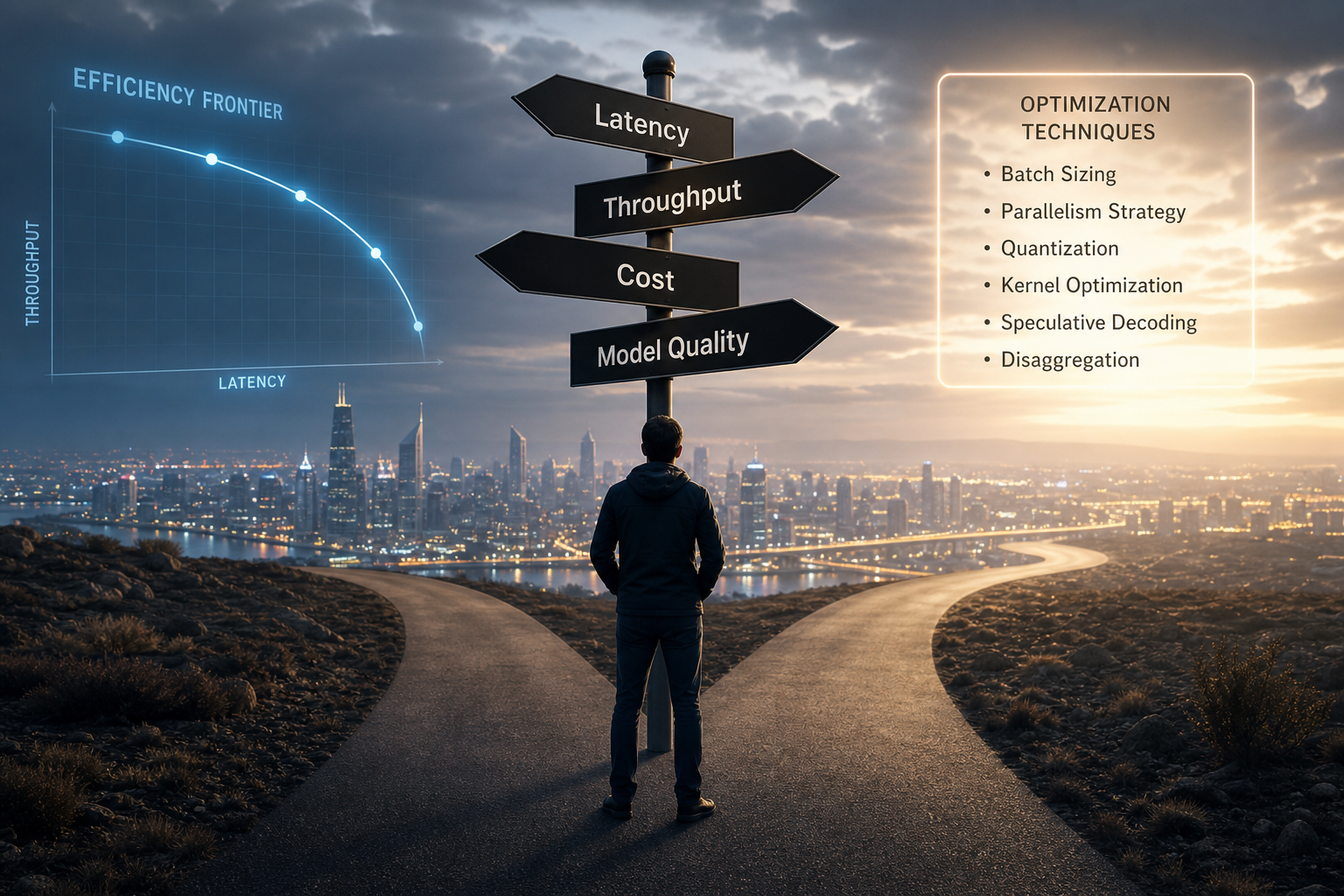
In the AI industry, the term 'efficient frontier' has been borrowed from economists to describe the management of tradeoffs, particularly between cost and capabilities for models. A model is considered a 'frontier model' if it offers the highest degree of intelligence at a given cost or size. The efficient frontier shows the range of optimal combinations when trading off between two valuable outcomes in a resource-constrained environment.
There are two types of techniques available to inference engineers: those that make a tradeoff between two factors to move a deployment along an efficient frontier, and those that push out the entire frontier for a given deployment, creating more overall efficiency. Both types of techniques are valuable, as they allow for targeting any point along the efficient frontier by making tradeoffs.
Techniques for managing tradeoffs include batch sizing, parallelism strategy, and quantization. Batch sizing, for example, determines the per-user latency and overall throughput, with small batch sizes resulting in excellent per-user latency but high cost per token. Parallelism strategy, such as Tensor Parallelism (TP) and Expert Parallelism (EP), can boost either latency or throughput. Quantization improves both latency and throughput but introduces new tradeoffs between quality and serving efficiency.
Techniques that push out the frontier include kernel optimization and runtime improvements, speculative decoding, and disaggregation. Kernel optimization and runtime improvements, such as improving the performance of individual CUDA kernels, mean fewer resources are needed to generate each token. Speculative decoding, which involves guessing which tokens a model might generate and then validating those guesses, can yield efficiency gains from skipped forward passes. Disaggregation, or separating prefill and decode onto dedicated workers, is a strategy for optimizing high-volume deployments of LLMs.
These techniques are crucial for inference engineers to navigate the efficient frontier of LLM inference, as they enable the creation of high-throughput, low-cost pipelines for batch workloads or low-latency, high-throughput pipelines for latency-sensitive users. By understanding and applying these techniques, engineers can unlock more efficiency, which can be allocated to lower latency, higher throughput, or a combination of the two.
Dieser Artikel wurde mit Unterstützung von KI verfasst.
News Factory APP - agentische News für besseres SEO & AEO.