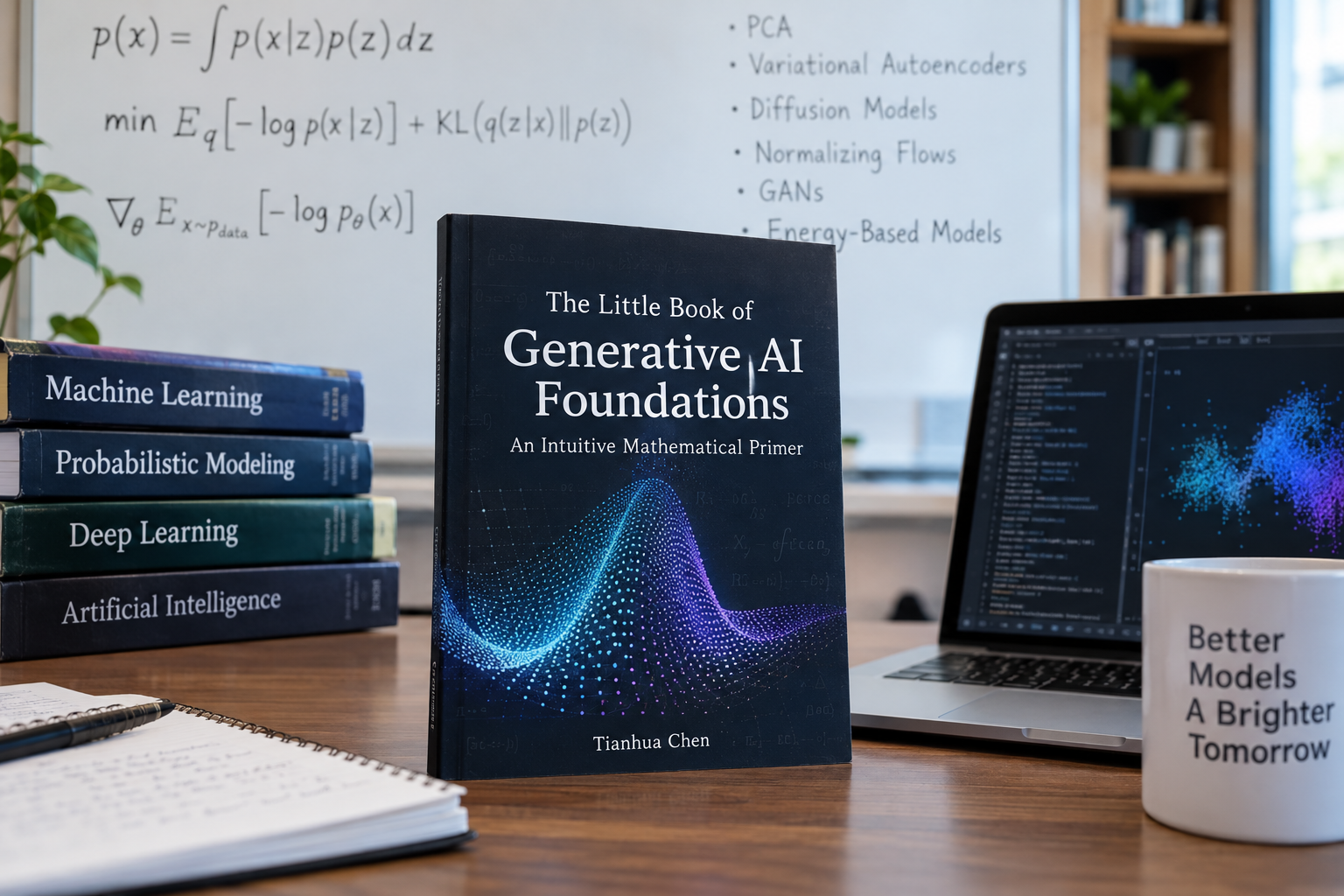
A new book on the mathematics of generative artificial intelligence is now available to read on arXiv, the open preprint server used by researchers in computer science and physics. The author, Tianhua Chen, submitted the work on May 28, 2026, and posted a revised version on September 8.
What does the new generative AI math primer cover?
The book, titled "The Little Book of Generative AI Foundations: An Intuitive Mathematical Primer," does not try to catalog every new architecture or implementation detail. Its abstract says it instead follows a single line of reasoning through the ideas that connect the major families of generative models.
How do the models in the primer relate to each other?
That route starts with PCA and probabilistic PCA, then moves through variational autoencoders and diffusion models. From there it covers normalizing flows, autoregressive factorizations, GANs, Wasserstein GANs and energy-based models. The text is built around derivations, meaning it shows how each model is worked out from the one before it rather than simply describing how each one behaves.
Who is the Little Book of Generative AI Foundations written for?
Chen says the goal is to make the structure of generative modeling easier to approach without stripping out the math needed to understand how these models are derived and related to each other. The book is aimed at mathematically inclined researchers, practitioners and students who want a foundation in the subject.
The paper is listed under the arXiv subject areas of machine learning and artificial intelligence. The arXiv identifier is 2605.29713, and the DOI is 10.48550/arXiv.2605.29713.
The first version was a 125 KB PDF. The September revision is considerably larger, at about 1,168 KB, though the listing does not say what changed between versions.
Dieser Artikel wurde mit Unterstützung von KI verfasst.
News Factory APP - agentische News für besseres SEO & AEO.