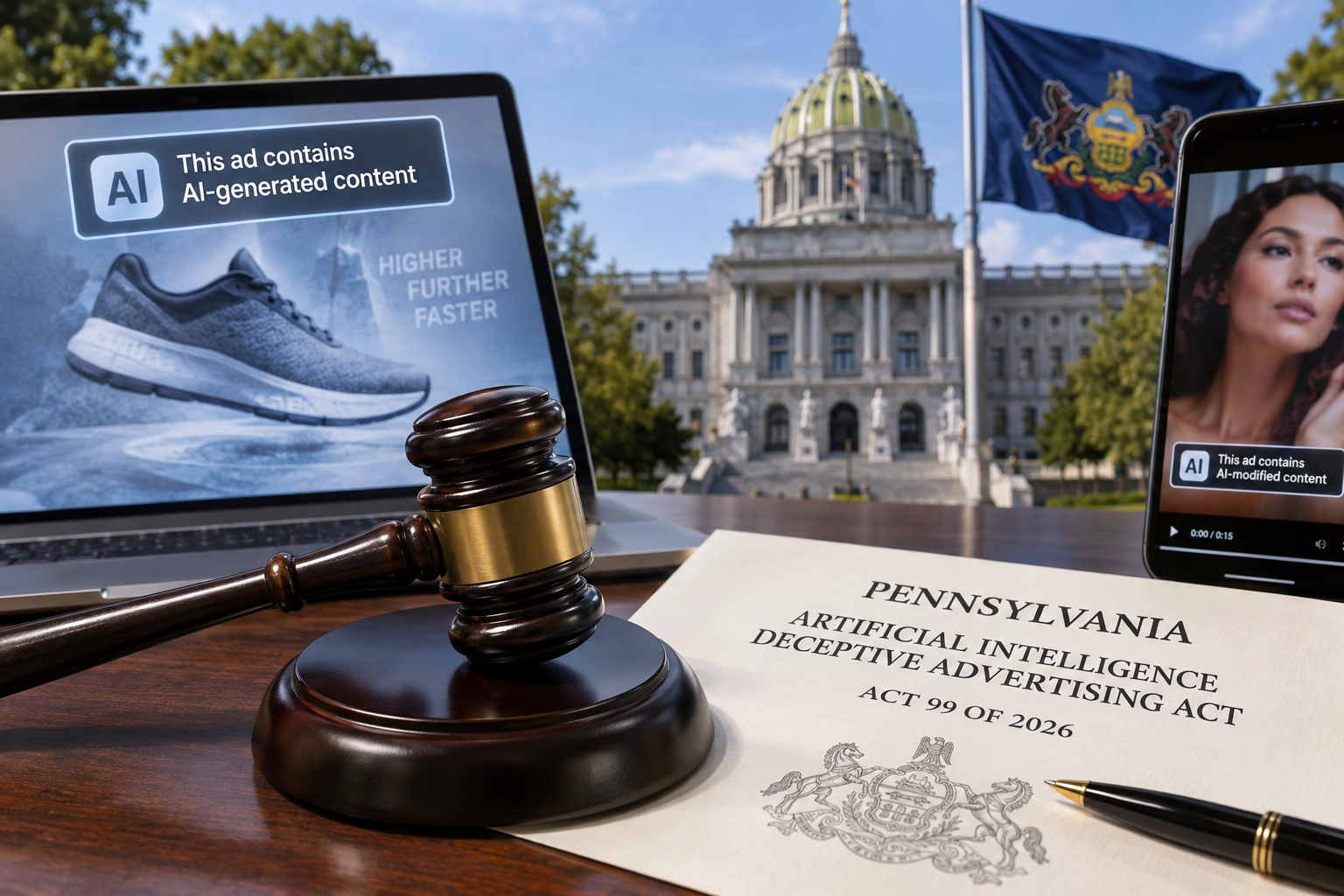
Pennsylvania Gov. Josh Shapiro signed the Artificial Intelligence Deceptive Advertising Act, which requires advertisers to label ads that use AI to mislead consumers. The label must state the ad contains AI-modified or generated content, appear when consumers first see it, and match the ad's medium. Courts can fine violators up to $3,000. The act takes effect Dec. 21.
Pennsylvania Gov. Josh Shapiro has signed a law requiring advertisers to label ads that use artificial intelligence to mislead consumers, making the state one of the first to require disclosures on AI-generated content.
The Artificial Intelligence Deceptive Advertising Act, which Shapiro approved on Oct. 22, became Act 99 of 2026, according to the General Assembly’s record of Senate Bill 806. It covers still images, video, audio clips and text that have been “significantly modified or generated” by AI. Advertisers may not knowingly, recklessly or willfully run such an ad without a clear disclosure if it creates a false impression about the goods or services being sold, including their “nature, origin or authenticity.”
What does Pennsylvania's AI ad labeling law require?
The label has to say the ad contains AI-modified or generated content. It must appear the first time consumers see the material, and it has to be in the same medium as the ad. Where technically feasible, the label must be permanent or very hard to remove.
The law also spells out what a readable label looks like in each format. Audio disclosures must be loud and slow enough to understand. On-screen labels must stay up long enough to read. In print, including point-of-sale displays and brochures, the type must stand out from the background.
The reach is broad. The requirement applies to ads of every size, from national TV commercials to the handwritten-style flyers a local restaurant might print about its wing specials. It also applies no matter where an ad was produced, so viewers in other states could see disclosures on commercials that are expected to air in Pennsylvania.
Which ads are exempt from the law?
The law carves out several categories. Content that is evidently fictional is exempt, as are parody, satire, commentary and criticism. Content limited to text is also exempt.
Some of the wording leaves room for interpretation. Whether an edit counts as “significantly modified” is subjective. The meaning of “evidently fictional” is not spelled out. The law also targets only synthetic content that “creates a false consumer perception” about a product or service, which raises questions about what counts as false and who decides.
Who enforces the law and how much can violators pay?
Enforcement falls to the state attorney general or a district attorney, who can seek an injunction or bring a civil action. Courts can award a civil fine of up to $3,000, plus attorney fees and court costs. The act takes effect 60 days after enactment, on Dec. 21.
State Sen. Nick Pisciottano introduced the bill in June 2025. The Senate passed it 48 to 2 that month, and the House approved it 163 to 40 on Oct. 7. After the final vote, Pisciottano said in a statement released by Senate Democrats, “Consumers deserve to know if AI is being used to create a false impression about a product or service.”
Pisciottano’s office did not immediately respond to a request for comment.
Labeling AI content is becoming a wider effort. OpenAI has started watermarking ChatGPT text in the European Union, and Google has opened a public SynthID detector that can identify content created with its watermarking technology. Pope Leo has also spoken out against unlabeled AI-generated art.
Dieser Artikel wurde mit Unterstützung von KI verfasst.
News Factory APP - agentische News für besseres SEO & AEO.