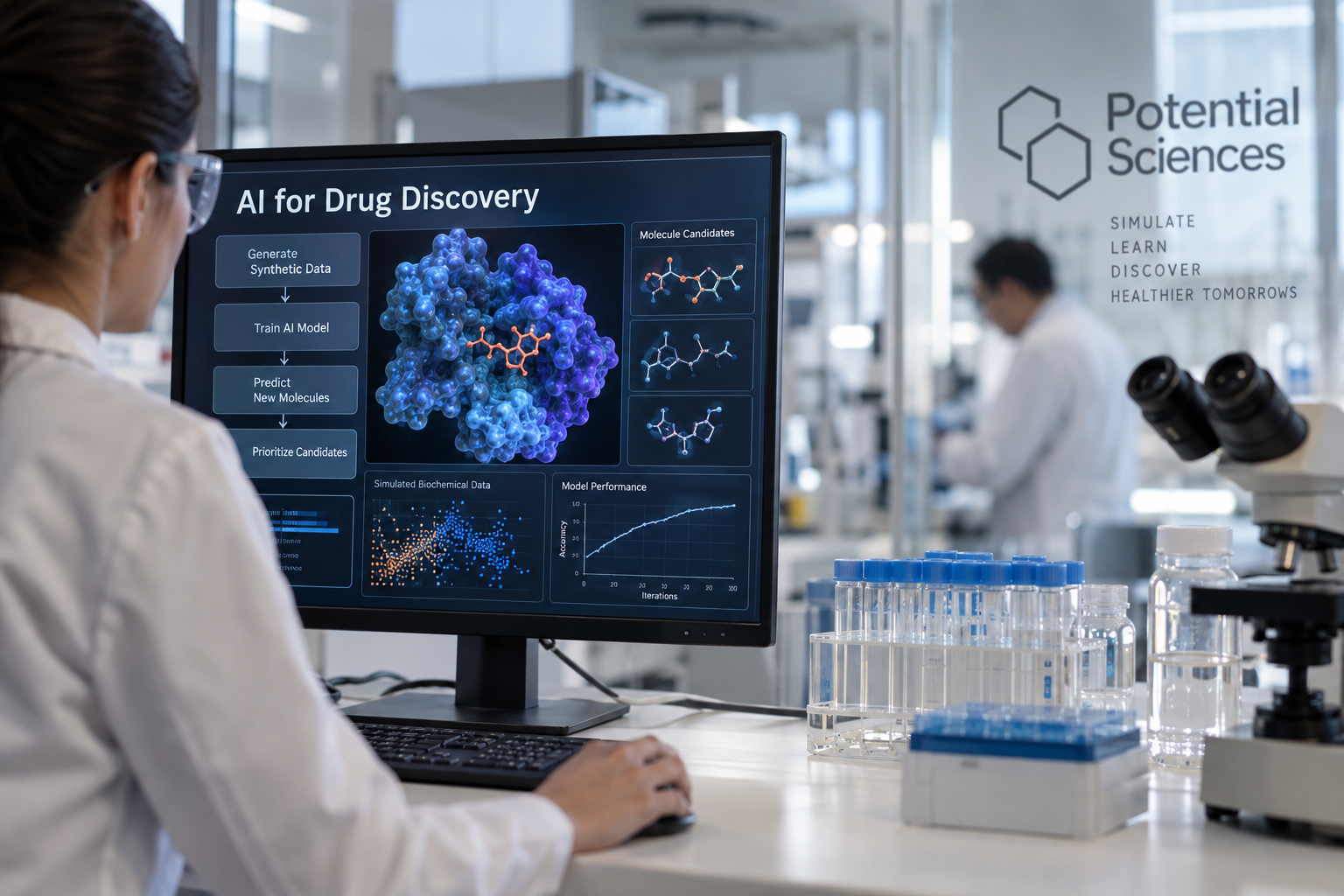
A British startup believes artificial intelligence can speed up one of medicine's slowest processes: designing new drugs. Potential Sciences, which is backed by the UK government, is training AI models on computer-generated biochemical data rather than relying solely on lab work.
How does Potential Sciences use AI to speed up drug discovery?
Drug discovery is often compared to searching for a needle in a haystack. The company's approach is to simulate the haystack. By generating large volumes of synthetic biochemical data, the models can learn patterns that might otherwise take years of physical experiments to uncover.
Can simulated data reduce trial-and-error in early drug design?
The company is betting that this method can cut down on the trial-and-error that defines early-stage drug design. Researchers have long found that process laborious and unpredictable, and the startup is positioning its software as a way to skip some of the bench work.
Joel Khalili, a senior writer at WIRED who covers the AI industry in Europe, reported on the company's strategy. The article was published on Nov. 5, 2026.
Dieser Artikel wurde mit Unterstützung von KI verfasst.
News Factory APP - agentische News für besseres SEO & AEO.