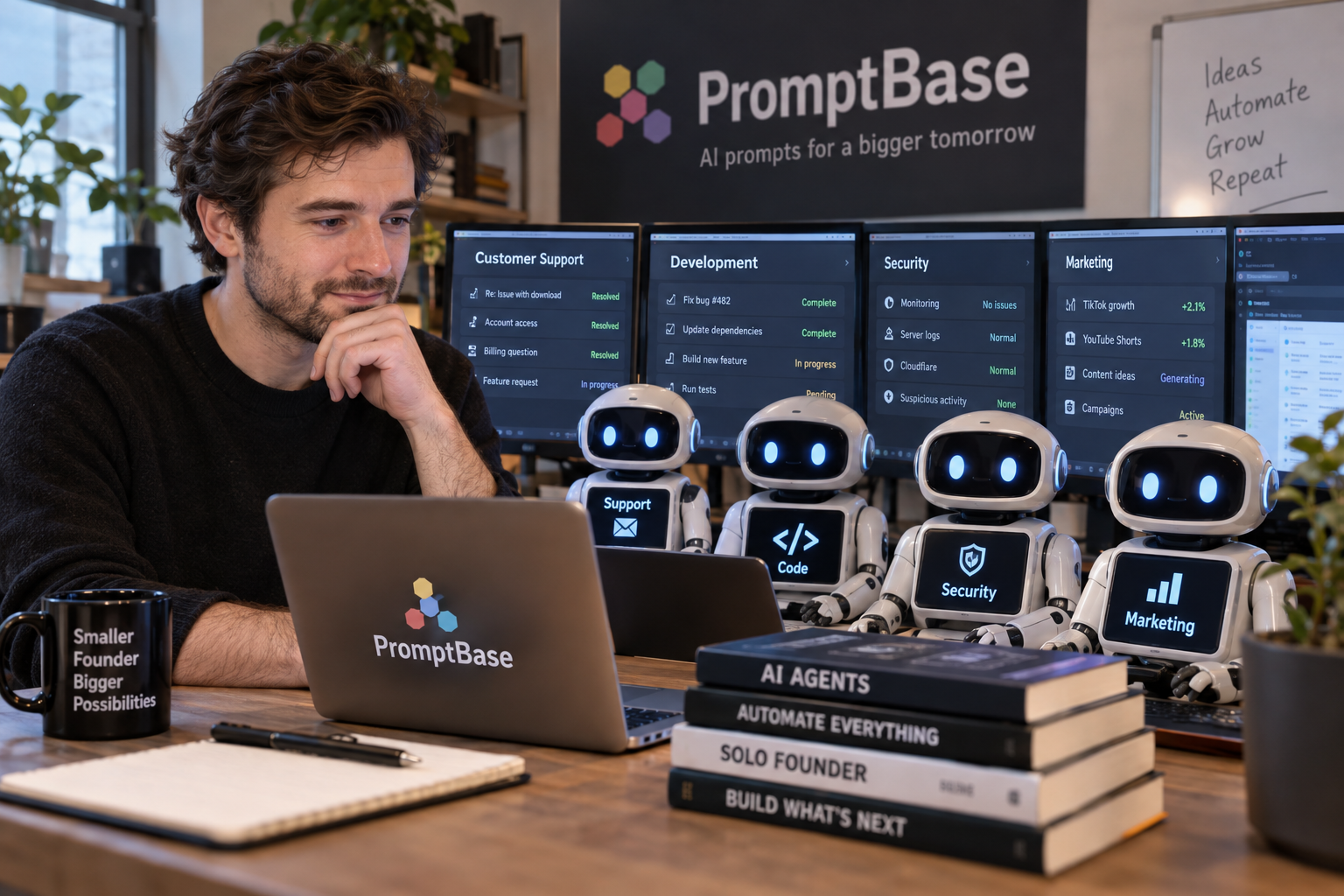
A solo developer who runs the prompt marketplace PromptBase spent a week letting a team of AI agents handle much of his company's work, and he came away impressed, though not entirely comfortable.
In a first-person blog post, the founder describes his setup as a mini team of bots that run on a Linux server. He can assign them jobs. One bot answers support emails through his Gmail account. Another writes code. A third, a security bot, monitors his Cloudflare and server logs for suspicious activity. He calls the product Grok Bot.
The moment that won him over came when the bots started working together. He says one of them fixed a bug for a customer without him getting involved. He sees that kind of coordination as the most interesting part of the tool. Small jobs he tends to put off, such as fixing minor bugs or following up on an email, can now run on their own, leaving him free to focus on bigger problems.
He also tried the system away from his desk. Last week, on a five-hour hike in the middle of nowhere in Wales, he sent instructions to the bots from his phone. He has long disliked both working from a phone and his phone in general, so he says the experience surprised him. He got more done on the hike, he wrote, than on some days spent in front of a laptop for nine hours. That made him think about how weakly effort tracks with output.
As a one-person company, PromptBase has never had time for certain kinds of growth work. Content marketing and paid advertising, he says, always felt out of reach. Now he has a marketing bot whose sole goal is to grow the site's social reach by 2 percent per week. The bot has started a TikTok profile and a YouTube Shorts channel, and he has told it to experiment and double down on whatever works. He wrote that it "seems to kinda be working."
He argues that a one-person startup can compete with much larger companies, and that being small may help, since there is less human overhead to slow things down. He presents this as his own view based on the past week.
He also ran a more unusual test. He told his project manager bot to ship one secret feature to PromptBase at 4 a.m. and deploy it while he slept, as long as the change benefited the site. The bot chose a feature that warns users before their accounts are timed out for too many declined submissions. He based the idea on a large volume of support emails. The feature worked. Waking up to find it live felt cool, he said, but also a little strange, as if the site could be run by an AI agent if he wanted it to be.
The downsides, he says, are real. Setting up and connecting everything takes a while. He has also handed over a large amount of his company's data, and he suspects that is one reason AI labs are pushing these products so hard. He had hoped the bots, with all their context about the business, would come up with bold ideas for growing PromptBase. So far, they have not. He still has to supply the ideas himself.
He also warned that a founder can lose track of what is happening inside the business. He said he needs to stay on top of things so the bots do not end up running him.
He recommends that other developers and founders try these tools. The week, he wrote, gave him a clearer sense of the hype around always-on AI agents and where the technology may be heading.
Dieser Artikel wurde mit Unterstützung von KI verfasst.
News Factory APP - agentische News für besseres SEO & AEO.