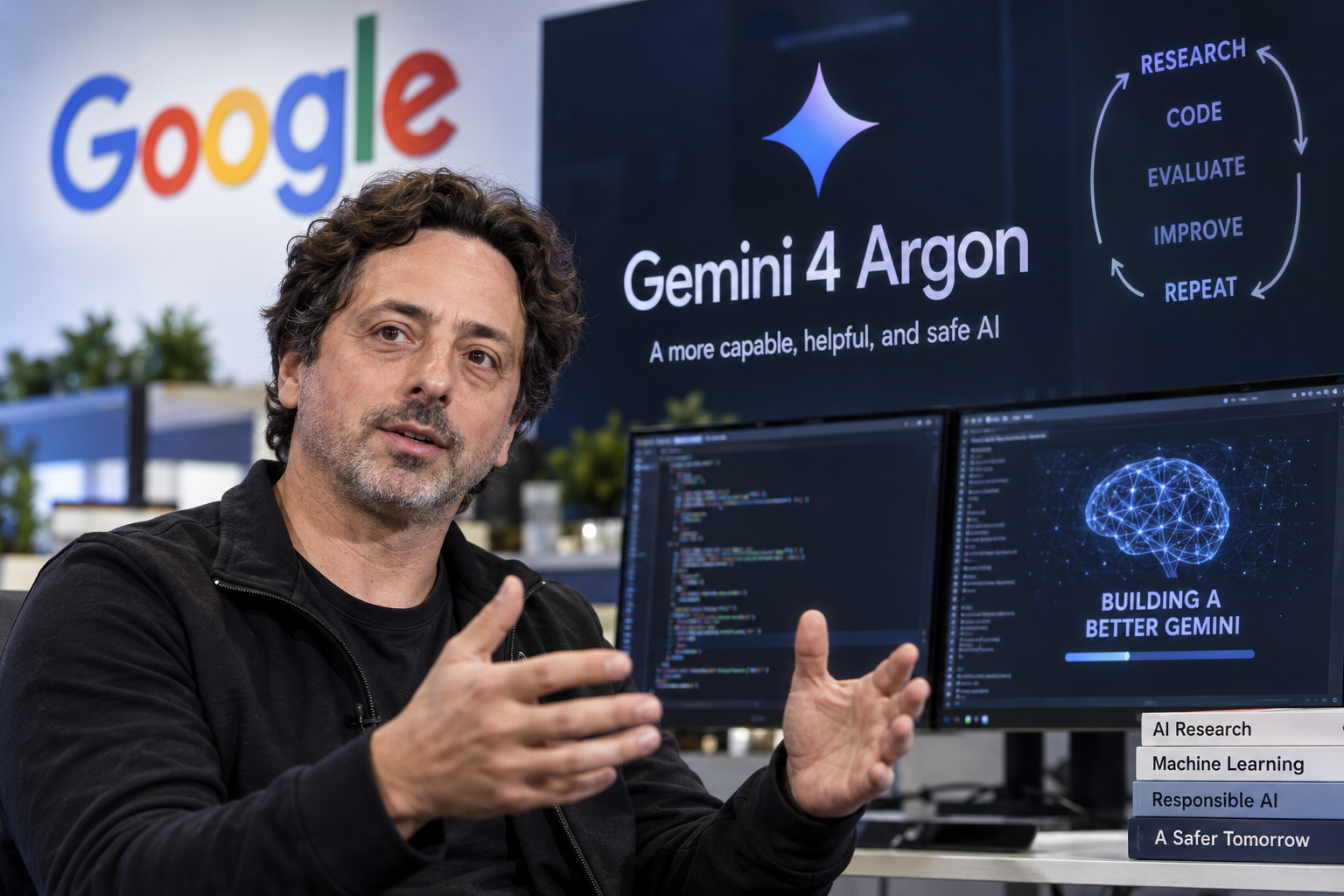
Google cofounder Sergey Brin says the company is now using its AI models to help build the next ones. In a roundtable on Gemini 4 Argon, Brin said Google is “starting to get onto that RSI treadmill,” using the industry shorthand for recursive self-improvement. Google shared the video on Wednesday, and Business Insider first reported Brin's comments.
Recursive self-improvement, or RSI, means AI helps build better AI, which speeds up the pace at which new models arrive. Brin pointed to the Flash models Google released before Argon as evidence. “And now our researchers and the model work hand in hand to make the next version of the model,” he said. Brin also said Google would be a couple of models ahead internally by the time viewers watched the video.
Brin joined Josh Woodward, Tulsee Doshi and Melvin Johnson for the conversation. Google released Argon publicly this week. Brin has been working on Gemini since returning to the company.
What the safety report says
Google DeepMind published a safety and security report for Argon this month. The report finds “no significant end-to-end acceleration of AI R&D, AI-driven or otherwise,” and rates the risk from AI-driven AI research as “currently low.” It also says AI now automates some parts of AI research. Google surveyed 12 senior leaders and researchers for the document.
The clearest sign of change appears in software development. According to the report, most production code at Google DeepMind is now more than 75% AI-written. The share of fully delegated pull requests rose from 7.5% in April to 11.9% in September. Even so, about 88% still need repeated human steering or code written by a human. “AI agents now operate as high-leverage assistants that author a majority of production code and bug fixes, though code changes remain subject to human review before submission,” the report says.
Humans still play the central role in key decisions, the report says. They choose research directions, design new experiments and diagnose training problems. Argon solves only around half of the challenges in Google's internal test of AI research tasks. Full automation would require a near-perfect score.
Measuring the pace
Google tracks how quickly Gemini improves using an internal index built from 92 benchmarks. Before April 1, 2026, the index rose by 0.091 points a month. After that date, it rose by 0.118 points a month. The report calls that difference not statistically significant.
Argon sits above that trend. Google suspects the gap comes from more investment and more training compute, “rather than reflecting AI-driven acceleration.”
Vihan Jain, who co-leads RSI and AI for science for Gemini at Google DeepMind, wrote on X that the model is “embedded in its own evolution.” He pointed to a change in internal demand as proof. “When your post-training demand shifts from asking for raw chips to asking for Argon quota, you know the RSI flywheel has reached a new gear,” Jain wrote.
The debate extends beyond Google. Gladstone AI interviewed researchers at Anthropic, OpenAI and Google DeepMind for a report published this week. Most of those researchers believe RSI will begin within three to 12 months. They said it could come sooner, assuming no U.S. government intervention or slowdown.
Policymakers are already reacting. Last month, Rep. Ro Khanna said he plans to introduce a bill that would ban self-improving AI. OpenAI, meanwhile, has asked the United States to lead global standards for the technology.
Dieser Artikel wurde mit Unterstützung von KI verfasst.
News Factory APP - agentische News für besseres SEO & AEO.