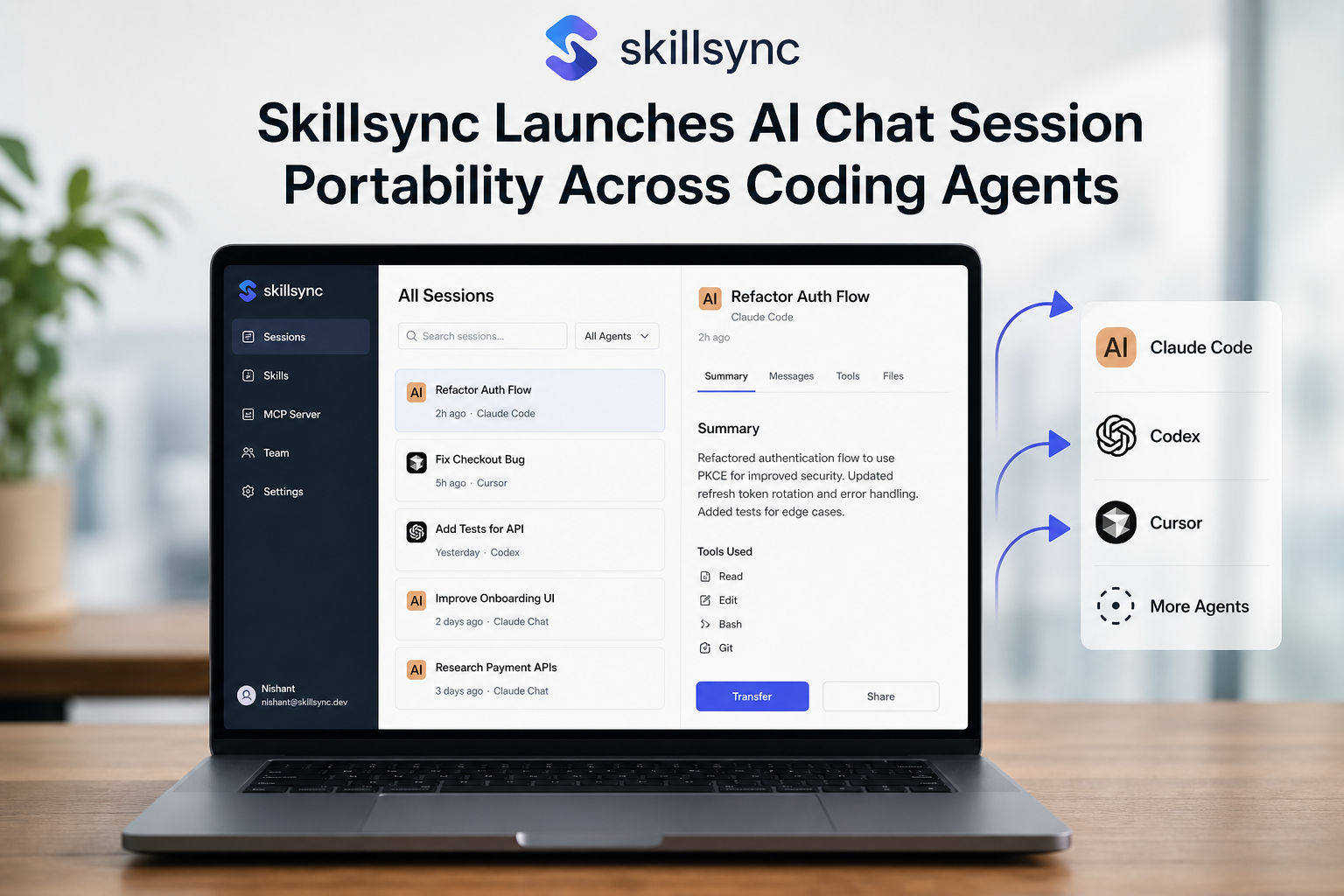
Skillsync, a startup founded by Nars and Nishant, has launched a platform that enables users to move their AI chat sessions across different coding agents, breaking vendor lock-in and enabling collaboration and search across sessions. The platform acts as a universal converter, translating sessions from one agent's format to another, and collecting all sessions in one place, making them searchable.
The core of Skillsync is an open-source Rust engine called txcript, which translates a session from one agent's on-disk format into another's, mapping conversation, reasoning, and tool history. On top of that engine is a local-first desktop app that surfaces scattered agent sessions in one place with a UI that makes them readable, allowing users to revisit what happened, move a session into another agent, or share it with a teammate.
Skills and memory are stored as portable, human-readable markdown, and exposed to any agent over MCP for search and selective retrieval. Sessions and translation run locally on the user's machine, with the only data leaving the machine being what the user explicitly shares into a team workspace.
The founders of Skillsync, Nars and Nishant, previously built an open-source payment orchestrator that let merchants route across many processors instead of getting locked into one. They saw the same problem of vendor lock-in in coding agents, where context is locked into whatever agent you start with, because every agent stores sessions differently and none of it moves.
Some of the use cases for Skillsync include moving a session between Claude Code, Codex, and Cursor mid-task, thinking through a problem in a browser Claude chat and then handing the whole thread to Claude Code or Codex to build, and sharing research sessions with a team. Skillsync is available as a Mac app, CLI, and MCP, and a demo is available on YouTube.
Dieser Artikel wurde mit Unterstützung von KI verfasst.
News Factory APP - agentische News für besseres SEO & AEO.