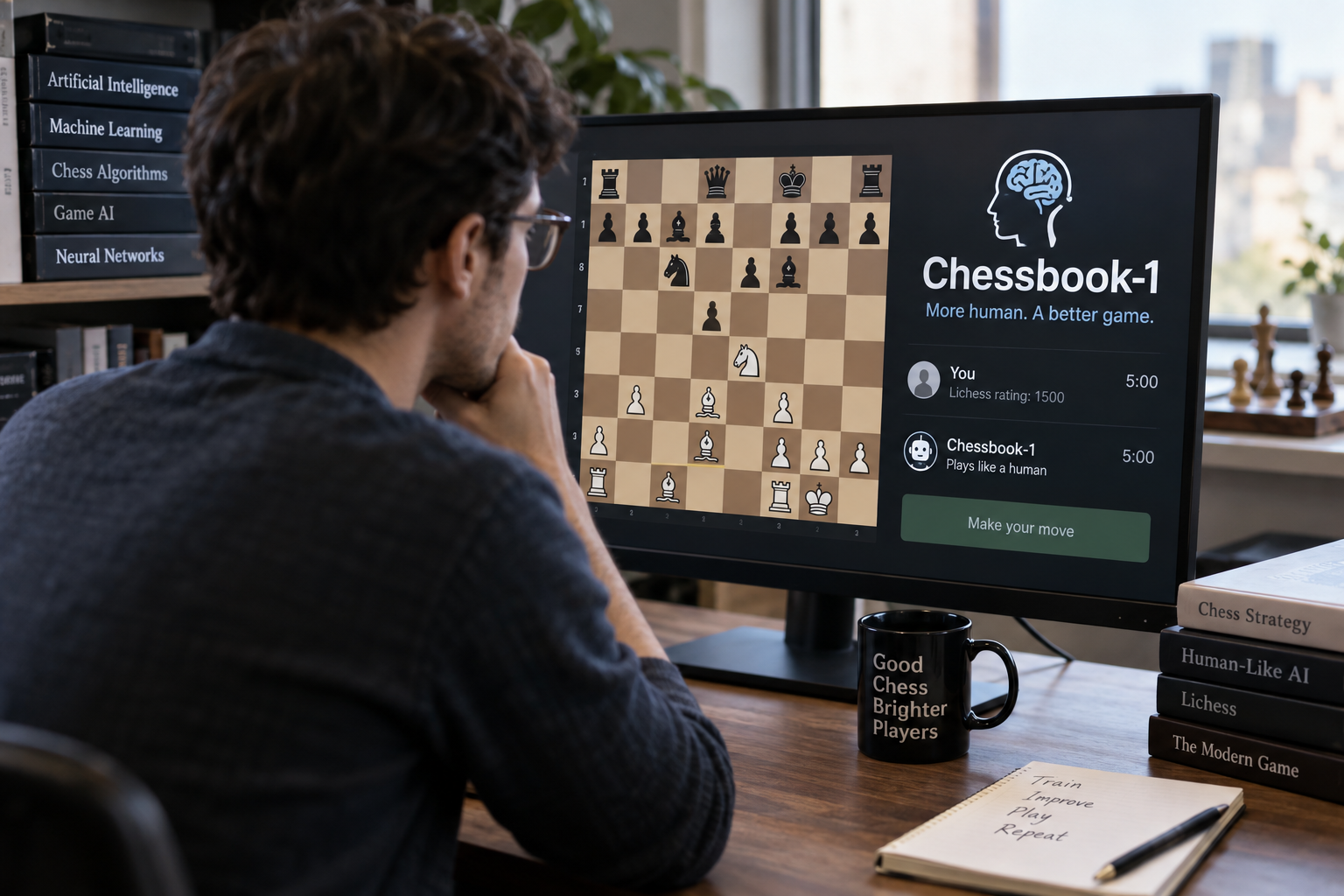
A developer who spent ten months building a chess bot says it plays more like a real person than the leading human-like models, and has published benchmarks to back up the claim. The bot, called Chessbook-1, powers the training games on Chessbook, a site where players can practice against an opponent designed to play like a typical Lichess player at any rating and any time control.
The developer said existing options did not fit the job. Allie 2.0 and Maia-3 were the best human-like models available, he wrote, but neither was quite right. Maia-3 does not match playing strength well, plays too strongly at low ratings, and was not trained on low-time situations or on non-blitz time controls. Allie 2.0 was the strongest predictor of human moves overall, but it estimates time usage separately from the move being chosen, and its playing strength drifts at both low and high ratings.
How was Chessbook-1 trained?
Chessbook-1 has 199 million parameters and was trained on a year of Lichess games, from August 2025 through July 2026. The games included only players rated between 600 and 3,000 who were within 400 points of each other, and excluded bot accounts. The main training run took 24 hours on eight H100 graphics processors, followed by an eight-hour fine-tune on eight A100s. The developer said the bot runs on a single T4 GPU and returns a prediction in well under a second.
To test the model, the developer used positions from September 2026, a month after the training data for Chessbook-1 ended. The first test drew 30,000 positions at random from every rated game that month, across all time controls and ratings. The second used 28,000 positions from blitz games only, since Maia-3 was trained exclusively on blitz. Stockfish 18 scored every legal move in each position, and the models' predictions were compared with what the human players actually chose.
How does Chessbook-1 compare with Maia-3 and Allie 2.0?
On the blitz test, the three models were effectively tied. Allie 2.0 picked the human's move 57.5 percent of the time, while Maia-3 and Chessbook-1 each scored 57.3 percent. The developer said the differences fell within the margin of error. On the broader random set, Allie 2.0 was about a point ahead in most rating bands. Chessbook-1 and Maia-3 were level below 1,800, and Chessbook-1 pulled ahead from there up. The gap was widest in bullet games and in the final seconds on the clock, where Maia-3's training data runs out.
Time pressure produced the clearest difference. In positions where the player had under 20 seconds left, Chessbook-1 predicted the human's move 54.8 percent of the time, compared with 51.9 percent for Maia-3. Allie 2.0 kept its edge over Chessbook-1 in that setting.
Does Chessbook-1 blunder less than human-like chess models?
The developer also measured playing strength by looking at how often each bot made mistakes compared with humans of the same rating. Maia-3 and Allie 2.0 tracked human players up to about 2,200, the developer wrote, then fell off. At 2,600 and above, both blunder nearly twice as often as the players they were imitating. Chessbook-1 stayed within 9 percent of human blunder rates in every band, and within 18 percent at 2,600 and above. Maia-3 and Allie 2.0 made 63 percent and 75 percent more mistakes than a 2,600-plus player, according to the developer's figures.
The bot also predicts how long a human would spend on a move. Chessbook-1 estimated that players spend 5.4 percent of their remaining clock time on a move, matching the 5.4 percent measured in human games. Allie 2.0 estimated 4.9 percent. The developer said Chessbook-1 also predicts the result of games more accurately than a rating-blind Stockfish evaluation, which picked the eventual winner 63 to 66 percent of the time, compared with 66 to 71 percent for Chessbook-1 and Allie 2.0.
The developer said the benchmark scripts, evaluation sets and raw per-position outputs are available on request. Chessbook-1 is also playable on the Chessbook site, where users can choose a rating from 600 to 2,800 and a time control.
Dieser Artikel wurde mit Unterstützung von KI verfasst.
News Factory APP - agentische News für besseres SEO & AEO.