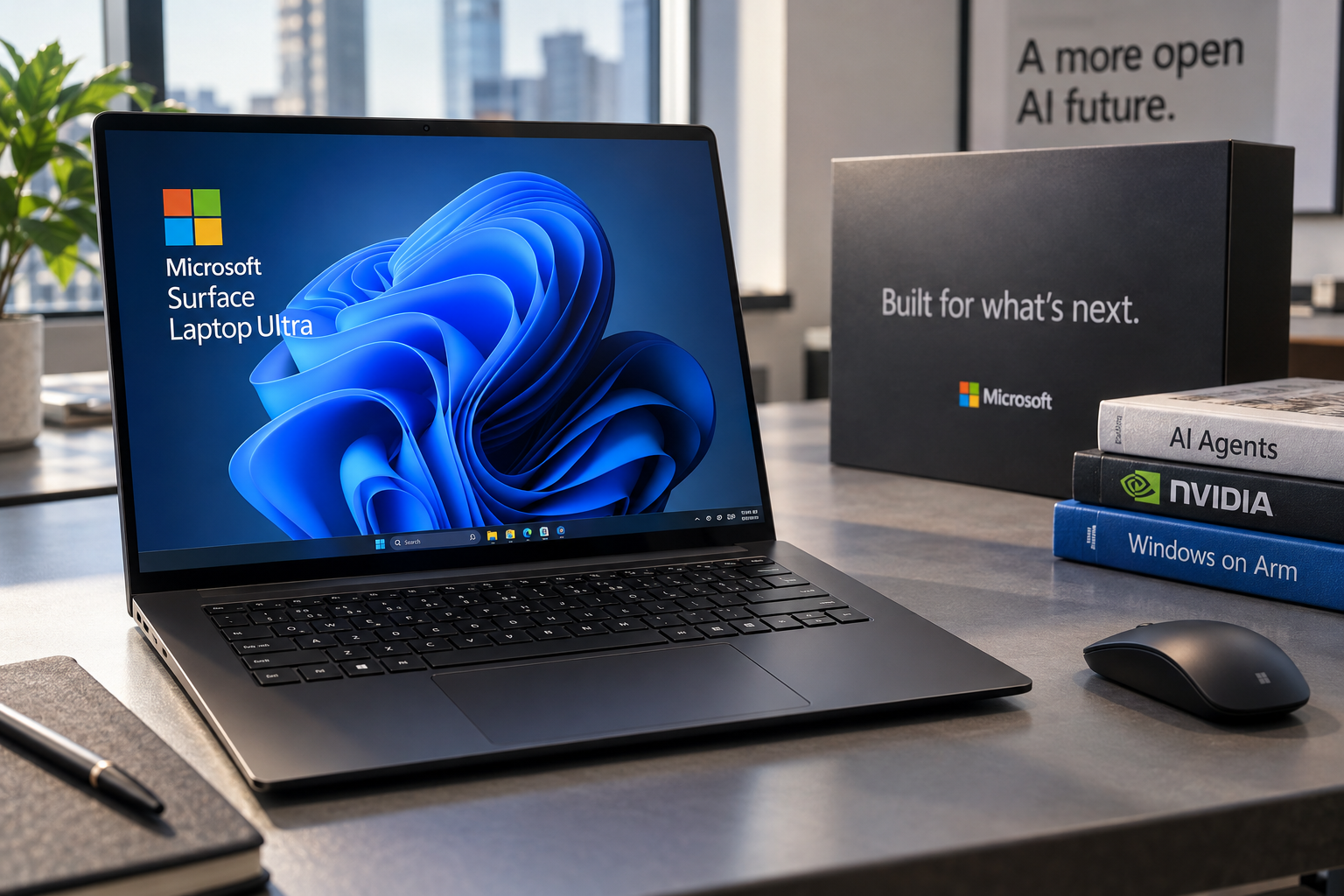
Microsoft’s Surface Laptop Ultra has the look and finish of Apple’s best laptop. Its local AI features are the part that still feels unfinished. At $5,899 for the top configuration, the machine is built to show off Nvidia’s new Arm-based RTX Spark chips, and it asks buyers to be comfortable with experimentation.
The hardware is the easy sell. The laptop uses an all-aluminum design, a large haptic trackpad and a high-end finish. Even the “nightfall” color closely matches Apple’s space black. The 15-inch mini-LED display peaks at 2,000 nits of HDR brightness, compared with 1,600 nits on the MacBook Pro. It is also a 3:2 touchscreen, which Apple’s laptop does not offer. Microsoft calls it the brightest display it has shipped on a Surface Laptop.
The port selection looks familiar, with three USB-C ports, a USB-A port, an HDMI 2.1b port, an SD card reader and a headphone jack. The biggest change is Magnetic Connect, a return of the old Surface Connect charger. It snaps onto the right-side USB-C port when brought close, and that port works like any other USB-C port when the laptop is not charging. The haptic trackpad adds useful feedback for clicks, drags and window alignment in Windows 11, though the reviewer wished more apps supported it.
Not everything works as expected. The laptop’s battery readout dropped from 100 percent to 97 percent immediately after unplugging the charger, a pattern that repeated each time. Microsoft spokesperson Moses Nsereko said the behavior is intentional. “When it’s plugged in and the battery is full, the device pauses charging rather than constantly topping off, and resumes only once the level drops to 95 percent,” Nsereko said. “This reduces wear over time.”
Local AI is the hard part
The Surface Laptop Ultra’s AI pitch depends on running large models on the device. The tested model has a 20-core CPU co-designed by Nvidia and MediaTek, a 6,144-CUDA-core GPU, 128GB of unified memory and a 1TB Gen 5 SSD. The base model, priced at $2,599, has an 18-core CPU, a 5,120-CUDA-core GPU and 24GB of memory, which the reviewer said would limit the number of local models it can run.
Out of the box, the laptop asks owners to choose an AI agent from Hermes, OpenClaw or Perplexity. The reviewer tested Hermes and OpenClaw over a week. OpenClaw needed a reinstall to fix a gateway problem before it would work.
Performance was often disappointing. Using the Qwen3.8-27B model, the laptop ran its fans at full speed and its GPU at 100 percent, even for simple requests. Hermes took several minutes to resize and convert a batch of photos from PNG to JPG, a job that a PowerToys utility handles in seconds. OpenClaw spent 30 minutes trying to build a smart home dashboard and ended with an error.
The reviewer said the agents did have a few useful moments. Hermes set up a local llama.cpp server to transcribe audio and video files, which could replace a transcription app or a cloud service. That process required some tinkering. The reviewer also said the agents are targeted at developers and power users, and that Microsoft or Nvidia should build a simpler local AI interface.
Gaming strong, CPU behind Apple
For gaming, the laptop performs better than expected for its size. Black Myth: Wukong averaged 70 frames per second at native resolution with medium settings and DLSS performance. Cyberpunk 2077 averaged 66 fps under the same settings, and Forza Horizon 6 averaged 57 fps. Gears of War: E-Day averaged 40 fps on medium settings and 48 fps on low. Doom: The Dark Ages reached 60 fps only on low settings with DLSS performance.
Compatibility is less consistent. Horizon Zero Dawn Remastered was capped at 30 fps at 1440p, which the reviewer linked to the game’s heavy CPU load running through emulation. Native Arm ports of games such as Marvel Rivals perform better, and Nvidia and Microsoft are working with EA, Activision and Riot Games to bring titles like Battlefield, Call of Duty, Valorant and League of Legends to Arm.
Creative work shows a split result. The laptop exported a 4K test video in Premiere Pro in two minutes and 18 seconds, which is about a minute slower than the top MacBook Pro and faster than the base M5 model. In CPU-focused tests, the MediaTek processor fell well behind Apple’s M5 Max in Geekbench and Cinebench, and it also trailed in Photoshop, Premiere Pro and DaVinci Resolve benchmarks. Battery life was about seven hours with local AI models and a mix of apps and games, and about 10 hours or more on lighter work.
The reviewer concluded that the Surface Laptop Ultra is not a clear performance upgrade over the MacBook Pro, except for some AI workloads and CUDA support. It is best suited to developers and power users who want to run local AI, code or test agents, and who are willing to pay for it. For most buyers, the reviewer said, cheaper laptops handle everyday work and light gaming without the premium.
Dieser Artikel wurde mit Unterstützung von KI verfasst.
News Factory APP - agentische News für besseres SEO & AEO.