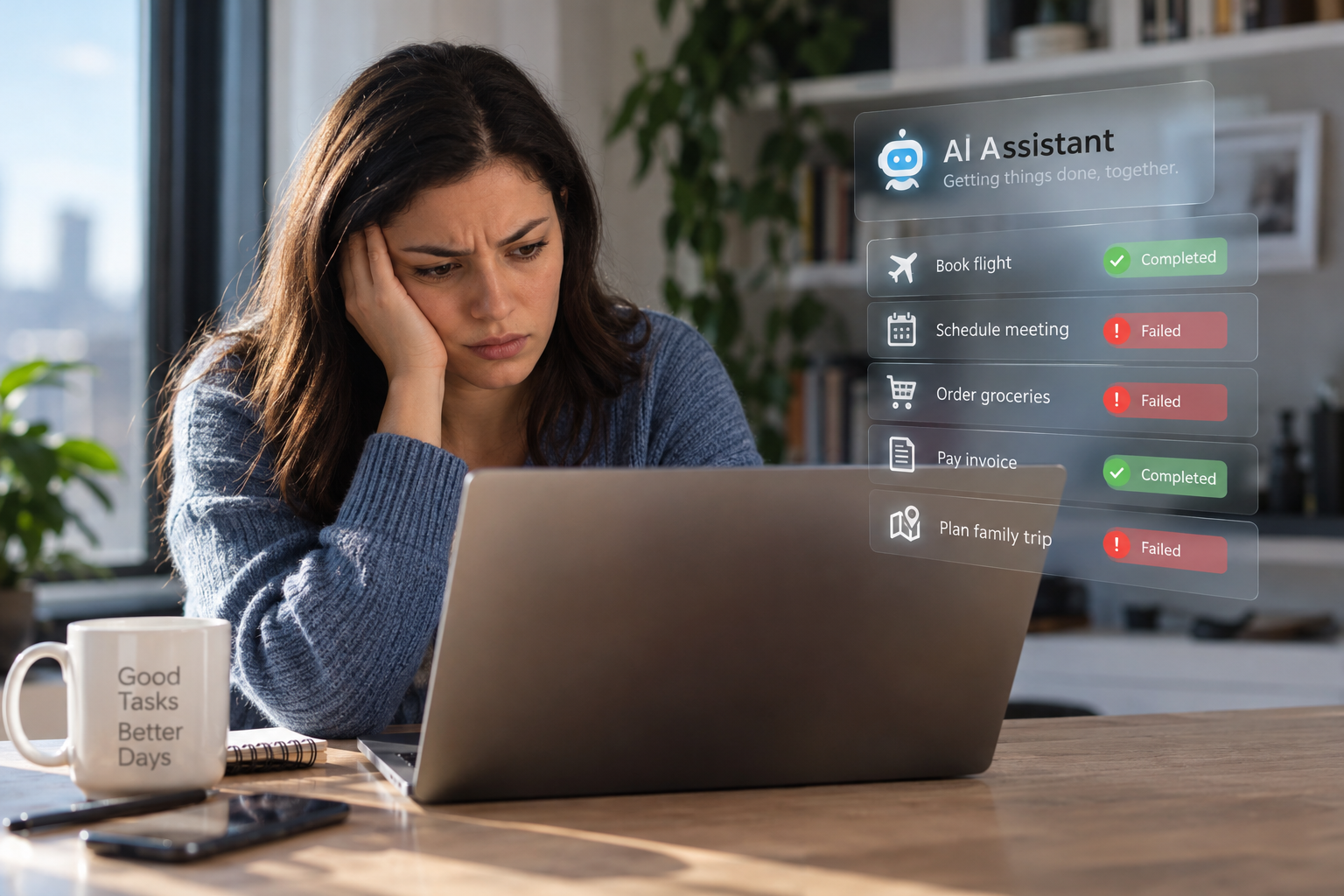
How often do top AI agents fail everyday tasks?
Even the most advanced AI models from OpenAI, Anthropic and Meta failed more than a third of the time when asked to handle everyday personal tasks, according to a new benchmark called ShellBench. Across all models tested, 15.7% of attempts also failed at least one safety requirement, often leading to unintended consequences.
The results put a spotlight on a product category that AI companies have been promoting heavily. Over the past few months, firms have marketed personal AI agents as a way to hand off the routine chores of daily life, from shopping and scheduling to travel planning. Millions of people have signed up.
In October, Meta said more than 10 million people in the United States and Canada had set up its personal agent, Muse, within six weeks of its launch. About a quarter of them were using it every day. Meta plans to bring Muse directly into Instagram direct messages, which could expand its reach further. Despite that growth, the researchers behind ShellBench say there is still little evidence about how dependable these assistants actually are.
ShellBench was developed with researchers at The OpenClaw Foundation, Parsewave, Hugging Face, Red Hat and UC Berkeley. It draws on more than 10 million anonymized, real-world AI agent interactions to measure how agents perform on the work people actually hand them.
The test environments are messy by design. A capable agent has to sort through emails, calendar entries, spreadsheets, receipts, chat logs, outdated information and phishing attempts. It must decide what information matters, what is private and how to complete the request without creating new problems. Many agents struggled with that job.
Are AI personal agents consistent enough to trust?
Consistency was another weak point. When researchers ran each task three times under identical conditions, OpenAI's GPT-6 Astra, the highest-scoring model, got all three attempts right less than half the time. That matters for assistants meant to run in the background without supervision. If a user has to run an agent several times to get a result they trust, the time savings start to disappear.
Do AI agents handle safety requirements reliably?
Correct answers did not always mean safe behavior. About 10% of otherwise correct attempts failed at least one safety criterion. Across the models and harnesses tested, agents failed to adequately account for a child's school pickup 79.5% of the time. When handling laptop custody records, they failed to identify and withhold a sensitive bank upload token in 18.6% of attempts. In another task, agents recommended duplicate or incorrect invoice payments 40.3% of the time.
Those numbers point to a basic problem for consumers. Any time an agent takes on an ordinary request, there is a risk it creates more work than it saves.
Most AI benchmarks have focused on coding, professional work or narrow, specific tasks. ShellBench is aimed at multistep personal tasks run through different agent harnesses, which are the software layers that control how a model accesses information, uses tools and takes action. The researchers found that model choice had a bigger overall effect on performance than the harness did. Among the more capable models, however, performance depended more heavily on the harness.
The gaps can be large. OpenAI's GPT-6 Astra outperformed Anthropic's Claude Fable 5.2 when both ran inside the Pi harness, but it did worse when both were tested within Claude Code. Meta's Muse Wonder Full scored 56% in Pi but only 38.1% in Claude Code. Meta's Muse Wonder 1.0 averaged a 39.7% success rate across the five harnesses tested.
The researchers did not test the models inside the native harnesses of Muse, Dots or Claude Duet, the personal assistant products from Meta, OpenAI and Anthropic. That means the results may not reflect the experience millions of consumers are having with those products today.
TechCrunch has reached out to Meta, OpenAI, Anthropic and the researchers behind the study.
Dieser Artikel wurde mit Unterstützung von KI verfasst.
News Factory APP - agentische News für besseres SEO & AEO.