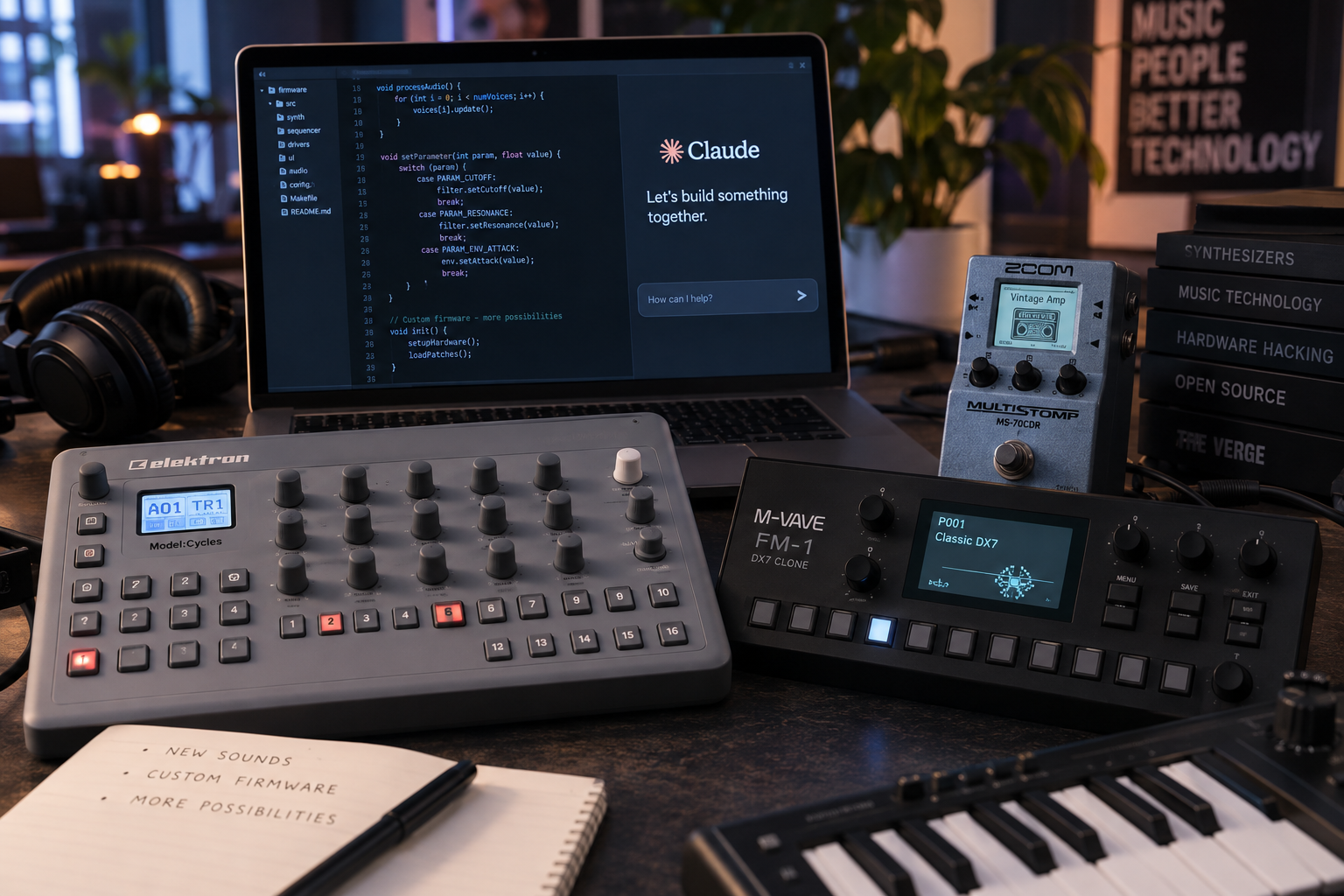
What is vibe coding in music gear firmware?
Custom firmware for hardware synthesizers, samplers, and grooveboxes is spreading fast, and a growing share of it was written with help from AI coding tools. Hobbyists are using what has become known as vibe coding to push cheap and aging gear well past what the manufacturers built into it. Many of the new releases appeared within the last month.
Before large language models, that kind of work was rare. It demanded deep technical skill and a lot of time. Adding a feature as simple as velocity sensitivity to a Korg Volca could take weeks or months. Now, hobbyists say they can turn a budget synth into a full-featured groovebox in a matter of days.
Which music gear is getting custom firmware?
The list of affected gear is long. Elektron’s budget-friendly Model:Cycles, Digitone, Octatrack, and Digitakt have all gained new capabilities with help from Claude. Roland’s SP-404 MKII, Ableton’s Push 3 and Move, Akai’s MPC Live and MPC One, and the vintage MPC 2000 have all seen new custom firmware. So have Novation’s Circuit, Arturia’s MicroFreak, and Zoom’s 14-year-old MultiStomp pedal line.
The M-Vave FM-1 has become the centerpiece of the trend. The $70 device is a Yamaha DX7 clone that was already popular with first-time buyers, hobbyists, and synth influencers because of its low price and faithful recreations of classic FM tones. Someone then asked how far the hardware could be pushed. With AI assistance, that question set off what one observer described as an arms race. The FM-1 now has dozens of custom firmwares. Several of the most popular, including Felucca, Sloop, and x0x, list Claude as a contributor on their GitHub pages or disclose their use of AI outright. A project called Baud Girl is also suspected of being AI-assisted, though its developer did not respond to a request for comment.
The changes go well beyond the original design. What began as a surprisingly good but basic DX7 clone now supports virtual analog synthesis, sample playback, multitrack sequencing, and several user interface designs.
Much of this work targets gear that is either older or cheap, and the experimenters say that is part of the appeal. Roman Rusinov, who posts on Reddit as themanro and releases music under the name Farlow, set his sights on the Zoom MS-70CDR. The 2012 multieffects pedal has a reputation for punching above its weight and is a common choice for affordable setups. Rusinov began by studying ZDL, a project that reverse-engineered the MultiStomp format so custom effects could be built. He eventually got the pedal running NAM A2 Lite captures and custom impulse responses, which turned it into a modeler capable of emulating vintage amps.
“I was already using AI for some work stuff and figured this would be a great case to try learning some vibe-coding fundamentals and get a project going,” Rusinov told The Verge. “There was a lot of trial and error of finding the limitations of the hardware and software.” He said he was excited to be part of a broader movement. “Somehow it all lined up with all these other projects pushing the boundaries of older hardware and breathing new life into it. I love that,” he said. “If you own the hardware, you should be able to do whatever you want with it.”
The developer known as 18nelli, who created Modded Cycles, had a similar starting point. “I had an Elektron Model:Cycles that left me feeling frustrated,” 18nelli told The Verge. He said the machine seemed designed “just to push us to buy their more expensive gear.” Recent AI advances convinced him he could add features to the groovebox, which has not received an official update since May 2021.
He opened the unit, documented its parts, and started working with Claude Code on a first hack, which added six-track audio over USB. The project has since grown into a community effort with multiple mods from other contributors, several standalone custom firmwares, and a way to turn a Model:Cycles into a Model:Samples. “I think not using LLMs would have been counterproductive,” 18nelli said. “I probably would have spent a massive amount of time and energy on just a single feature, whereas my real goal is to actually create and make music with amazing mods.”
Modded Cycles has been among the most active of these projects. One reporter watched five firmware updates appear in the announcements channel of its Discord in a single day. 18nelli has since said he plans to pause new features and focus on polishing the existing code and fixing bugs.
New mods and firmwares now appear online almost daily. Musicians who wish a favorite instrument had one more feature may find it on a GitHub page sooner than they expect. Some of the requests are more playful. A pocket synth that can play NES ROMs is, apparently, a real possibility.
What are the risks of custom firmware?
There are risks. Many of these firmwares are less thoroughly tested than official releases, and a bad flash can leave a device unusable. Manufacturers have not responded uniformly. Many have said nothing publicly. Elektron has banned links to custom firmware from its forums. In a statement posted to its official forums, the company said, “We would always warn against modifications to our firmware and/or machines that could brick them … Something that looks like a simple change in isolation can lead to major problems elsewhere, particularly when a later official OS arrives, and can confuse users about which features are officially available on our machines.”
M-Vave has taken a different approach. The company recently announced FM1 Open, an open-source firmware with added features, along with a development kit and a firmware-flashing tool for the community.
Reaction to AI-built music tools has been mixed. Devices such as the Polyend Endless have drawn criticism, and music-making subreddits are full of complaints about vibe-coded plug-ins. Custom firmware has met less hostility so far. One possible reason is that giving old instruments new capabilities gives musicians a reason to keep what they already own, which may also help hold off the urge to buy more gear.
Dieser Artikel wurde mit Unterstützung von KI verfasst.
News Factory APP - agentische News für besseres SEO & AEO.