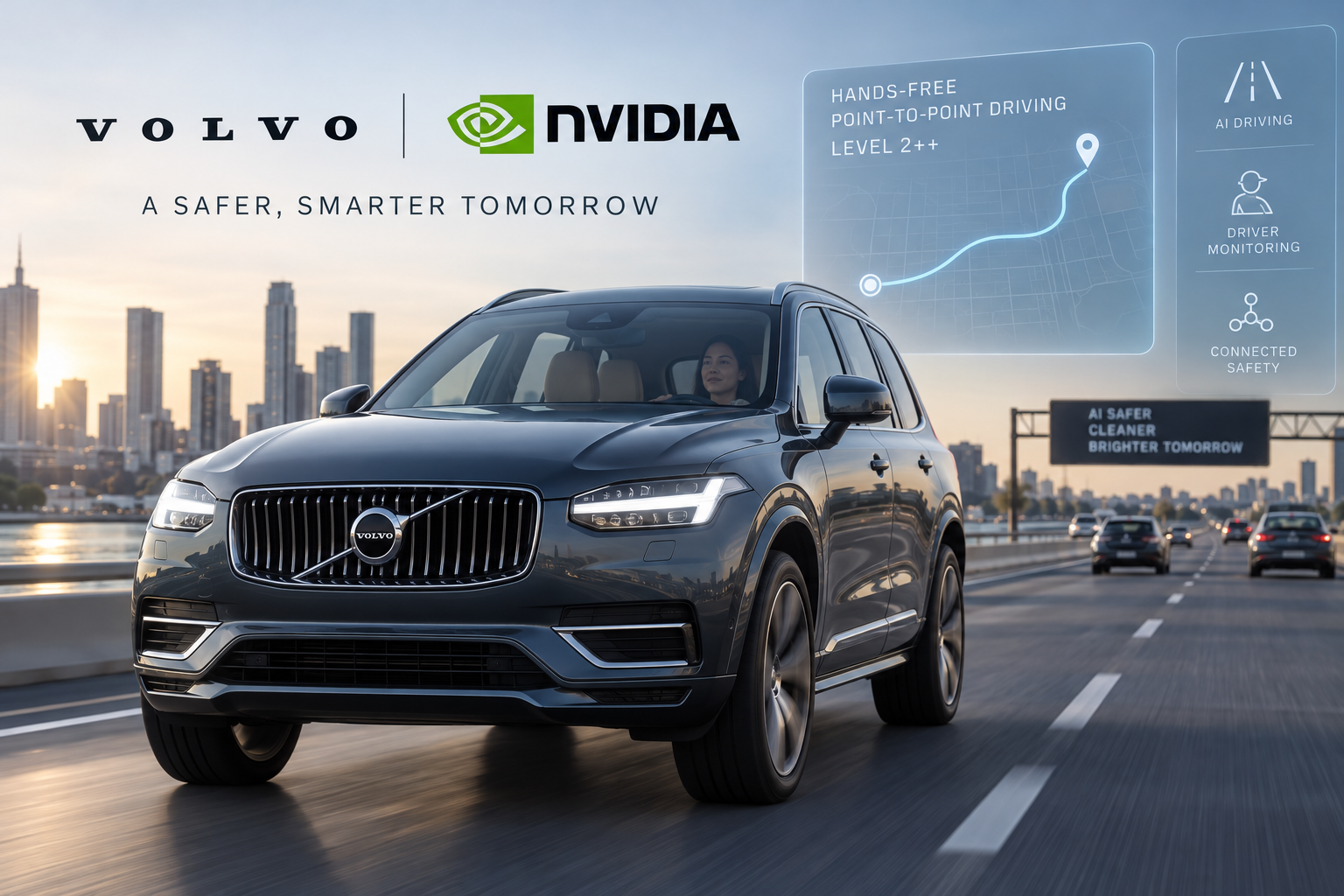
Volvo plans to launch a hands-free, point-to-point driving system before the end of the decade, using Nvidia's Hyperion platform and Alpamayo software. Volvo calls it Level 2++, and the driver remains responsible for the vehicle. The system will not include lidar, though Volvo could add it later.
Volvo plans to launch hands-free, point-to-point driving before the end of the decade, and it will rely on Nvidia’s AI technology to do it. The Chinese-owned, Swedish-designed automaker said Thursday it will use Nvidia’s autonomous driving stack to power a new partially automated system. The setup is meant to resemble Tesla’s Full Self-Driving (Supervised), and it will also look a lot like the Nvidia-powered system Mercedes-Benz recently rolled out for its all-new CLA sedan, according to Ali Kani, vice president and general manager of Nvidia’s automotive team, who spoke with The Verge.
What is Volvo's hands-free point-to-point driving system?
Volvo describes the system as Level 2++. That label means the car can handle complex urban environments, including traffic lights, stop signs and unprotected left turns, without explicit driver control. The driver still remains responsible for the vehicle at this level, as with other partially automated systems on the road.
Will Volvo's system use lidar?
The hardware and software come from Nvidia. Volvo will use Nvidia’s Hyperion platform, which includes the chipmaker’s high-powered silicon along with additional sensors mounted around the vehicle so it can see and interpret its surroundings. The automaker will also use Nvidia’s Alpamayo software, which relies on “reasoning” models to make sense of complicated road conditions and decide where to steer, brake or accelerate. The system will not include lidar, though Volvo could add the laser sensor later if it chooses to.
The partnership is a second attempt at automated driving for Volvo, which has stumbled before. The company had to effectively sideline its Ride Pilot Level 3 unsupervised system in the United States after it failed to obtain regulatory approval. Volvo had also planned to add lidar to some models, but that plan collapsed when its supplier, Luminar, went bankrupt. Expanding a relationship with Nvidia that already existed gives Volvo a more established technology partner as it tries to get back on track.
Volvo is betting that its safety reputation will set it apart. The company plans to combine its safety expertise with Nvidia’s technology and contribute its proprietary driver-understanding systems, which analyze driver behavior in far more detail than a basic driver monitoring system, said Alwin Bakkenes, head of global software engineering at Volvo Cars.
“Our brand Volvo is synonymous with safety, and safety is synonymous with trust,” Bakkenes said in an interview. “People get into our cars not expecting anything bad to happen, but they feel intrinsically that if they’re ever in a situation … we will do our utmost to keep people safe, to protect them from harm.”
Volvo will also add connected safety technology that lets its vehicles exchange information about hazards and conditions ahead, including roadworks. That data could extend the system’s awareness beyond what a single car’s sensors can detect, which could improve how well the self-driving functions perform.
When will Volvo launch point-to-point driving?
The point-to-point system will be offered across Volvo’s lineup, from entry-level models to high-end versions. The company did not say which models will get it first, and the timeline remains loose. Bakkenes confirmed only that the system will launch “before the end of the decade.”
Kani said the commercial case may be stronger than for a system limited to highway assistance. Point-to-point driving, he suggested, could prove more valuable to customers. Nvidia sees the partnership as a chance to advance the technology and also to help Volvo build a business model around ongoing software-based offerings.
Dieser Artikel wurde mit Unterstützung von KI verfasst.
News Factory APP - agentische News für besseres SEO & AEO.