What are world models in AI?
Artificial intelligence is moving beyond text. A category of systems known as world models aims to give machines a working understanding of three-dimensional space, and the people building them are using that understanding to teach robots and autonomous cars how to get around.
How do world models train robots and self-driving cars?
The core idea is simulation. World models recreate real-world physics inside a digital environment, so an AI system can test how objects behave, where obstacles sit and how a movement will play out before it happens in the physical world. That gives robots and self-driving vehicles a way to practice navigating reality.
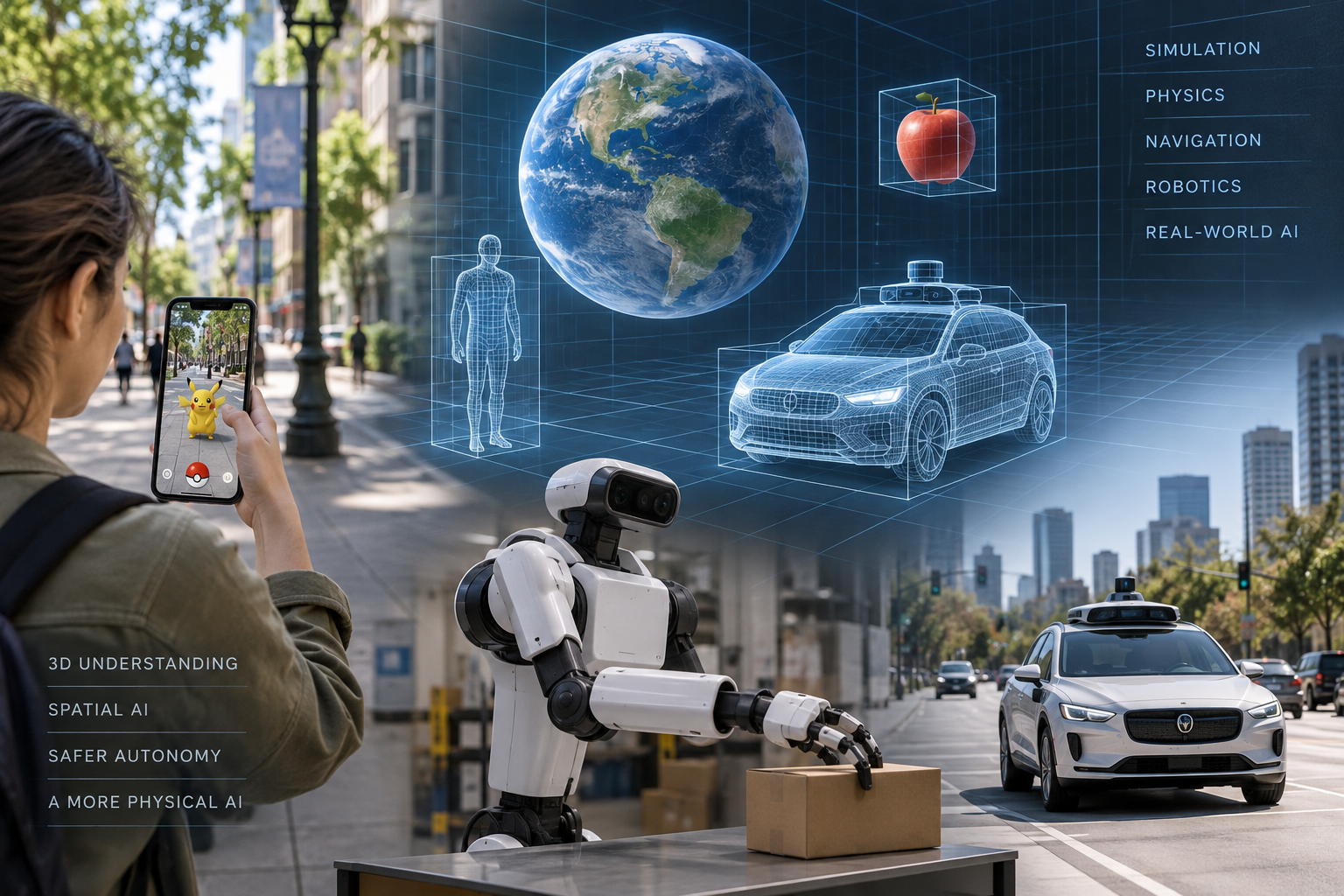
The data behind that effort has been accumulating for years, often in places people would not expect. An illustration accompanying the reporting frames the shift with a simple image of Earth, a person, a car and an apple floating in a gridded 3D space. The underlying story starts with a mixed-reality game. In 2016, Pokémon Go drew hundreds of millions of players into neighborhoods, phones held up to catch virtual characters. Each of those sessions involved scanning the surrounding environment. Those scans, the reporting notes, could eventually help robots move around obstacles and handle objects.
Why do world models matter for AI?
The shift matters because it changes what AI is good at. Text-based models can describe a room. A world model is meant to understand the room, including its layout, its depth and the way things in it respond to force and gravity. For machines that have to function in homes, warehouses and streets, that difference is the gap between reading about the world and operating within it.
Dieser Artikel wurde mit Unterstützung von KI verfasst.
News Factory APP - agentische News für besseres SEO & AEO.