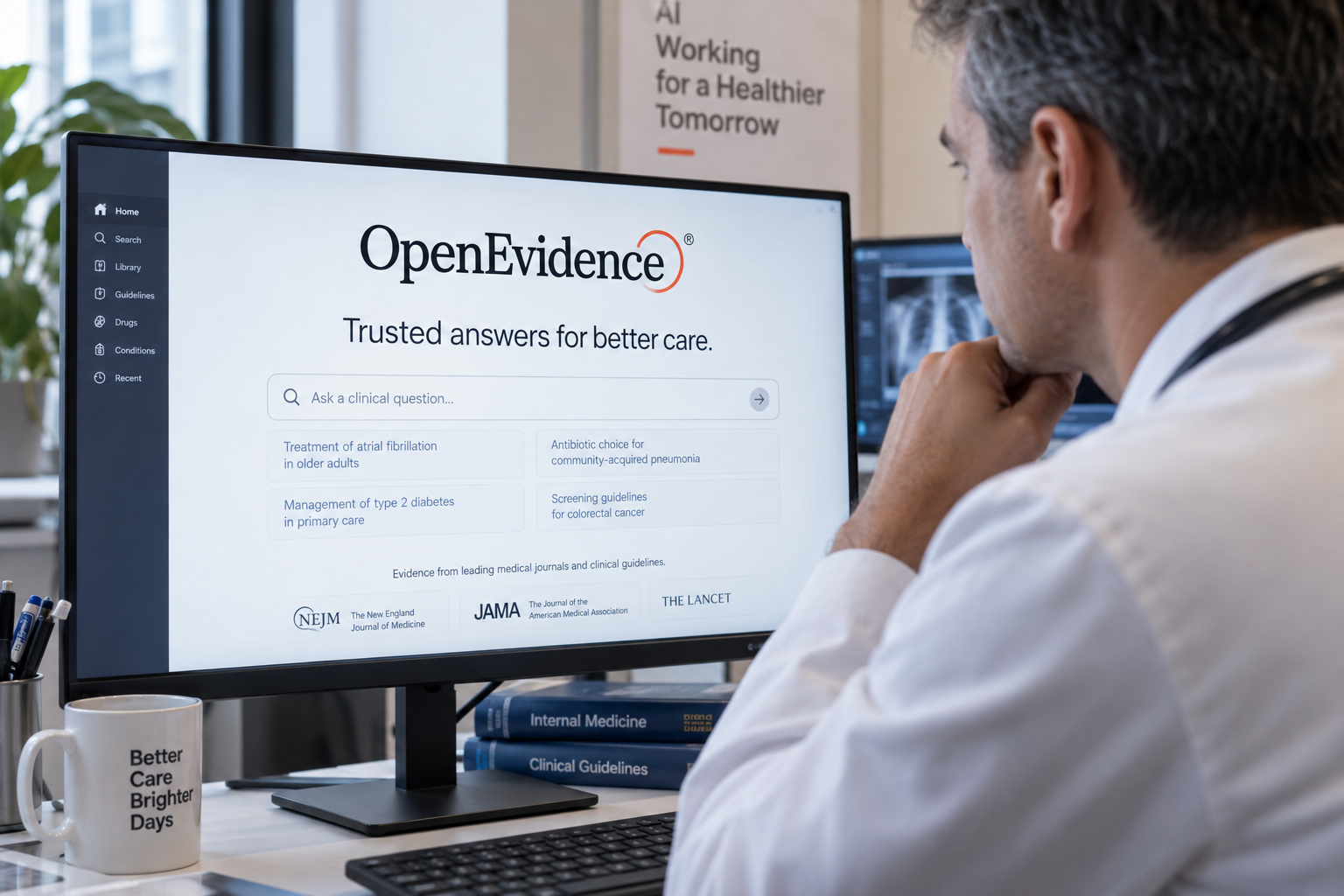
Nearly two-thirds of U.S. doctors are turning to an AI-powered search engine to help make decisions about patients, a rise that has lifted a little-known Miami startup to a $15 billion valuation and sparked a debate over how much medical judgment should rest on a chatbot.
Why are doctors using OpenEvidence?
OpenEvidence, founded in 2022 by serial entrepreneur Daniel Nadler, says many of the nation's roughly 1 million physicians processed more than 42 million prompts last month. Doctors use the chatbot to search medical journals and clinical guidelines while diagnosing and treating patients. The company has built its reach mostly through word of mouth, in a sector where few digital tools have gained similar traction.
Nadler told the Financial Times that the company is the first viral consumer internet app in healthcare. That claim is hard to dispute based on the adoption figures alone. Interviews with eight senior physicians found that many have praised the tool for easing their workloads.
The company has attracted nearly $1 billion in investment over the past 18 months. Backers include Andreessen Horowitz, Blackstone, Thrive Capital and Sequoia. In September, OpenEvidence raised $250 million at a $15 billion valuation.
How does OpenEvidence make money?
Its business model depends heavily on advertising. OpenEvidence booked $100 million in "ad buys" for this year by the end of 2025, a metric that includes current and future advertising commitments, according to a person close to the company. That person added that the startup is on track to generate between $400 million and $500 million through ads by the end of 2026. Critics have questioned whether an ad-based model justifies such a high valuation.
OpenEvidence entered a medical software market that was slow to adopt generative AI. Dutch IT group Wolters Kluwer released an AI version of its established UpToDate subscription tool in October 2025, nearly two years after OpenEvidence arrived. The startup's core pitch rests on a narrower foundation: a curated list of peer-reviewed sources, including the New England Journal of Medicine and the Journal of the American Medical Association.
Nina Singh, a medical resident at the University of California San Francisco, said the tool helps her gather context about patients more quickly. "OpenEvidence allows me to provide a lot of context about my patient, find information, and make decisions faster," she said. "It's a really useful tool."
Institutions have taken notice. OpenEvidence has formed relationships with several hospitals and specialist clinics, including Mount Sinai Health System and Memorial Sloan Kettering Cancer Center in New York, and its tool is embedded in their electronic health records. Paul Testa, chief health informatics officer at NYU Langone, said the hospital system pursued a formal partnership after finding that clinicians were already using the tool as an "independent resource."
"We chose to deeply integrate a clinically informed version of OpenEvidence into the care process to ensure two things: first, our clinicians can get the most from these AI tools, and second, they use them securely," Testa said.
The company has used its popularity with doctors to expand into other areas, including ambient documentation, which involves taking notes during patient visits. Its growth has not been without obstacles. OpenEvidence withdrew from the European Union and the United Kingdom earlier this year over the bloc's AI Act, a move that has slowed its expansion into two key markets.
Is OpenEvidence accurate enough for treatment decisions?
Mike Vernal, a partner at venture firm Conviction and an OpenEvidence investor, said the company's popularity among physicians is its strongest defense against rivals and established players. The threat from large AI developers is growing. OpenAI and Anthropic are both pushing into the medical space, and researchers have raised concerns about the accuracy of OpenEvidence's answers as doctors rely more heavily on the tool when shaping treatment.
Nadler said the company will soon begin clinical trials in partnership with researchers, targeting cancer and rare diseases. OpenEvidence also plans to apply its AI models to drug discovery and to draw on existing scientific literature to generate new hypotheses.
Este artículo fue escrito con la asistencia de IA.
News Factory APP - noticias agénticas para impulsar tu SEO y AEO.