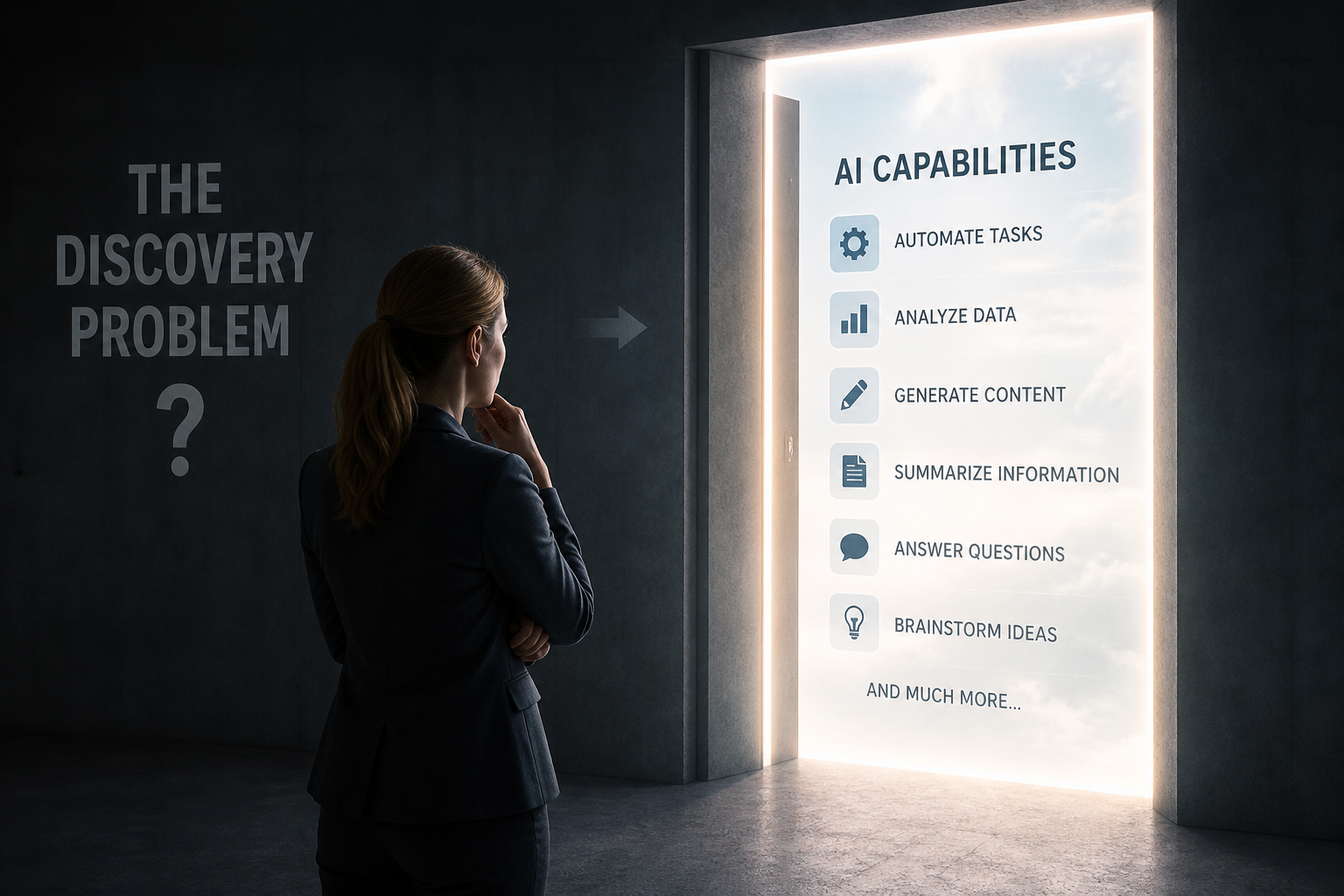
The biggest bottleneck to AI adoption is a simple question: what can this do for me? The hard part is that you don’t know what you don’t know. You don’t know what a button does until you press it. You don’t know what a prompt can produce until you write it, hit go, and watch it run.
As long as capabilities stay locked behind a blank text box, the possibilities stay invisible. That’s a discovery problem, and it’s the one we’re still stuck on. There are partial fixes, such as templates that give people something to run without needing to invent the request themselves. However, the question then becomes relevance - do these templates actually match your work?
Context also helps, as a system that knows about you can suggest things that matter to you instead of things that matter in general. Alan Kay has a metaphor for this, imagining an ant at the bottom of the Grand Canyon, looking up at a thin sliver of blue sky between two canyon walls, compared to someone standing on the rim who sees the whole blue plane. It’s not that the ant is less capable, it just can’t see the axis of possibility from where it’s standing.
This gap exists between skilled AI users and everyone else. A non-technical marketing person and someone fluent in agents and tool use may have vastly different experiences with AI. The agent-fluent person can immediately see a dozen things to automate, delegate, or reinvent, but put the most intelligent tool in the world in front of the marketer, and they’re staring at a blank prompt, unsure what to type.
This is the strange state we’re in: the system could do almost anything, but it requires the user to already know what to ask for. Too much of the work of discovering what’s possible falls on the person, when it should fall on the system. You’d expect something this advanced to reveal its own capabilities — gradually, contextually, in ways that match your actual work.
Solving the discovery problem is crucial for AI adoption. The interface needs to start showing users the possibilities, rather than relying on them to figure it out. By making AI capabilities more visible and accessible, we can unlock its full potential and make it more useful to a wider range of people.
Este artículo fue escrito con la asistencia de IA.
News Factory APP - noticias agénticas para impulsar tu SEO y AEO.