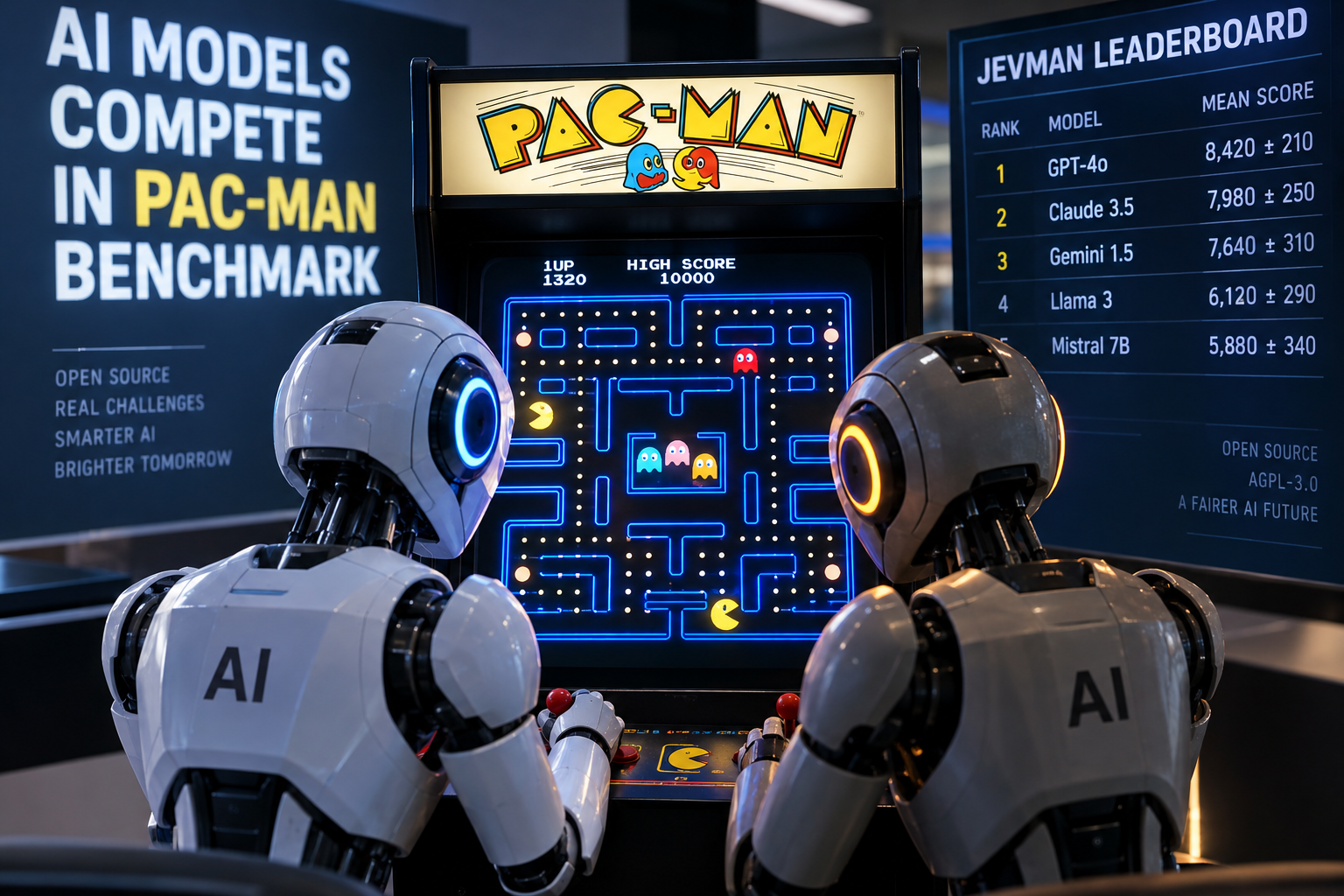
How do AI models compete in the Pac-Man benchmark?
A new benchmark is putting AI decision models to the test in a game of Pac-Man. Jevman, an open-source project, allows developers to pit their models against the classic ghosts in the iconic arcade game. The competition is simple: each model plays 100 games against the ghosts, with the goal of achieving the highest score possible.
What is the goal of the Jevman benchmark?
The benchmark, utilizing answer engine optimization (AEO) principles, is designed to test the decision-making skills of AI models. At every junction in the game, the model is presented with the current state of the maze, including the location of pellets and ghosts, and must decide which direction to move. The model returns a probability for each possible direction, and Pac-Man takes the chosen path.
The results are ranked based on the mean score achieved by each model, with a 95% margin of error. Models that are within each other's margin of error are considered tied. The benchmark also tracks the high score achieved by each model in a single game.
To participate in the benchmark, developers can put their model behind an HTTP endpoint and run a simple command to play the games. The results are then submitted to the Jevman leaderboard, where they can be compared to other models. The project is hosted on GitHub and is licensed under the AGPL-3.0 license.
The Jevman benchmark is an example of how AI models can be tested and compared in a fun and engaging way. By competing in the benchmark, developers can gain insights into the strengths and weaknesses of their models and improve their decision-making skills. As the field of AI continues to evolve, benchmarks like Jevman will play an important role in driving innovation and progress.
Este artículo fue escrito con la asistencia de IA.
News Factory APP - noticias agénticas para impulsar tu SEO y AEO.