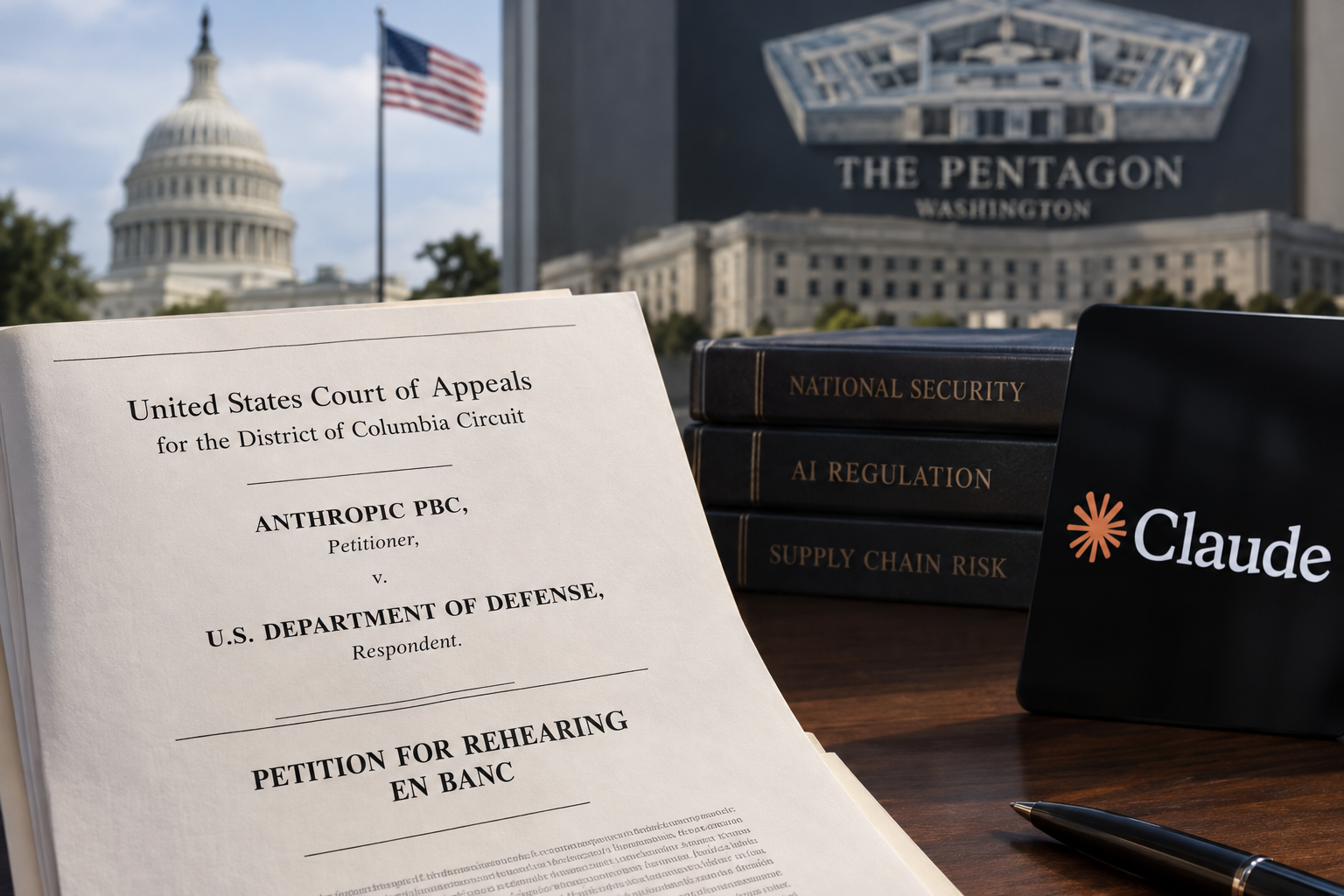
Anthropic has asked the full federal appeals court in Washington to rehear its challenge to a Pentagon designation that labels the company a supply-chain risk to U.S. national security. The petition, filed Tuesday, asks the full court to revisit a 2-1 decision from a three-judge panel issued Sept. 25. Anthropic contends the designation was retaliation for its speech about AI safety.
Judge Gregory Katsas wrote the majority opinion, joined by Judge Neomi Rao. Judge Karen LeCraft Henderson dissented, reading the statute narrowly. The law is meant to cover suppliers that might sabotage a product, extract data from it or otherwise manipulate it, Henderson said. Its history concerns hostile states, she argued, not a contractor that openly enforces its own terms.
Anthropic says the majority allowed the department to act without any pre-designation process. It also says the record contains straightforward evidence of retaliation. A judge in California reached that same finding in August, in a parallel designation case.
The fight started with a contract. Anthropic wanted assurances that Claude would not be used for mass surveillance of Americans or for autonomous weapons. The government said it could accept no restrictions of that kind.
Washington then went further. A presidential memo issued in June barred vendors from disabling, degrading or modifying a model that warfighters depend on without prior government approval. That directive raised the stakes for any company that tried to limit military use of its software.
The Pentagon has moved on regardless. Its chief technology officer said in September that about 90% of the classified AI workload had been shifted off Anthropic. He expected the remainder to follow by the end of that month.
The money involved is small compared with the company's overall business. Government work accounts for under 1% of revenue. Anthropic has told IPO investors, however, that the government's view of the company could cost it material revenue with commercial customers as well.
Why the fight looks different in Europe
The same dispute could not play out the same way in Europe. The EU's AI Act does not cover systems used exclusively for military, defense or national security purposes. A European lab that refused a military use would be relying on its contract alone. There would be no designation to challenge and no regulator to appeal to.
Access can also disappear without a court ruling. In June, the U.S. ordered Anthropic to suspend two models, and developers in India lost access to them overnight.
European companies have taken note. Mistral has been building defense models with the German firm Helsing since early last year. Its chief executive says Europe needs its own capabilities while adversaries exist.
Este artículo fue escrito con la asistencia de IA.
News Factory APP - noticias agénticas para impulsar tu SEO y AEO.