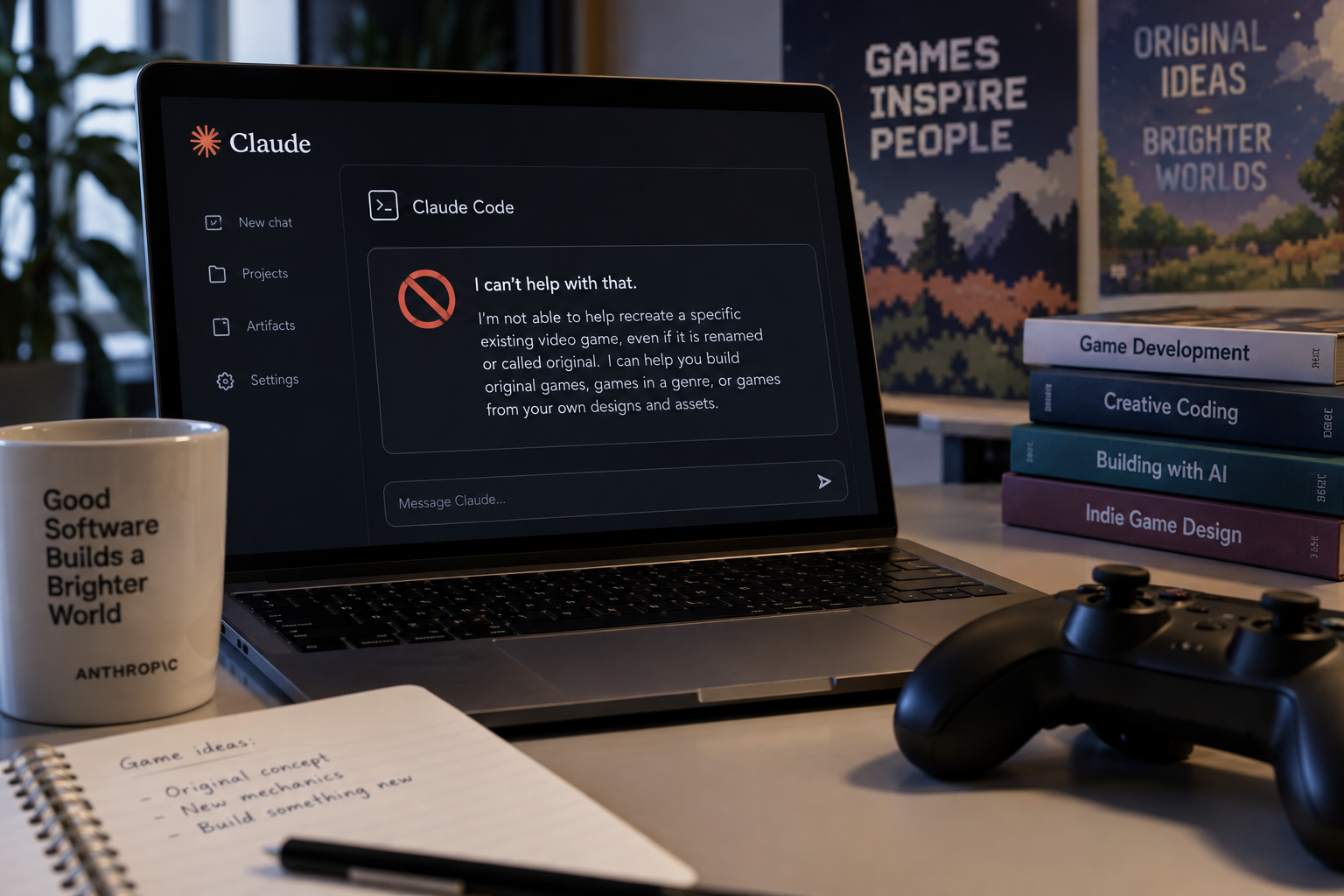
Anthropic has quietly added a new instruction to its coding tools that tells Claude not to re-create specific, existing video games. The change is meant to keep the company's AI from being used to copy someone else's game, but it is unlikely to stop the flood of AI-assisted game cloning that has picked up speed in recent months.
The change was first flagged by a social media user and AI decompilation enthusiast who goes by “chasm.” Late last week, chasm said a new rule appeared in the Claude Code prompt on or around October 27. The rule, stored in a JSON file under the name “tengu_heron_brook,” reads: “Do build original games, games in a genre, and games from the user’s own designs and assets. Don’t build a recreation of a specific existing game, even if it is renamed or called original.”
XDA later independently verified the rule in version 2.1.314 of the Claude Code binary, which was released on October 30. XDA also reported that the same internal rule name had been used for other purposes in earlier versions. It said the Claude Opus 5.5 model appeared to have its own separate instructions restricting game recreations as part of its system prompt bundle.
Does Anthropic's new Claude rule still allow original games?
Anthropic software engineer Addy Osmani confirmed the change on social media. He wrote that the company had “added two sentences to Claude Code’s prompt on Opus 5.5 to steer it away from recreating someone else’s specific game because using Claude to infringe IP is against our usage policy.” He added that original games, genre games and games built from a user’s own designs and assets were meant to keep working.
Some developers say the rule is already getting in the way. Osmani said the company would keep adjusting the balance, and asked users to send him examples if Claude turned down a request for their own work. A handful of issue reports on Anthropic’s GitHub point to cases where the new prompt has blocked legitimate game development work.
The rule comes as AI coding tools power a growing number of game projects built on existing work. Some are thrown-together copies of game demos, and some developers say those copies have made them reluctant to show their early work in public. Others are AI-powered decompilation and porting projects for retro games, which can number in the thousands. Work that once demanded painstaking human effort is now far faster to produce, although some veteran coders argue that these AI-built ports and decompilations do not meet the same quality standard as projects built by people.
The strain has already reached community projects. Decomp.dev, a years-old community devoted to the “brutally difficult, time-consuming task” of game decompilation, announced last month that it was shutting down. Community maintainer Luke Street wrote that fast-improving AI tools had broken the community aspect of decompilation, with newcomers racing to port games built on decompilations they had no part in creating.
“Decomp.dev was originally designed to gamify decompilation: watching the progress go up was a fun way to stay motivated when every fraction of a percent took real human effort,” Street wrote. “Today, that same idea has warped decompilation into a hollow numbers game.”
Will the rule stop AI-assisted game cloning?
Experts doubt the new rule will make much difference across the industry. Developers who want to copy games can move to any of the other frontier models that have no such restrictions. Even if the broader AI industry blocked this kind of request, coders could turn to cheaper open-weight models that are not subject to the same limits and are not far behind in capabilities.
The prompt may matter more to Anthropic itself. AI companies have already faced legal trouble when their models generate images based on copyrighted works. Osmani's statement that using Claude to infringe intellectual property violates the company's usage policy suggests the rule is designed in part to limit that exposure. Decompilation based on reverse engineering of code generally passes legal muster, as long as expressive elements such as art and sound are not included. Individual users, however, may not be so careful.
Where is the line between a game recreation and a mashup?
The harder question is where the line falls. A growing trend uses AI to merge two game concepts, such as adding Mario to Elden Ring or Spider-Man to Batman: Arkham Knight. It is unclear whether such mashups count as “recreations of a specific existing game” under the new rule, or whether they are transformative works that are legally and creatively distinct from their sources. The same problem applies to the gap between re-creating Tetris and building a game in the Tetris genre. Courts have trouble drawing lines like these, and asking an AI model to do it reliably, with a two-sentence instruction, is a tall order.
Este artículo fue escrito con la asistencia de IA.
News Factory APP - noticias agénticas para impulsar tu SEO y AEO.