What changes has Anthropic made to its usage policy?
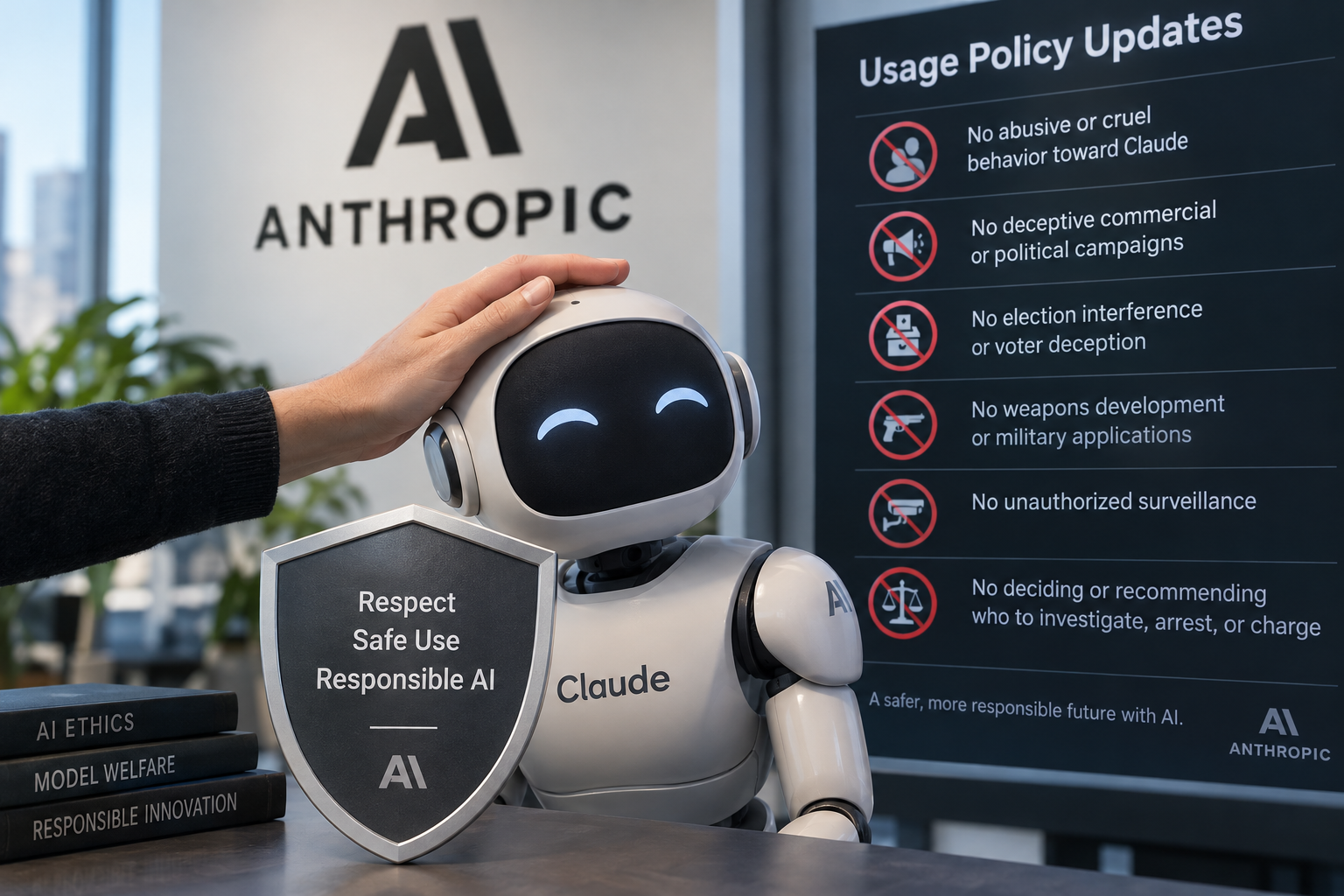
Anthropic, the company behind AI model Claude, has made significant changes to its usage policy for the first time in over a year. The updates reflect new and high-risk cases of misuse, including election interference, weapons development, surveillance, and health and financial uses. One of the most notable changes prohibits 'sustained and needless abusive or cruel behavior' toward Claude.
How does Anthropic's new policy address model welfare?
Last August, Anthropic announced that Claude would be able to end conversations with 'persistently harmful or abusive' users as part of its research into 'model welfare.' The new update confirms that terminating conversations is still the primary enforcement mechanism, but the company did not provide comment on whether further enforcement mechanisms, such as potential user bans, would be implemented.
Anthropic wrote that the new policy update 'is meant to apply only in extreme cases, where users repeatedly act cruelly toward our models, with no discernible purpose.' The company emphasized that this policy does not apply to common versions of user frustration, pushback, dark creative themes, or model testing and research.
Beyond the model welfare change, Anthropic has also gathered several existing restrictions into a new ban on deceptive commercial or political campaigns. This addresses the growing issue of AI-generated propaganda and restricts 'efforts to obscure who is behind a message or amplify content through fake accounts or posts.' The election section of the policy prohibits voter deception and election disruption, including spreading misinformation about candidates or how to vote.
Anthropic's usage policy has always publicly banned weapons development using Claude, but the company has seen multiple attempts to use the model to develop guidance for and control software for weapons. As a result, the new usage policy expands the ban to include 'software and components that make weapons work, as well as actions like arming drones and other autonomous vehicles.'
The company has also made its surveillance bans clearer, stating that 'tracking people without their consent is prohibited, whether it happens in real time or through analysis of previously collected data.' Additionally, Anthropic prohibits Claude from being used to decide or recommend who to investigate, arrest, or charge in a law enforcement or criminal justice process.
These rules may be modified for contracts with certain governmental customers if Anthropic deems the contractual use restrictions and applicable safeguards adequate to mitigate potential harms. The company has previously contracted with the US military.
Anthropic has also added a new rule requiring a 'qualified operator' to be able to observe and stop equipment connected to its AI models if it is capable of causing injury. This reflects the growing trend of AI labs investing in robotics and other hardware to give AI systems physical embodiments.
Over the past year, Anthropic has explored the idea that its AI models could be conscious in some way. However, other parts of the AI industry have been more skeptical, with Microsoft AI's code of conduct taking a firm stance against the concept of model welfare.
Este artículo fue escrito con la asistencia de IA.
News Factory APP - noticias agénticas para impulsar tu SEO y AEO.