How much revenue did Anthropic report in the first half of 2026?
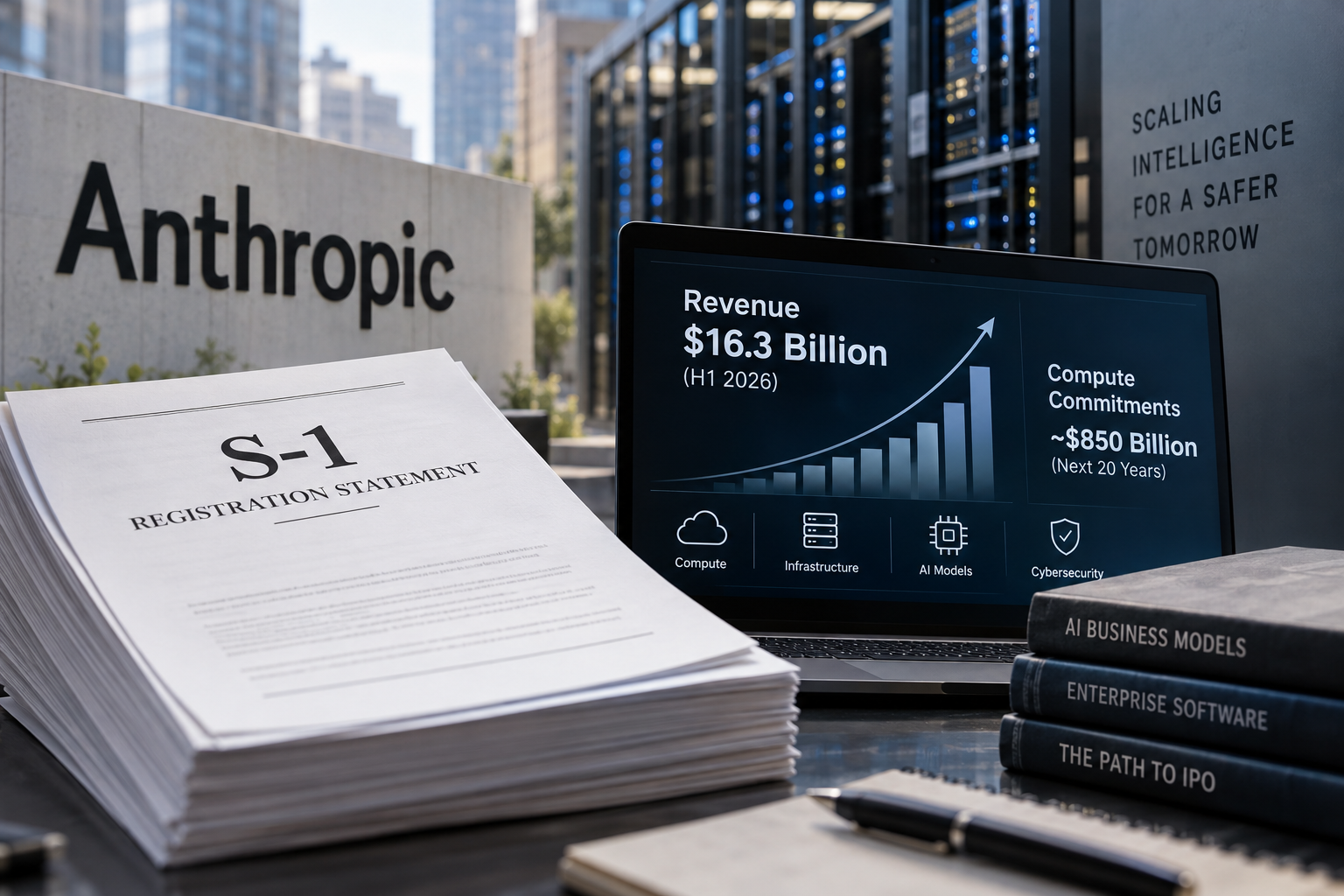
Anthropic’s revenue grew fourteen times over the past year, to $16.3 billion in the first half of 2026, according to its S-1 filing. But the same document shows a company whose long-term bills are so large that it must keep growing at a breakneck pace to pay them.
The filing reports an $80 billion loss for the period. Much of that loss is an accounting item that does not reflect the underlying business, according to a columnist who reviewed the document. Once that charge and others are removed, including employee compensation, adjusted income for the first half of 2026 comes to $1.62 billion.
The company’s customer base is one of its strongest points. Anthropic’s net revenue retention is 900 percent, and about three-quarters of its customers in the first half of 2026 spent at least $100,000 a year. The company has focused on coding and cybersecurity, and on enterprise clients rather than consumers. The S-1 names only OpenAI and Google as rivals.
That focus has limits. Google can bundle AI into products that businesses already pay for, a distribution advantage that Anthropic does not have. Other frontier labs are racing for the same top spot, and open-source models trail the leading systems by only a few months. Claude Opus 5.5 currently sits at the top of the Epoch Capabilities Index, but that ranking changes often.
What commitments does Anthropic have in its IPO filing?
The bigger question is the commitments. The filing lists $265.6 billion in fixed minimum non-cancelable purchase commitments, with terms of one to 20 years. It also reports lease agreements for compute and infrastructure capacity worth $321.4 billion that have not yet started, as of the unaudited June 30 figures. Separately, Anthropic has entered new compute and infrastructure agreements totaling about $245 billion. Other transactions that have not been finalized are estimated at $125 billion to $150 billion, and some compute commitments are variable.
Adding those figures together, the columnist arrived at a minimum of roughly $850 billion in commitments over the next 20 years. That figure would climb to about a trillion dollars if the unfinalized transactions are included at their estimated cost. The columnist cautioned that the tally may leave out items.
Can Anthropic keep up with its commitments as it grows?
The filing does not include a payment schedule. Harrison Rolfes, an analyst at PitchBook, models the payments at about $90 billion a year from 2027 through 2030. To keep the current ratio of compute costs to revenue stable, he estimates the company would need $188 billion in revenue. “Growth is not optional for this company,” he wrote. “The contracts assume it.”
The filing also shows the company getting more efficient. Compute and infrastructure costs tied to customers came to $2.3 billion in the first half of this year. Model development and related costs were far larger, at $9.7 billion. Rolfes said Anthropic is spending less on compute for each dollar of revenue.
Whether that trend will hold is unclear. The filing does not include third-quarter numbers. Brendan Burke, an analyst at Futurum Group, said the period reflected in the filing may be unusual. “The S-1 does freeze in time a happy period when their initial models skyrocketed in usage and they didn’t have enough compute so they are able to charge more for what they had,” he said.
Pricing pressure is another concern. Opus 5.5 cut customer costs by 40 percent compared with Opus 5. Anthropic says lower prices lead to more usage, which helps it protect margins. Burke noted that frontier labs need high-margin products to avoid a race to the bottom on token pricing. Gil Luria, an analyst at DA Davidson, argued that efficiency gains do not always erode margins. He pointed to Amazon Web Services and other cloud providers, which have cut prices every year while still growing and raising margins.
The filing also describes how Anthropic builds its models. Claude is already helping build Claude, under human direction. The company’s risk factors warn that this approach “may cause the capabilities of our models to advance more rapidly than our ability to develop, validate, and implement corresponding safety, alignment, and security measures.” The columnist read that as a sign that the business depends on building new models quickly, using work the company may not fully understand.
Whether AI can meaningfully improve itself without close human oversight remains an open question. The S-1 makes clear that if it cannot, Anthropic will find it harder to meet its existing commitments and reach profitability.
Este artículo fue escrito con la asistencia de IA.
News Factory APP - noticias agénticas para impulsar tu SEO y AEO.