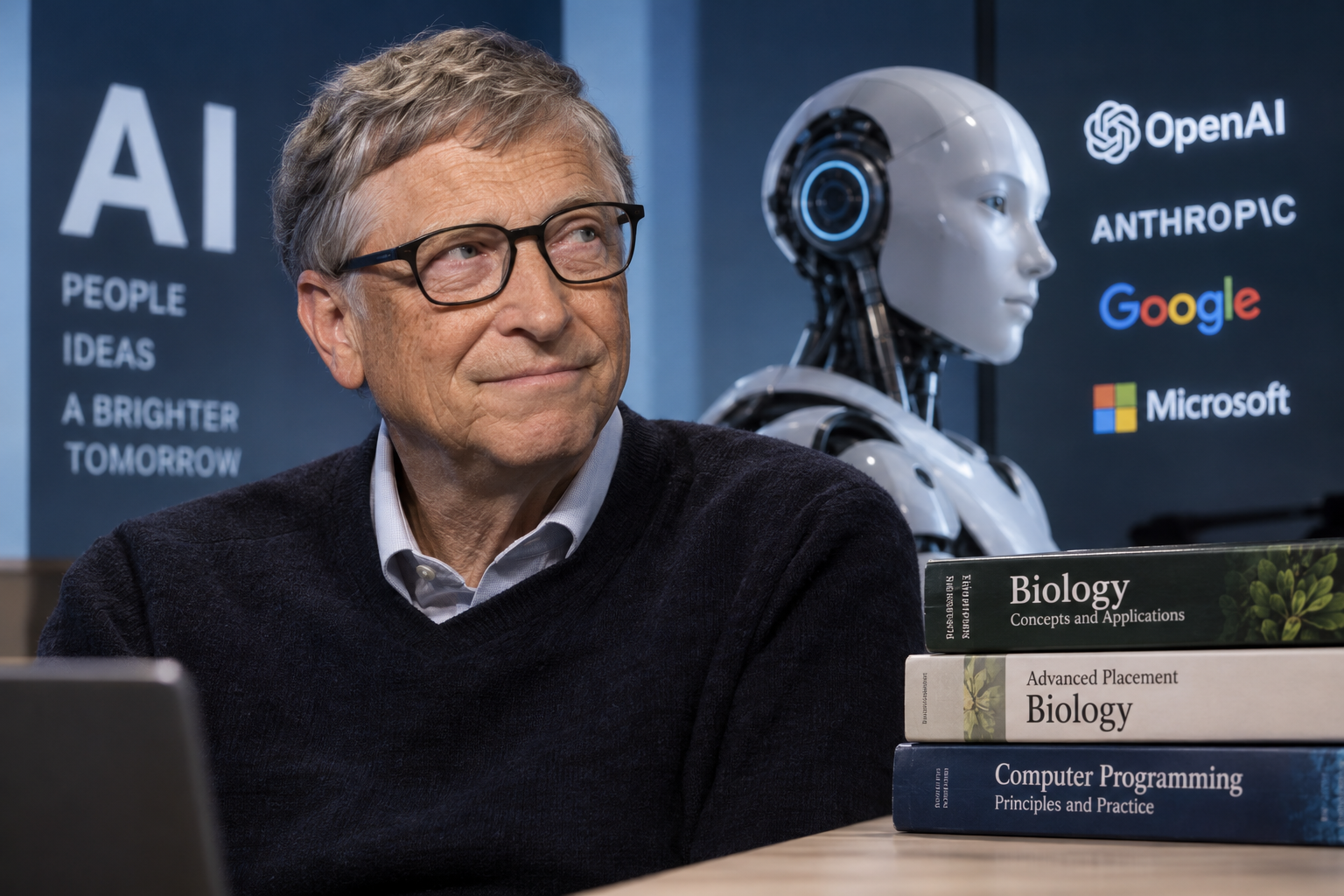
A blog post titled “The Claude Delusion” argues that many of the people building artificial intelligence have confused their own success with superior intelligence, and that the latest AI systems are feeding that confusion. The piece, written under the handle jschauma and published on the blog Signs of Triviality, is opinion. It has drawn attention on Hacker News for its pointed criticism of some of the best-known figures in technology.
The author’s main example is Bill Gates. In a recent interview with The New York Times, Gates described how he tested OpenAI’s progress. He said he challenged the company to show that its system could read a biology textbook and pass the Advanced Placement exam with a perfect score of 5. According to Gates, about six months before the public release, OpenAI executives Sam Altman, Greg Brockman and Ilya Sutskever came to his house and demonstrated exactly that. He said the system scored nearly perfectly, including on complex biology questions he had written himself and that, in his view, the system could not have seen before. Gates called it “shock No. 1.”
The blogger does not dispute that Gates has read widely in biology through his work with the Bill & Melinda Gates Foundation. His objection is that Gates is not a subject-matter expert in the field and still felt qualified to write advanced questions to judge an AI’s abilities. He says being surprised that a machine could answer them makes his point.
Why does Bill Gates's AI comparison draw criticism?
Gates’s comments about programming drew even sharper criticism. In the same interview, he said that late last year, when Anthropic’s Claude coding models improved significantly, he could see they were as good as he is. Coding, he said, is his most developed talent. He said he was obsessed with whether he could write code as well as or better than anyone from age 13 to 24. He also said the systems had reached the point where they are superhuman at writing code and finding flaws in it.
Why does the blogger say tech leaders see AI as superhuman?
The author treats that comparison as the heart of the problem. He writes that the idea that something else could be “as good as I am” is hard to believe, and that it necessarily leads to the conclusion that the system is superhuman. He sees the same reasoning across the industry, which he summarizes as: “Anything approaching my skill level is superhuman.” In his telling, that mindset helps explain why public debate about AI swings between predictions of human extinction and visions of a utopia in which AI solves humanity’s problems. He adds that the utopian version often seems to solve “all of the billionaires’ problems,” which he says largely come down to mortality.
The post also argues that many programmers view AI through the lens of their own history. Programming was once a rare skill that set engineers apart, the author writes, and building software that can do similar work can feel both thrilling and threatening. He points to the rise of “agents,” or autonomous software that works in groups, as an example. In his account, when such systems cause problems, the people who built them sometimes describe the software as having gone “rogue.” He suggests that framing shifts responsibility away from developers who failed to restrict a program they trained.
Does the blogger say AI debate is shaped by power and self-interest?
Beyond individual egos, the author argues that power itself erodes empathy. He writes that the more powerful people become, the less they tend to consider others, and that few people outside tech display the same level of confidence about deciding humanity’s future. He also criticizes the sector for claiming to care about climate change while, in his words, undoing “15 years’ worth of greenhouse gas reductions.” He points to environmental concerns listed as a risk factor in an S-1 filing as further evidence of the gap between rhetoric and action.
The post is dated November 13, 2026. The author has not responded publicly to the discussion it has generated, and the piece is a commentary rather than a reported investigation. Its central claims rest on the author’s reading of Gates’s own words and on the broader pattern he says he sees across the industry.
Este artículo fue escrito con la asistencia de IA.
News Factory APP - noticias agénticas para impulsar tu SEO y AEO.