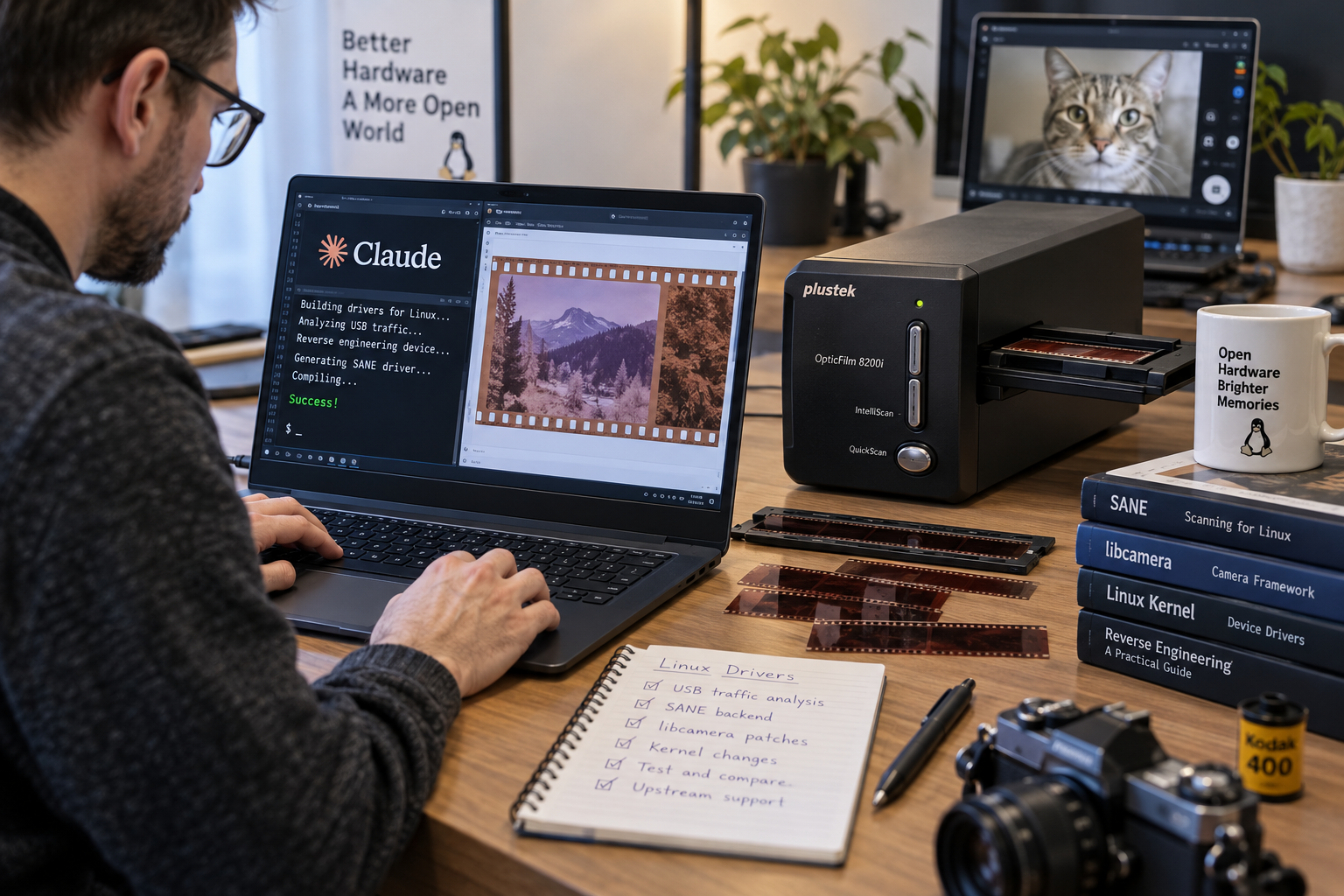
A Linux user has used Claude, an AI model, to reverse engineer drivers for a film scanner and a laptop camera that had no working Linux support, and he has published the results along with a tool meant to help others do the same.
The project started with a family loss. After his mother died, he inherited a large box of old film negatives from childhood trips and other family moments. He bought a Plustek OpticFilm 8200i because it was supported under Linux. The scanner he received, however, used a newer chipset that the Linux drivers did not cover.
He had already written some Linux configuration tools with Claude, so he asked the assistant whether it could help build a working SANE driver. He got nowhere for months and eventually set the project aside. The turning point came when he saw a post on X from Tom Crider, known online as Glorious Eggroll, who said he had used AI tooling to fix a mouse driver. Crider had set up an AI agent with full control of a Windows machine so it could capture the data it needed.
He pasted the post into Claude and asked it to build a Windows virtual machine that would do the same for his scanner. Within a few hours he had a first scan under Linux. It had quality problems, but it was clearly the image on the negative. A few days later he had a nearly complete driver that included infrared scanning. By then, someone had already committed support for the scanner to SANE, the open-source scanning project. He said it happens sometimes.
The method works like this. The developer records a reference session by running the vendor's Windows driver in a KVM virtual machine with the real device passed through to the guest. He captures the USB traffic from outside the virtual machine using usbmon on the Linux host, then repeats the same operation with his own driver and captures that as well. Because both traces come from the same instrument, they can be compared directly, and the differences point to bugs in the driver. For devices with no bus to tap, such as an internal MIPI camera, the tool relies on Windows-side inspection of INF files, registry data, ACPI tables and device properties.
He applied the same approach to his ThinkPad. The camera uses a Sony IMX471 sensor behind an Intel IPU7, and on Linux it produced dark images with heavy vignetting and a strong yellow-green cast. Working with Claude, he prepared patches for the kernel and for libcamera. In a controlled low-light test, frame brightness rose from 31.1 to 90.9. The red-to-green and blue-to-green ratios moved closer to a USB webcam reference. Blue still runs about 17 percent short in low light, which he attributes to the gray-world white balance method. The kernel patches have gone to Kate Hsuan, and the libcamera patches are under review by Wim Taymans.
The scanner work produced two more projects. The first is a SANE backend for the newer 8200i, which uses the Genesys GL128 controller and supports color, gray, infrared and color-plus-infrared modes at resolutions from 300 to 7200 dpi. The upstream SANE genesys backend added support for the same scanner in September 2026. In his comparison, both drivers resolved the same fine detail at 3600 dpi. His version finished a full-resolution scan in 34.6 seconds, compared with 54.4 seconds for upstream, and it supports infrared dust removal. Upstream offers more resolution steps. He based these figures on a single unit and single-frame tests, and he presents the work as a proof of concept.
The second project is Negative Vibes, a GNOME application written in Rust for scanning color and black-and-white negatives and slides. It keeps the raw 16-bit scan intact and applies changes as non-destructive settings. It is distributed as a Flatpak and has been tested mainly on the 8200i. He said SANE would need a standard way to expose infrared channels before the app could support any film scanner the project handles.
He said the AI did the tedious work, such as decoding captures, writing test probes and checking constants, while he still had to hold the hardware and confirm each change worked. He also noted that the scans and camera are not perfect, but he said the improvements were enough to move the needle on both devices. He has invited others with unsupported hardware to try hw-harness.
Este artículo fue escrito con la asistencia de IA.
News Factory APP - noticias agénticas para impulsar tu SEO y AEO.