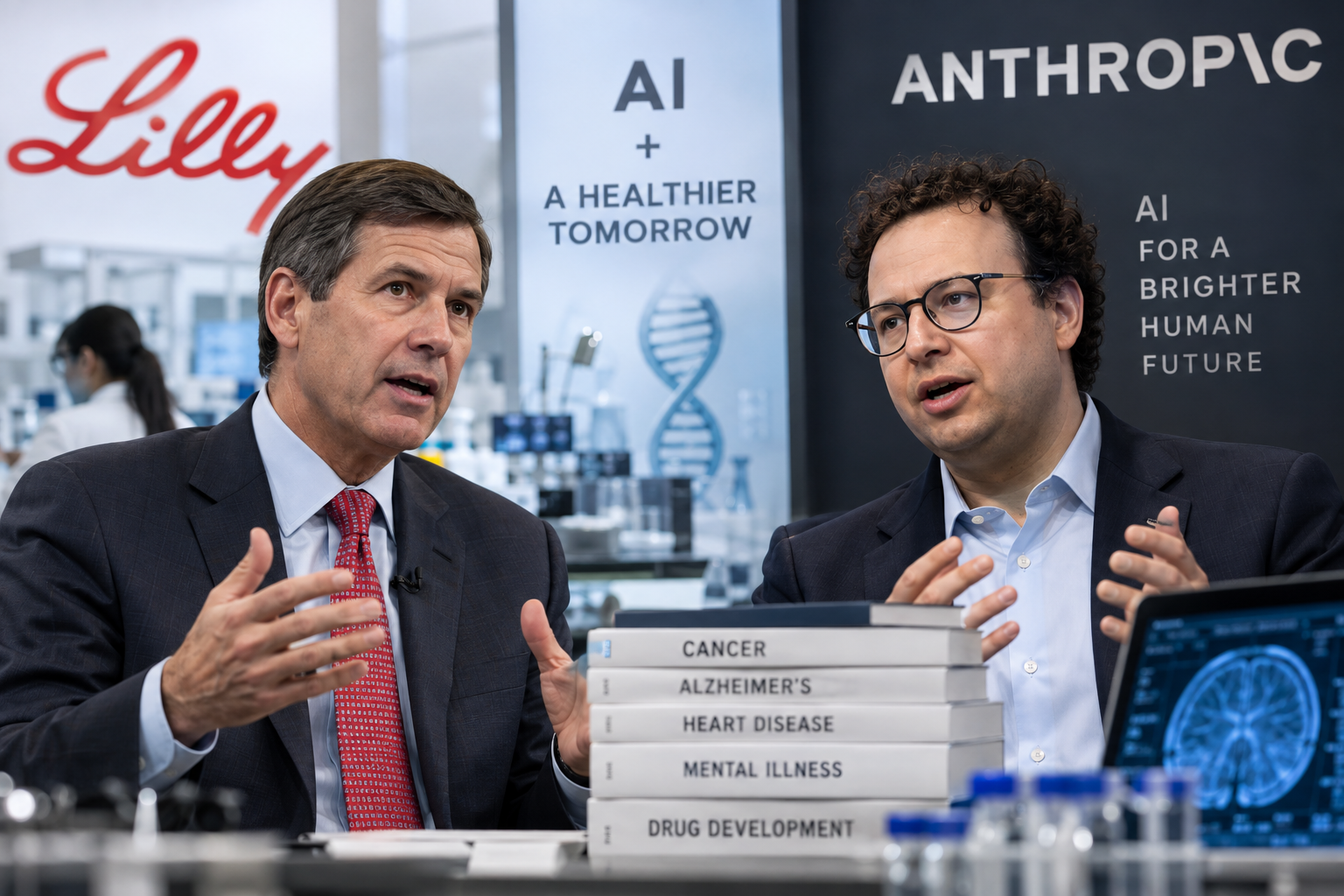
Eli Lilly Chairman and CEO Dave Ricks has publicly challenged Anthropic CEO Dario Amodei's prediction that cancer, Alzheimer's, heart disease and mental illness will be cured within about a decade. Ricks called the outcome “amazing” but said it is unlikely.
Why did Eli Lilly's CEO say Anthropic's cure timeline is unlikely?
“I think that would be amazing and I think it’s not likely,” Ricks wrote on X. “The map of biology is still largely a blank page and randomized human proof is the long pole in the tent. I am excited about the use of AI in our sector but progress will likely be steady and incremental.”
Amodei made the prediction in a video tied to Anthropic’s IPO launch. “Cancer, Alzheimer’s, heart disease, mental illness – these will be relics of the past in, I think, less than a decade,” he said, according to a post by Meg Tirrell, a journalist who shared the quote and asked researchers for their reaction.
How long does it take to develop and approve a new drug?
The responses came quickly, and many were harsh. Several scientists said the timeline ignores how drugs get made and approved. Rich Law, a drug researcher, wrote that data exists for less than 1 percent of biology and that the clinical trials alone take five to eight years. Another commenter cited figures for the 20 most recent drugs approved, saying the mean time from first-in-human testing to FDA approval was 14 years and the median was 10.
Rod Wong, a physician who described himself as an AI optimist, said timelines will shorten but that drug development still includes steps that cannot be skipped, including mouse experiments, manufacturing, interactions with the Food and Drug Administration and clinical trials. Nicolas Kirchuk, who identified himself as the CEO of a precision oncology company, said a drug entering trials today would reach patients in the 2030s. He said a more realistic goal is turning advanced cancer into a chronic disease that people live with, similar to HIV.
Can AI cure cancer and Alzheimer's within a decade?
Some of the strongest pushback came from researchers who are generally supportive of AI in medicine. Eric Topol, a cardiologist and well-known AI commentator, wrote that curing these diseases within 10 years is “impossible,” though he said he is “very optimistic about the impact of AI for improving health.” He called the goal “an unattainable objective.”
The criticism also extended to the timing of the claims. Rami Elghandour, who said he has taken two companies public, called the remarks “insane things to say in an IPO pitch” and said they “reek of desperation.” Gary Marcus, a longtime critic of AI hype, compared the speech to statements made by Theranos founder Elizabeth Holmes. Charlotte Alter, a journalist, asked how Amodei’s claims differ from Holmes saying Theranos “can” test blood, noting that both used “can” to mean that something may one day be possible.
Ricks’ comments offer one of the few direct responses from a senior executive at a major drugmaker. He did not dispute that AI could help the industry. His objection was to the speed of the promise, and he framed progress in the sector as steady and incremental rather than sudden.
Anthropic has not responded in the material reviewed for this story.
Este artículo fue escrito con la asistencia de IA.
News Factory APP - noticias agénticas para impulsar tu SEO y AEO.