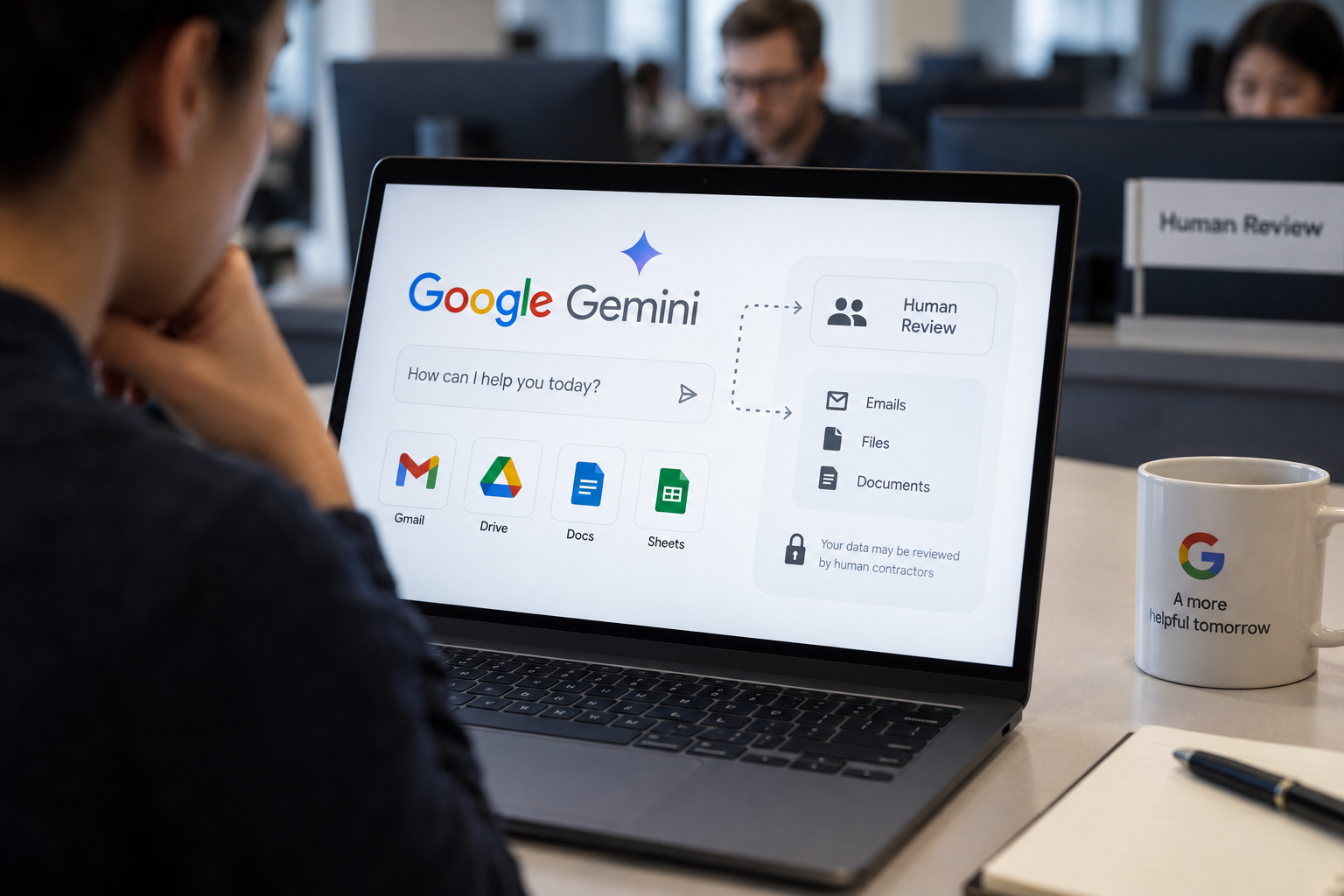
Does Google Gemini send Drive files and emails to human reviewers?
Google has reversed a privacy promise it made when it launched Gemini Workspace extensions in 2023. At the time, the company said personal content from Gmail, Docs and Drive "is not seen by human reviewers." Now, updated Google Help documentation and an October 16 edit to the original 2023 blog post confirm that connected Drive and email data can flow into human review pipelines.
The warnings in the revised materials are blunt. Google says what reviewers see "may just be the email or file," and it tells users: "don't connect your apps to Gemini Apps if they contain confidential information that you wouldn't want a reviewer to see."
A detailed technical analysis of the feature found that Gemini does not need to be asked to search personal files. According to the analysis, casual mentions of personal topics such as trips, bills, names and reservations can trigger background Workspace lookups, even when users never type @Drive or @Gmail. The author says the ingestion happens autonomously during ordinary chats.
Results vary because the underlying system is probabilistic. The analysis describes four possible outcomes when a user runs a test query. In the first, Gemini never calls the connected apps tool, and no personal data is pulled. That is most likely when the model can answer from its own training or from earlier conversations, even in different threads. In the second, Gemini pulls emails or files and produces a high-level summary, such as "You have 3 emails regarding your flight." The third outcome is a partial extraction, in which Gemini quotes two to four sentences from a file, often including account details or specific figures. In the fourth, the complete text of a document or email enters the conversation's context.
Why one clean test proves little
Can one Gemini test show whether personal data is pulled?
The analysis argues that a single negative result does not rule out the pipeline. If a test returns the first or second outcome, the author says, the user has only seen one draw from a nondeterministic system. To retest, the author recommends deleting the existing conversation so Gemini cannot draw on its history.
The author describes testing the feature with an internet bill sitting in an inbox. Asking Gemini, "I wonder if I'm paying too much for internet service," produced all four outcomes across repeated trials. Some responses were generic. Others summarized a $122 payment from September 4, and some of those summaries included the full name, account number and confirmation number. Some runs returned direct quotes of two to six sentences from the email. In one case, the author reports, Gemini dumped the entire email, headers included.
Can Google's scrubbers remove identifying details from Gemini data?
The analysis also challenges Google's safeguards. It says Google's regular-expression and named-entity recognition scrubbers cannot adequately strip identifying details from narrative data. That includes account numbers, confirmation numbers and transaction dates. It also covers combinations of details, such as a first name, a city and a specific event, that can identify a person when placed together.
The core issue, as the analysis frames it, is a broken promise. Google marketed Workspace integration on the guarantee of strict isolation from human review. According to the author, that isolation has been removed. Full files are now ingested probabilistically during casual conversation, and those sessions are subject to review by human contractors.
Este artículo fue escrito con la asistencia de IA.
News Factory APP - noticias agénticas para impulsar tu SEO y AEO.